

Wrestling with Giants: India’s Strategic Manoeuvres In A Tri-Polar World
India’s position in the US-Russia-China tri-polar wrestling arena in 2025 is that of a clever, determined, and autonomous contender. It refuses to be pinned by Beijing’s might, Washington’s transactional approach, or Moscow’s nostalgia. Every move, whether economic, diplomatic, or military, is carefully calculated to preserve its space, grow its influence, and keep the balance constantly shifting.
 Nov 07, 2025
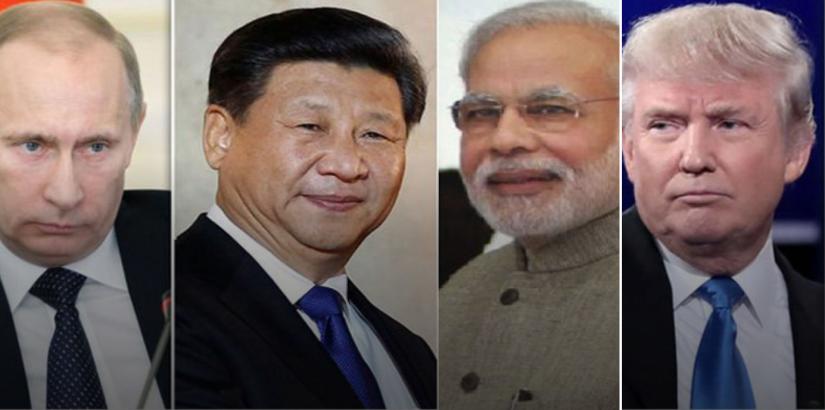
India’s position in the current US-Russia-China tri-polar geopolitical contest, imagined as a virtual wrestling arena, is that of a flexible, fiercely autonomous contender using a multi-alignment strategy to maximise influence while reducing vulnerability to any single great power. In this new era of transactional diplomacy and shifting alliances, India’s choices and challenges have a significant impact on the global power balance.
World A Wrestling Ring
Imagine the world stage as a massive wrestling ring, with three heavyweights - the United States, China, and Russia, each battling for top dominance. India, once seen as an outsider or a secondary contender, now steps onto the mat as a strong, smart “swing power.” In 2025, unlike during the Cold War, India’s economic strength, demographic advantage, and strategic insight put it nearly on equal footing with the established giants.
This arena is not just a test of brute force. Here, agility, adaptability, and the ability to exploit shifting alignments are as necessary as strength or historic alliances. India’s role is not just that of a contender, but a “strategic balancer”, a key pivot point that determines future outcomes. India's position is not that of a camp follower, but a crucial player that keeps the balance of power in constant flux.
Multi-Alignment: India’s Winning Strategy
India’s doctrine of “strategic autonomy” forms the basis of its foreign policy, enabling it to interact with all powers without relying on any one of them. This principle is rooted in India's history of non-alignment. Still, its modern variant, multi-alignment, involves the country's participation in rival blocs, such as the QUAD (with the US and Japan), BRICS (with China and Russia), the SCO, and others.
With the US. India is a vital player in the Indo-Pacific strategy, sought by Washington as a bulwark against China. High-tech and defence collaboration has grown, and India is the USA's natural partner in defence, technology, counterterrorism, and economic rivalry with Beijing.
With Russia, despite Western pressure, India maintains strong arms and energy ties with Moscow, using Russian support at the UN and hedging against over-reliance on the West. Recent defence deals and energy arrangements are a deliberate hedge against global volatility.
The relationship between China and the West is characterised by both rivalry and interdependence. Trade volumes are high, but border disputes and China’s encirclement strategy pose a challenge to New Delhi’s security. India’s participation in forums with China is calculated diplomacy, not deference.
India’s success lies in maintaining flexibility. In the face of changing alliances and shifting power dynamics, India has successfully engaged, hedged, and extracted concessions from all sides. This adaptability, coupled with its leadership in the Global South and its advocacy for multipolarity, has projected India as a resilient and influential player in the global arena.
Navigating Hostility and Opportunity
This “wrestling match” is not without risk. China’s assertive posturing, whether in South Asia, the Indian Ocean, or against Indian allies, means India faces constant jabs and probing holds by a neighbour determined to expand its influence. The border skirmishes, economic competition, and strategic encirclement by the Belt and Road Initiative have prompted India to strengthen its ties with the US and diversify its defence relationships beyond Russia.
Economic opportunities are plentiful, but so are vulnerabilities. The US’s protectionist stance, tariff threats, and inconsistent signals can expose India to risks. Russian weaknesses are pushing Moscow closer to Beijing, limiting India’s options in Eurasia and the energy sector. In this environment, India must constantly navigate, respond, and adapt, protecting its role as a “third pole” and preventing the conflict from becoming a solely Sino-US or Sino-Russian struggle.
Tools And Tactics Of Strategic Balancing
Much like a wrestler studies every move of his opponents, India monitors, anticipates, and uses the actions of the big three.
- Economic Diversification. India expands trade and technology cooperation with the EU, Japan, the Middle East, Africa, ASEAN, and Latin America. It aims to become the world’s factory, supply chain hub, and services leader, while balancing dependence on any single market.
- Defence Modernisation. By purchasing weapons from Russia, the US, France, and Israel and developing indigenous capacity. India decreases its reliance on any single supplier. Joint exercises and technology sharing expand its defence network.
- Diplomatic Forums. India utilises the BRICS, the SCO, the G20, and the Quad to promote reform and articulate the agenda of the developing world, focusing on climate finance, fair trade, technology transfer, and anti-terrorism, while maximising its own influence.
- Soft Power and Diaspora. The Indian diaspora, digital diplomacy, and cultural outreach enhance the country’s global standing, increasing its influence in capitals from Washington to Canberra to the Gulf.
The Risks and Rewards
India’s multipolar strategy is both its shield and its challenge. If it manages to balance its relationships, it can become the “pole" others seek, a key player in the ongoing power struggle for global leadership. But the risks are significant: overdependence on a weakening Russia, a potential escalation in the China standoff, or a US that shifts focus or adopts protectionist policies that hinder India’s economic goals.
Success involves securing strategic autonomy, promoting economic growth, maintaining border security, and fostering a stable periphery. Failure would result in subordination to a duopoly or losing influence in global affairs, a risk India’s policymakers are keenly aware of as they navigate every handshake, summit, and negotiation.
Champion of the Global South
India’s third strategic move in the ring is positioning itself as a leader of the “Global South.” As chair of the G20, a key member of BRICS, and an advocate for climate justice and digital democracy, India appeals to nations seeking alternatives to Western financial dominance and Eastern authoritarianism.
India’s advocacy for reforms at the UN, financial institutions, and climate frameworks strengthens its reputation as a moral wrestler, not just a pragmatic one. In the virtual arena, India asserts itself with both hard and soft power, earning applause from peers who see it as a bulwark against neo-colonialism and great power bullying.
An Indispensable Third Pole?
India’s position in the US-Russia-China tri-polar wrestling arena in 2025 is that of a clever, determined, and autonomous contender. It refuses to be pinned by Beijing’s might, Washington’s transactional approach, or Moscow’s nostalgia. Every move, whether economic, diplomatic, or military, is carefully calculated to preserve its space, grow its influence, and keep the balance constantly shifting. As global tectonics shift and alliances mutate, India stands as the swing state par excellence: the indispensable “third pole” whose choices will help shape the outcome of 21st-century geopolitics.
(The writer, an Indian Army veteran, is a strategic analyst. Views expressed are personal. He can be reached at manojchannan@gmail.com; linkedIn www.linkedin.com/in/manoj-channan-3412635; X @manojchannan )





Post a Comment