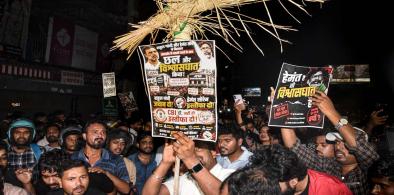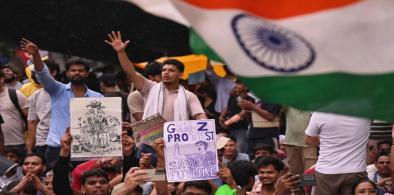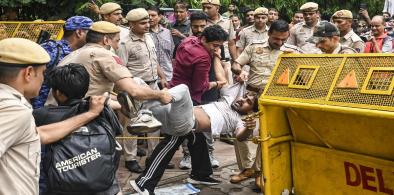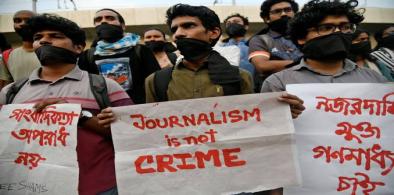
Assassinated Bangladeshi youth leader Osman Hadi.

Bangladesh Must Not Delay Elections: This Is What Hadi's Killers Would Have Wanted

The only way out for Bangladesh, the only way forward, the only way to deliver us from the current instability is to hold the elections as scheduled. This is what the Bangladeshi people want and this is what the country needs. We must all come together to make sure that it happens. The only people who benefit from elections being delayed are the enemies of the Bangladeshi people.

The Vande Mataram Controversy: A Polarising Agenda

The Indian freedom struggle was inherently multi-religious, multilingual, and multi-ethnic, with women and men participating across communities to forge a united nation. While the Muslim League demanded Pakistan in Muslim-majority areas, the Hindu Mahasabha and RSS pursued the idea of a Hindu nation. The Constituent Assembly, however, embodied the collective will of an inclusive India and resolved symbolic questions such as Vande Mataram and Jana Gana Mana through dialogue and compromise.

Hindu Rate Of Growth, Or Jobless, Ruthless, Rootless Growth?

The airline brought national disaster. The nightclub hotel was a more localised story. But both mock the nation and its growth story in their own ways, highlighting the hidden costs of a faster growth that has beaten the “Hindu rate of growth” but has brought us a disaster that unfolds at periodic intervals to shock the nation and ridicule its governance structures.

The Next Battlefield: Artificial Intelligence Through A Soldier’s Lens

In such a world, the greatest danger is not that AI becomes alien. The danger is that humans start behaving less humanly by outsourcing thinking, surrendering responsibility, and hiding behind the machine while letting it make decisions we should be making ourselves. Leaders may find it convenient to blame the algorithm. Companies may find it profitable to exploit it. Ordinary citizens may find it easier to trust AI’s shortcuts than to cultivate patience and understanding.

More on Perspective

India's Airline Fiasco Reflects On Weak Regulatory State, Poor Economic Governance

IndiGo’s meltdown, telecom’s flip-flop policy history, the fragility of airport PPPs, the helplessness of education regulators—all point to one truth: India’s regulatory state is not yet strong enough to discipline the giants it has created, nor can they rein in monopolies. Until regulators regain independence, authority, and credibility, India will continue to oscillate between private excess and public helplessness. Rogue companies will be blamed, but the deeper fault will lie in a system where rules are flexible for the powerful and rigid for everyone else.

India’s 2014 Election And The Question Of Invisible Influence

India does not need political rhetoric around its elections. It needs independent, bipartisan, and technically competent audits of its electoral infrastructure. It needs transparent review of data partnerships. It needs clear legal boundaries for foreign political consultancies and digital firms. And above all, it needs to rebuild public confidence that government is derived from consent, not calibration.

Building One Million ESG Young Ambassadors: Why India Needs This National Sustainability Movement Now

Many respected organisations in India have already achieved notable success in CSR and ESG initiatives. They lead impactful programs in renewable energy adoption, community health improvement, environmental protection, gender inclusion, education and ethical governance. Their experience and leadership are invaluable assets for the country.

India's Labour Reforms Appear More Industry-Friendly, Than Labour-Friendly

The problem in the Indian context is not about the legal codes but about the on-ground working conditions that remain markedly at odds with what is professed from the corridors of power and from the boardrooms of owners and directors. When this market reality meets with a government that has not built capital with the workers and is further seen as working in favour of business lobbies, then in effect trust disappears and the government has hurt itself and the so-called reforms by pushing through measures that could trigger fierce resistance.

India’s Path To Global Standing And National Wellbeing: Need To Sustain Momentum Of Reforms

The real taste of the pudding, the real measure of progress, will be revealed only when the average Indian experiences opportunity, fairness and security as everyday realities. When a dispute is resolved in weeks instead of years, when a farmer receives fair price directly, when a start-up gets clearance swiftly, when a citizen is treated with respect in a government office, then only the transformation will have occurred deep down.

क्या भारत की औपनिवेशिक शिक्षा उसकी पारंपरिक ज्ञान-व्यवस्था के विपरीत है?

क्या अंग्रेज़ी ने क्षेत्रीय भाषाओं को दबाया? इतिहास इसके विपरीत संकेत देता है। शिक्षा के विस्तार ने क्षेत्रीय भाषाओं को भी मज़बूत किया। लोकमान्य तिलक ( केसरीमहारत्ता ) और गांधी ( नवजीवन ) ने क्रमशः मराठी और गुजराती में प्रभावशाली अख़बार शुरू किए। रवींद्रनाथ टैगोर (बंगाली) और मुंशी प्रेमचंद (हिंदी) जैसे साहित्यिक दिग्गज इसी दौर में फले-फूले।

Is India's Colonial Education At Odds With Its Traditional Knowledge?

Did English suppress regional languages? History suggests otherwise. The expansion of education strengthened regional languages as well. Lokmanya Tilak (Kesari, Maratha) and Gandhi (Navjivan) launched influential newspapers in Marathi and Gujarati respectively. Literary giants such as Rabindranath Tagore (Bengali} and Munshi Premchand (Hindi) flourished during this very period.

Cross-Border Marriages Blur the India-Pakistan Divide

Within the Muslim community, such marriages often occur among extended families due to cultural acceptance of cousin marriages. With maternal aunts, uncles, and cousins living across the border, arranging these alliances is relatively easier. Hindu cross-border marriages, however, are far less common due to the dwindling Hindu population in Pakistan, driven by its theocratic state policies.

A Rare Pakistani Military Man Who Talked And Fought For Peace

Once I asked him why Pakistan did not stop terrorism against India, the biggest roadblock in the peace process. He replied quite candidly that some in the Pakistani establishment believed that if the terrorism tap was closed, India would never talk about Kashmir. Then he said something which left me stunned, “You see, even if orders are given to close the tap, some amount of terrorism may continue..

Bihar Elections: A Clean Sweep Amid Concerns Over Electoral Fairness in India

In Bihar, too, like has happened in earlier elections in Maharashtra and Haryana for example, the winning side will have to contend with the allegations that they romped home with an umpire whose role remains hotly contested, placing the fairness of the entire electoral process under a cloud. The allegations are more than a case of sour grapes and have now become a growing part of recent election campaigns and results, putting Indian democracy at risk 

CSR in South Asia: What It Means to the Corporate and Social World

An important pillar of CSR is the role of non-government organisations (NGOs) as partners in channeling funds to social sectors. While NGOs are committed to social development, their work is severely constrained without funding support. CSR funding strengthens the NGO ecosystem, while corporates gain a credible channel to fulfil their ethical and social commitments. Governments, in turn, benefit from effective partnerships with corporates and NGOs, enabling shared responsibility for social-sector goals.

India’s Mega Military Exercises Send Strong Strategic Signals

The exercises project India’s capability and political will to safeguard its territorial integrity. The US seems to acknowledge this: on October 31, 2025, US Secretary of War Pete Hegseth and Defence Minister Rajnath Singh signed a 10-year Defence Framework, called a “cornerstone for regional stability and deterrence”.

Right To Information In Danger Of Becoming Right To Deny

What needs to be done is as follows. Firstly, restore the public-interest override and RTI balance must be returned. Privacy does matter, but corruption, abuse of State power, and public finance accountability matter more. Secondly, we must reinstate the proviso that information that cannot be denied to Parliament cannot be denied to any citizen. This principle is the heart of democratic equality.

The Great Climate Finance Divide: Broken Promises, Systemic Hypocrisy and the Defining Challenge for COP30

COP30 can still be a watershed moment if political courage and a tech-savvy Gen Z influence outcomes. Brazil, as a major developing country hosting the summit, provides an opportunity to amplify the Global South’s voice — but only if top-down approaches of world leaders combine with the bottom-up energy of youth. The success of COP30 will be judged by a single, non-negotiable outcome - adoption of an ambitious New Collective Quantified Goal.

India In The Crosshairs of State-Sponsored Terrorism: Is The Delhi Bombing A Wake-Up Call?

Terrorists are developing new types of explosives experimenting with commercially available products like fertilizer and chemicals, coupling them with radioactive like material to increase destructive power. Al Qaeda has devised ways to conceal explosives inside the body that can avoid detection by sophisticated scanners, in addition to undetectable liquid explosives that can be soaked into clothing and ignited when dry.