

From Crisis Management to Crisis Prevention: South Asian Research Collective Working on AI-Driven Solutions
Together, the team conducts collaborative research and policy development initiatives across four South Asian countries - Sri Lanka, India, Nepal and Bangladesh. Their work aims to strengthen national preparedness, improve crisis response systems, and support governments in building resilient, technology-enabled public safety infrastructure. Together, these researchers represent a growing national capability in applying Artificial Intelligence to real-world challenges.
 Mar 27, 2026

The escalating conflict involving Iran, the United States, and Israel represents a "global energy stress test" with profound implications for international fuel and Liquefied Petroleum Gas (LPG) security. At the heart of this vulnerability is the Strait of Hormuz, a maritime choke point responsible for the passage of approximately 20% of the world’s oil and gas supply. Disruptions in this region trigger immediate global shockwaves, including price spikes exceeding $100 per barrel, supply chain halts, and domestic economic instability.
For importing nations, particularly in South Asia, traditional reactive management is no longer sufficient. The integration of Artificial Intelligence (AI) into national crisis management systems is now a strategic imperative. AI facilitates resilience through predictive modelling, global risk monitoring, and optimized resource allocation, transforming fuel crisis management from a localized operational response into a globally aware, proactive security strategy.
Dr Nalinda Somasiri, Associate Professor and senior academic leader specialising in Artificial Intelligence, crisis management, and digital resilience systems at the York St John University, London Campus, UK leads the AI for Climate & Disaster Resilience Research Group (AICDRG) that focuses on applying artificial intelligence to real-world challenges such as fuel shortages, disaster response, early warning systems, and national infrastructure resilience.
Collaborative Research Team
The group operates as an international research collective bringing together experts from academia and industry across South Asia and the United Kingdom. A key strength of this international initiative is the leadership and contribution of four Sri Lankan researchers who are actively developing practical AI-driven solutions for national resilience and public safety.
His research team at York St John University, UK comprise of Senior Computer Science Lecturer Dr Soonleh Ling (Malaysia) three Indian Senior Lecturers, Dr Amjad Alam , Dr Swathi Ganesan and Dr Rebecca Balasundaram, Lecturers Dr Rashmi Siddalingappa from India, Lakmali Karunarathne from Sri Lanka, Prashant Bikram Shah and Sangita Pokhrel from Nepal and Samanthi Siriwardana and Kavindu Karunaratne from Sri Lanka.
Together, the team conducts collaborative research and policy development initiatives across four South Asian countries - Sri Lanka, India, Nepal and Bangladesh. Their work aims to strengthen national preparedness, improve crisis response systems, and support governments in building resilient, technology-enabled public safety infrastructure. Together, these researchers represent a growing national capability in applying Artificial Intelligence to real-world challenges.
Dr Somasiri pointing out that the ongoing conflict centres geographically and strategically on the Strait of Hormuz of which the security is paramount to global energy stability as approximately 20% of global oil and gas supply traverses this route and current military actions, including strikes on infrastructure and tanker disruptions, have led to stranded tankers and halted exports.
South Asian nations, specifically India, Sri Lanka, and Nepal, face the highest exposure to these energy shocks due to their heavy reliance on imported oil and LPG. The consequences of Middle Eastern disruptions manifest rapidly across several sectors. While rapid increases in global oil prices, often surpassing $100 per barrel, significant interruptions in LPG imports, shipping schedules, and tanker rerouting or cancellations reduced availability of fuel at national depots resulting in premature depletion of strategic reserves.
Socio-economic consequences of the conflict include inflationary pressure due to increased transportation costs. Local shortages often trigger panic buying and the formation of long queues at distribution points. Global disruptions have the power to shut down local fuel availability and destabilize entire national economies.
AI-Enhanced Management Capabilities
Dr Somasiri’s team say that in a landscape where fuel crises are global and fast-moving, AI is categorized as an essential tool for maintaining national security. The AICDRG team identifies six critical areas where AI enhances management capabilities:

The Strategic Imperative
The South Asian team believes that the transition from treating LPG shortages as local operational issues to recognizing them as interconnected global emergencies is vital. To effectively manage future volatility, the document outlines a move toward:
- AI-driven early warning systems linked directly to global energy intelligence.
- Predictive supply chain models that account for geopolitical variables.
- Smart allocation systems for demand management.
Integrated national crisis dashboards to provide real-time visibility to policymakers.
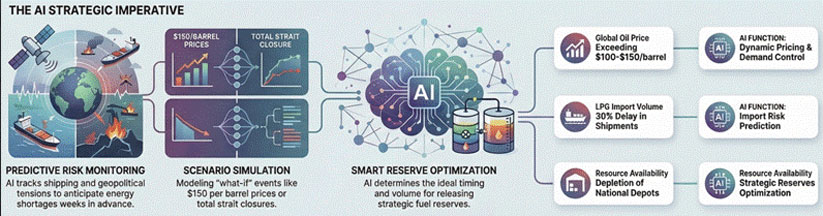
As geopolitical shocks can disrupt energy flows overnight, national resilience is no longer solely dependent on the physical supply of fuel, but on the intelligence, speed, and adaptability provided by AI systems.
AI-Enabled Crisis Response
Fuel and LPG shortages will remain a risk in an increasingly uncertain global environment. Geopolitical tensions, economic pressures, and climate-related disasters will continue to challenge national energy systems.
To protect its citizens and economy, affected countries must invest in predictive energy management systems, digital supply chain monitoring, strategic fuel reserves, data-driven decision-making and AI-enabled crisis response capabilities. By embracing Artificial Intelligence, they can move from crisis management to crisis prevention—and build a more resilient future.
Energy security is not just about having enough fuel. It is about having the intelligence to manage it wisely. Artificial Intelligence provides Sri Lanka with a powerful tool to anticipate risks, protect essential services, and ensure stability in times of uncertainty.
(The author, a former Sri Lankan diplomat, is a political and strategic affairs commentator. Views expressed are personal. He can be reached at sugeeswara@gmail.com.)





Post a Comment