

Bamiyan Buddhas Are A Test And Opportunity For The Taliban Now
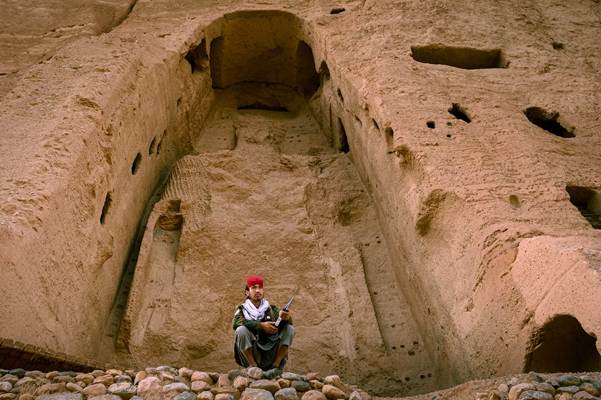
The Taliban regime has started building a tourism complex and rebuilding a historic bazaar near the destroyed Bamiyan Buddhas without UNESCO consultations. Archaeological experts have warned that this could cause permanent damage to the UNESCO World Heritage Site. The damaged statues - where only the niches remain - are now belatedly being seen as a lucrative source of revenue for the financially crunched Taliban regime.
 Nov 05, 2025

The painting of the original Bamiyan Buddhas seen as a backdrop at the press conference of Taliban’s (acting) Foreign Minister Amir Khan Muttaqi at the Afghan embassy in New Delhi had created great controversy. The painting was placed by the staff of the previous regime, the Republic of Afghanistan. However, it has once again brought back memories of the Taliban’s destruction of the Bamiyan Buddhas, carved into the sandstone cliffs of the Bamiyan Valley, and a reminder of their extremist Islamist ideology. The Bamiyan Buddhas were known with the names ‘Salsal’ and ‘Shahmama’. Salsal and Shahmama - the Eastern and Western Buddhas - were some of the tallest standing Budhhas in the world with height of 173 feet and 115 feet respectively.
Mullah Mohammad Omar, founder of the Taliban group, ordered the destruction of Bamiyan Budhha on 11th March, 2001. The operation to destroy the site was supervised by Mullah Obaidullah, Taliban’s then defence minister. Pakistan’s Interior Minister in 2001, Moinuddin Haider, a Shia by faith, visited Kandahar to persuade Mullah Omar against the destruction of the Buddhas. He tried to persuade Mullah Omar using historical examples of Mahmud Ghaznavi and others. However, Mullah Omar was adamant about the Taliban’s commitment to Islamic Sharia as these were considered idolatrous under the Sharia. Some notable world leaders and religious authorities such as Qatar’s Foreign Minister Sheikh Ahmad Abdullah Zaid al-Mahmood, the famous religious personality Yusuf al-Qaradawi and Egyptian Grand Mufti Farid Wasil visited Mullah Omar to persuade against this action, but could not meet Mullah Omar, and instead met with Chief Justice Noor Mohammad sadiq.
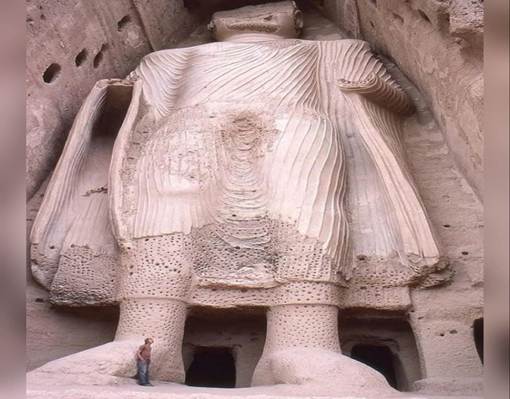
Mullah Omar and the Taliban group were clear on the issue that statues of the pre-Islamic age should not be present in an Islamic society as these were considered idolatrous. Buddhism was an important religion in Central Afghanistan from the pre-Islamic history of Afghanistan. Mullah Omar and his ministers were not comfortable with the fact that the people of Afghanistan celebrate their pre-Islamic past in any way. Mullah Omar was not interested anymore of what US and UN committee thought about his order to destroy Bamiyan Buddhas. "I am not concerned about our relations with the world,": he told a local journalist. "My task is to implement the rules of Islam, no more or less than that." Earlier, Mullah Omar had opposed taking action, mentioning the Bamiyan Buddha as part of Afghanistan’s cultural heritage. In July 1999, Taliban’s Culture Minister stated the need to protect pre-Islamic antiquities and highlighted the risk of retaliation against mosques in Buddhist countries if Buddhas were destroyed. Robert Kluijver, member of the Society for the Preservation of Afghan Cultural Heritage (SPACH), stated that Mullah Omar had initially dealt rigorously with protecting ancient monuments because they believed that it would bring them international recognition. The lack of international recognition for the Taliban was a significant disappointment for them.
A Finger To The West?
Bette Dam in her book, Looking for the Enemy: Mullah Omar and the Unknown Taliban, argued that Nancy Dupree, well known American archaeologist, told me "it was Arabs" and the Western narrative also embraced this idea that Osama bin Laden made Mullah Omar change his mind on the Bamiyan Buddhas. Bette Dam argued that from her investigations she learnt that Mulla didn’t accept advice on political decisions from others. Kluijver also rejected the influence of Al Qaeda on Mullah Omar to destroy the Bamiyan Buddhas and blamed the US and UN sanctions and the refusal to grant the Taliban a seat in the UN General Assembly. Francesc Vendrell, successor of Lakhdar Brahimi as UN Special Envoy to Afghanistan, also believed that sanctions and increasing isolation of the Taliban encouraged them to take this extreme step of destruction. Latif, a close aide of Mullah Omar, explained it explicitly, it was "Omar giving the finger to the West."
Abdul Hai Mutmaeen in his book, Taliban: A Critical History from Within, interpretes the meeting between Yusuf al-Qaradawi and Taliban’s Supreme Court Chief Justice Noor Mohammad Sadiq. Noor Mohammad Sadiq asked Yusuf al-Qaradawi a single question whether Sharia orders us or not to destroy statues in Islam. Qaradawi responded that he was not there to debate this but requested that Kabul not engage in destruction at a time when the whole world was looking for reasons to isolate it and impose a ban on it. Sadiq replied that the world was anyway going to isolate and ban Afghanistan and his concern was only to strictly implement Islamic Sharia. The Taliban's destruction of the Bamiyan Buddha statues have been criticized globally as a "cultural crime".
Abdullah Sarhadi, the current Governor of Bamiyan under Taliban’s Islamic Emirate of Afghanistan, was also involved in the destruction of the Bamiyan Buddha statues in 2001. He is now obeying orders from the supreme leader, Mullah Hibaitullah Akhundzada, to protect ancient Buddhist sites in the Bamiyan. Locals have levelled allegations against him for illegal excavation activities.
Belated Recognition?
The Taliban regime has started building a tourism complex and rebuilding a historic bazaar near the destroyed Bamiyan Buddhas without UNESCO consultations. Archaeological experts have warned that this could cause permanent damage to the UNESCO World Heritage Site. The damaged statues - where only the niches remain - are now belatedly being seen as a lucrative source of revenue for the financially crunched Taliban regime. The Bamiyan Buddha complex - or whatever is left of it - can be visited by paying a ticket price of 58 cents by Afghans and $3.45 by foreigners. More than 1000 Taliban guards presently protect the complex.
For archaeologists, the Bamiyan Buddhas are a test of whether pre-Islamic heritage sites of Buddhism and Hindus would survive the extremist ideology of the Taliban regime. For the Taliban, it is a test and opportunity to show the world a modified and moderate version of themselves that accomodates global mainstream opinion.
(The author is a PhD student of politics of Afghanistan at MMAJ Academy of International Studies, Jamia Millia Islamia, New Delhi. Views expressed are personal. He can be reached at navneet2009074@st.jmi.ac.in and on Linkedin at https://www.linkedin.com/in/imkhannavneet/ )







Post a Comment