

‘Gaza Board of Peace’ is no Place for India; Not in Tune With Its Foreign Policy Objectives
Declining Trump’s invitation would not signal hostility toward the United States. It would signal coherence in India’s own diplomacy. It would affirm that New Delhi will not lend its name to a project that concentrates authority in a single capital at a time when global cooperation demands broader legitimacy and shared accountability.
 Feb 15, 2026
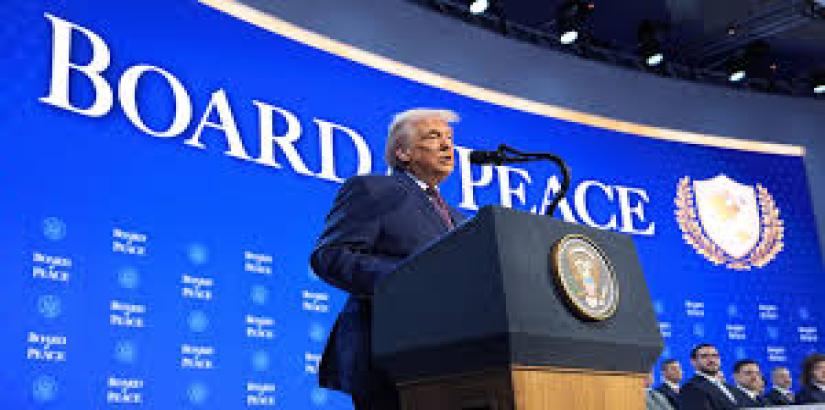
The first meeting of the newly announced ‘Board of Peace for Gaza’ is reportedly scheduled for 19 February in Washington DC. Though invited, India has not yet joined the body, which US President Donald Trump launched at the World Economic Forum in Davos last month. The invitation may be framed as recognition of India’s stature as the world’s largest democracy. However, it appears less an honour than a test of New Delhi’s strategic clarity and moral steadiness at a fraught global moment.
Under the draft charter, Trump would serve as the Board’s inaugural chairman with overriding veto authority over its plans and actions. When asked whether the institution might replace the United Nations, he initially replied that it “might.” Within hours, he recalibrated, suggesting it would operate “in conjunction with the United Nations.” The ambiguity is revealing. Is the Board meant to complement the UN, compete with it, or quietly supplant it?
Several states have already agreed to participate, including Pakistan, Israel, Saudi Arabia, Egypt and Hungary. The composition suggests transactional convergence more than shared principles. All major European countries -- Britain, France, Sweden and Norway – and Canada have declined. Vladimir Putin has indicated he is consulting Moscow’s strategic partners before deciding, while China’s position remains uncertain.
No permanent member of the UN Security Council other than the United States has committed to join. India’s participation would lend democratic legitimacy to an enterprise otherwise anchored in U.S. power and selective partnerships. That alone should give New Delhi pause.
Single Centre of Authority
The timing is significant. The invitation comes amid deep international unease, captured starkly by Canadian Prime Minister Mark Carney in his widely discussed address at Davos. “We are in the midst of a rupture, not a transition,” he told delegates already unsettled by war, tariffs and the steady erosion of multilateral norms. The old order, he argued, was not merely under strain; it had fractured. To pretend otherwise was to engage in dangerous self-deception.
Drawing on Václav Havel’s parable of the greengrocer who displays in his shop window a slogan he does not believe in order to avoid trouble, Carney warned against “living within a lie.” He cautioned middle powers tempted to go along in the hope that compliance would purchase security. It would not. Accommodation, he implied, rarely guarantees respect.
Those words resonate uneasily with the architecture of Trump’s new initiative, presented as an ‘international organisation’ but designed around a single centre of authority.
The Board would sit above a founding Executive Board that includes Jared Kushner, Trump’s son-in-law, Secretary of State Marco Rubio, Special Envoy Steve Witkoff, and former British prime minister Tony Blair, who continues to face sustained criticism for his role in the Iraq War. The structure signals not broad-based international stewardship but a tightly curated circle.
Politically Not Expedient
Any serious peace mechanism for Gaza must be grounded in humanitarian law, accountability and inclusive multilateral consent. Trump’s proposal offers none of these foundational assurances. Instead, it concentrates authority in the hands of one leader whose record reflects open scepticism toward international institutions and a preference for spectacle over substance. Under the draft charter, decisions would flow less from negotiated norms than from the chairman’s discretion. What is presented as peace-making risks evolving into a vehicle for unilateralism, buffered from scrutiny by the participation of selected states.
The Board offers optics without architecture: the appearance of leadership without the discipline of law, the symbolism of cooperation without its constraints. India’s participation, however carefully hedged in diplomatic language, would be read globally as endorsement. That endorsement would not be cost-free.
India’s recent experience with Trump hardly suggests a partnership built on mutual respect. He has publicly described India’s economy as “dead” and permitted senior aides to mock New Delhi’s ties with Moscow by branding the country Russia’s “launderette.” These remarks were not stray provocations. They formed part of a broader pattern in which allies and partners were alternately praised and publicly rebuked, a method of signalling hierarchy rather than equality.
Besides, currently there is also public outcry in India over the asymmetry of the trade framework recently agreed upon by the two nations with the Opposition accusing the BJP government of “selling” the country to the United States.
Against that backdrop, India is now invited to join a body chaired by Trump, endowed with veto authority, operating outside established international legal frameworks and openly floated as a potential alternative to the United Nations. The lopsidedness is evident.
Optics Against Indian Interests
The initiative traces its lineage to UN Security Council Resolution 2803 of last November which authorised the creation of a mechanism to oversee Gaza’s post-war reconstruction. Yet the Trump-led version would function beyond the UN’s institutional framework, free from its legal disciplines and collective accountability. Rather than strengthening multilateral governance, it risks encouraging parallel structures answerable to power rather than principle. For India, which has consistently advocated reform and democratisation of global institutions rather than their circumvention, participation would represent a sharp departure from long-held positions.
Canada and the European countries that have declined to sign on appear to have grasped this distinction. Their refusal is not reflexive anti-Americanism; it reflects institutional self-respect. It acknowledges, as Carney argued, that middle powers negotiating alone with a hegemon do so from a position of structural weakness. The alternative is coordination, not capitulation.
The selectivity of invitations further underscores the Board’s political design. From the African continent, only Morocco has been invited; South Africa’s exclusion is conspicuous. The inclusion of Pakistan complicates India’s strategic calculus while inevitably diluting its influence. New Delhi’s presence would help confer legitimacy on decisions over which it would exercise limited control. Optics matter in international politics, and here the optics would serve Washington’s narrative more than India’s interests.
Beyond immediate diplomacy lies the question of reputation. Across the Global South, India has carefully cultivated an image as an autonomous actor, neither aligned nor acquiescent. That image draws moral authority from the legacies of Mahatma Gandhi and Jawaharlal Nehru, whose approach to international engagement rested not on abstention but on agency, restraint and the conviction that legitimacy matters even in a world structured by power. Joining Trump’s Gaza Board risks eroding that hard-earned capital.
Carney’s framework in Davos offers a useful lens. In a fractured international system, the options are not confined to submission or isolation. There exists a third path rooted in principled, coordinated engagement among states committed to rules-based order. For India, that path aligns more closely with its declared foreign policy objectives than participation in a structure centred on unilateral discretion.
Coherence in Diplomacy
India has alternatives. It can work with like-minded partners to strengthen humanitarian and reconstruction mechanisms for Gaza within established international law. It can press for substantive reform of the United Nations rather than acquiesce in its hollowing out. It can diversify economic and strategic partnerships to reduce vulnerability to coercion while remaining anchored in principle. These are not acts of defiance; they are expressions of consistency.
Declining Trump’s invitation would not signal hostility toward the United States. It would signal coherence in India’s own diplomacy. It would affirm that New Delhi will not lend its name to a project that concentrates authority in a single capital at a time when global cooperation demands broader legitimacy and shared accountability.
The Gaza Board of Peace, for all its grand rhetoric and carefully staged unveiling, offers neither durable peace for Gaza nor institutional credibility for those who participate. For New Delhi, the calculation should be clear. This is no place for India.
(The writer is a former UN spokesperson and a contemporary affairs commentator. Views expressed are personal. He can be reached at edmathew@gmail.com / tweets @edmathew)





Post a Comment