

Greenland, Great Power Politics, And India’s Strategic Imperative: A Realist Geopolitical Analysis
Greenland’s geopolitical prominence illustrates how a distant region can reflect deeper shifts in global power, economics, and security. For countries like India, Greenland is not about territorial ambition; it is a reminder that structural shifts in global power dynamics transcend geography. In a realist world, engagement is not optional; it is necessary for safeguarding long-term interests in a system where power continually redistributes itself.
 Jan 19, 2026
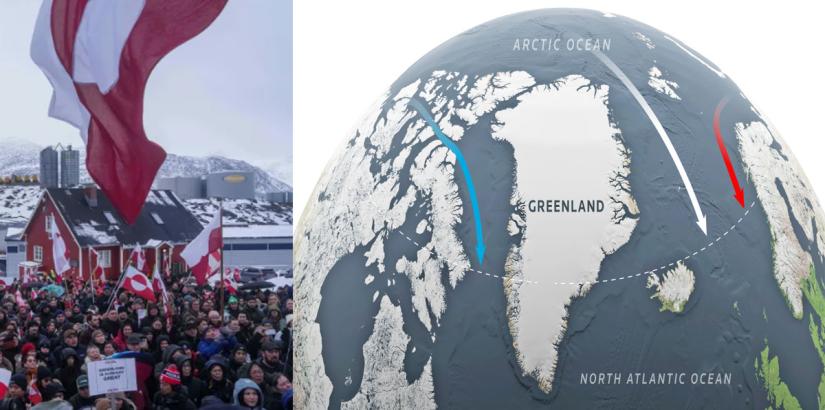
At first glance, Greenland may seem irrelevant to Indian strategic planners. With a population of around 57,000 and located thousands of kilometres from South Asia, it appears far removed from India’s immediate concerns. Yet recent developments have revealed how Greenland has become a geopolitical flashpoint, exposing deeper realist dynamics of power competition, resource access, alliance shaping, and strategic positioning among major powers. These developments matter even to distant states because structural shifts in global power reshape the international environment in which all states operate.
Geography as Structural Power
In realist international relations, as articulated by theorists like Kenneth Waltz, states operate in an anarchic system where no authority enforces peace or order. Under such conditions, geography becomes a structural determinant of power, not a backdrop. Greenland’s location, lying between North America and Europe and guarding the gateway between the Arctic and the North Atlantic, exemplifies this logic. The island sits astride the GIUK gap (Greenland–Iceland–United Kingdom), a critical maritime and air corridor for monitoring naval and submarine access between the Arctic and the wider Atlantic. This corridor has been central to NATO strategy since the Cold War, and its importance persists in light of renewed Russian military activity in the Arctic.
In early 2026, Denmark’s top Arctic commander publicly emphasised that Greenland’s defence posture focuses on potential Russian activity, not internal allied conflict, underscoring how seriously European NATO members view Arctic security. Denmark has pledged significant investments into Arctic defence, around 42 billion Danish crowns (roughly $6.5 billion), including new naval vessels and surveillance assets, signalling Greenland’s growing role in allied deterrence and early warning.
Arctic as New Theatre of Power Competition
Realist theory predicts that great powers will seek to secure relative advantage and prevent rivals from dominating key strategic spaces. The Arctic, previously seen as peripheral has become precisely such a space. Climate change is accelerating this shift: the Arctic is warming nearly four times faster than the global average, reducing sea ice and exposing new maritime routes and resource potential.
Routes such as the Northern Sea Route and the Northwest Passage can significantly shorten shipping distances between Asia and Europe by up to 40 % compared with the traditional Suez route, reshaping future global trade patterns and imposing new considerations for naval logistics and commercial connectivity. For realist scholars like Alfred Thayer Mahan, command of sea lanes and strategic waterways is central to global power. Greenland’s proximity to emerging Arctic sea lanes thus increases its structural significance, making it a pivot in geo-economic as well as military competition.
Resource Competition and Material Interests
Beyond geography, material resources anchor Greenland’s geopolitical value. The Arctic and Greenland are believed to hold vast deposits of critical minerals, including rare earth elements, uranium, nickel, iron, and other materials crucial for advanced technologies, defence systems, and clean-energy infrastructure. A 2023 European Commission survey identified that Greenland could contain deposits of 25 of the 34 materials considered critical for industrial and technological development.
Although physical extraction remains challenging due to the harsh environment and fragmented infrastructure, Greenland’s mineral potential feeds into broader strategic competition: states now vie not merely for current production, but for future supply-chain leverage in technologies central to economic and security power. China’s Polar Silk Road concept, an extension of its Belt and Road Initiative explicitly includes Arctic routes and resource exploration, reflecting Beijing’s long-term ambition to secure strategic materials and influence. Meanwhile, Russia’s Arctic posture has emphasised energy and resource extraction as integral to its national economy, underlining the multifaceted nature of material competition.
In realist thought, such material capabilities form the basis of national power. Access to critical minerals and energy resources enables industrial modernisation, technological autonomy, and military innovation, making Greenland a strategic asset in long-term power calculations.
Great Power Rivalry and Institutional Realignments
The geopolitical contest over Greenland is not confined to rhetoric; it has real policy consequences. In January 2026, U.S. President Donald Trump reignited global debate by threatening tariffs of up to 25% on European countries unless Denmark agreed to sell Greenland to the United States, a move that prompted widespread diplomatic pushback.
These threats exacerbated tensions within NATO and raised fundamental questions about allied solidarity. Nordic and European leaders have largely rejected the notion of Greenland’s sale, emphasising the island’s sovereignty and the enduring importance of collective defence under the alliance umbrella. Despite U.S. claims of Russian and Chinese military activity near Greenland, senior Nordic officials have publicly stated that there is no evidence of significant Russian or Chinese warship presence in Greenland’s immediate waters, underscoring how current geopolitical narratives are as much about perceived influence as actual military deployments.
European NATO members have responded by enhancing Arctic exercises such as Operation Arctic Endurance, a Danish-led 2026 military exercise in Greenland involving multiple NATO allies, designed to reinforce allied preparedness and strategic cohesion in high-latitude defence.
Why Greenland Matters to India
For India, Greenland’s strategic evolution has real implications even if New Delhi does not directly contest Arctic sovereignty. Realism posits that systemic shifts in power structures affect all states, not just immediate neighbours. India’s reliance on global energy markets underscores this vulnerability: according to the International Energy Agency (IEA), India imports over 89 % of its oil and nearly 50 % of its natural gas, making it susceptible to global price shocks and supply disruptions that could be influenced by changing geopolitical formulas in the Arctic.
Importantly, Greenland’s melting ice contributes to global sea-level rise and modifies atmospheric circulation patterns that can influence the Indian monsoon, which underpins the country’s agricultural economy and food security. India’s official Arctic Policy recognises that the Arctic has “atmospheric, oceanographic and biogeochemical linkages” with South Asia, emphasising the intrinsic climate connection between distant poles and Indian realities.
India’s participation in the Arctic Council as an Observer since 2013 provides the country with access to multilateral dialogue on Arctic environmental management, indigenous affairs, and scientific cooperation. While Observer status does not confer voting rights, it allows India to remain informed and contribute to discussions that shape norms around Arctic governance, shipping regulations, and sustainable resource development. From a realist perspective, this engagement is foundational, not optional. Remaining silent risks ceding normative influence to powers shaping future rules of access and usage in the Arctic, including those governing shipping corridors, resource extraction regimes, and environmental protections.
How India Should Respond
India need not pursue military deployment in Greenland or the Arctic. Rather, its strategy should be pragmatic, multifaceted, and grounded in structural awareness. New Delhi should deepen its participation in Arctic Council working groups that address maritime safety, climate modeling, and infrastructure resilience, thereby building epistemic networks with Nordic states, EU partners, Canada, and other observer countries. India can leverage its scientific capabilities to contribute to shared data platforms on Arctic climate impacts, which in turn enhances India’s domestic climate resilience planning.
Diplomatically, India should articulate a coherent narrative that connects distant developments in the Arctic with Indian priorities such as energy security, climate stability, and diversified global engagement. This narrative should anchor India’s realist rationale, not ideological alignment and highlight common interests with like-minded partners committed to a rules-based order.
Looking Beyond Greenland
Greenland’s geopolitical prominence illustrates how a distant region can reflect deeper shifts in global power, economics, and security. For countries like India, Greenland is not about territorial ambition; it is a reminder that structural shifts in global power dynamics transcend geography. In a realist world, engagement is not optional; it is necessary for safeguarding long-term interests in a system where power continually redistributes itself. India’s future strategic landscape is being shaped today in places as far away as the Arctic and New Delhi cannot afford to ignore it.
(The author is a final-year political science student and geopolitical researcher specializing in great power politics, climate security, and international strategic affairs. He writes on contemporary global issues with a policy-oriented lens. Views expressed are personal. He can be contacted at piyushchaudhary2125@gmail.com )





Post a Comment