

India’s Great Ideological Shift and Rise of a New National Identity
India stands at a historic crossroads. The older frameworks of left-wing politics and the secular-liberal consensus are gradually receding into history. The nation is moving forward on the pillars of development, identity, and global leadership. This is not a temporary wave but a structural transformation.
 May 07, 2026
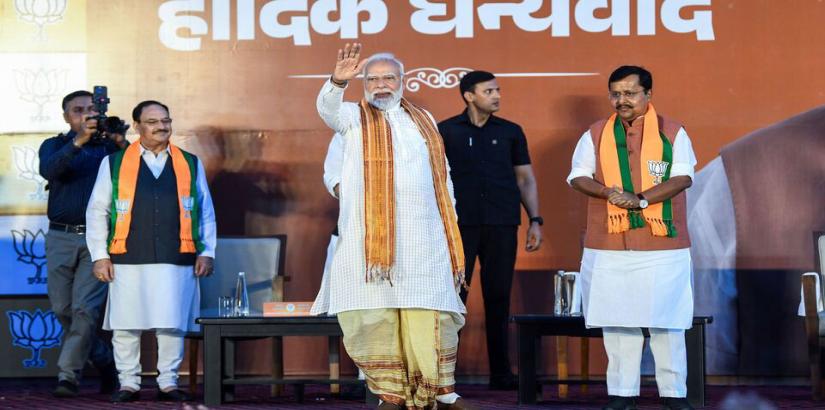
The current resonance across India’s political landscape is not merely the sound of a transfer of power; it signals the twilight of a decades-old consensus and the rise of a renewed national identity. The results of the 2026 assembly elections stand as a clear testament to this transformation. “New India” has found its voice in a confident and unapologetic ideology—one that blends civilizational pride with futuristic aspirations. This is not just a political shift; it is a profound ideological realignment.
Ideological Clarity for an Aspirational India
At the heart of this transformation lies ideological clarity. The ruling establishment has built a cohesive narrative anchored in the principles of “Nation First” (Rashtra-Pratham) and the idea of “decolonizing the Indian mind.” Unlike the uncertain political experiments of the past, this framework seeks to redefine India not merely as a post-1947 administrative entity but as a “civilizational state.” This clarity has given direction and purpose to the electorate, particularly the middle class, which long felt that the country’s leadership lacked a distinct cultural and strategic vision.
The youth have emerged as the driving force behind this shift. For a generation raised in the digital age, the old politics of identity rooted in deprivation holds little appeal. Today’s young Indians are aspirational and globally aware. They are drawn to a leadership that envisions India as a global power, a hub for advanced technology, and a nation capable of defending its own interests. The successful linkage of “cultural nationalism” with “individual growth” has further strengthened this connection. When young citizens witness cultural revival alongside technological advancement, they perceive it as a holistic rise of the nation. Nationalism, for them, is no longer an abstract idea but a lived experience of pride and progress.
Simultaneously, the traditional political bastions are witnessing a transformation. States like West Bengal and Kerala, once considered strongholds of left ideology, are no longer politically static. A decade ago, nationalist forces struggled for relevance in these regions; today, the emergence of alternative narratives marks a significant turning point. This transformation is not merely geographical—it is psychological.
Fabian Socialism to Cultural Nationalism
In Southern India as well, particularly in Karnataka, Tamil Nadu, and Kerala, long-standing binaries such as “regionalism versus nationalism” are being questioned. A younger generation increasingly sees itself as part of a broader Indian civilizational identity. The growing nationalist sentiment in the South suggests that regional strongholds are no longer insulated from the national pulse. People are gradually moving beyond identity politics based on language and caste toward a more inclusive vision of national integration.
To fully understand this shift, one must examine the erosion of the “Nehruvian Consensus”—a framework built on Fabian Socialism and a particular interpretation of secularism that shaped post-independence India. For many modern voters, this model appears disconnected from contemporary realities. The new generation often views the old secularism as a form of selective "minority appeasement" and the earlier socialist approach as a constraint on individual growth. The shift, therefore, is from a “State-driven identity” to a “civilization-driven identity.” In this new paradigm, India’s heritage is not seen as a relic of the past but as a foundation for a future superpower.
The digital revolution has accelerated this transformation. The democratization of information through social media has broken the monopoly over historical and cultural narratives. Young Indians are rediscovering their roots—from the architectural brilliance of ancient empires to the philosophical depth of classical traditions. This renewed emphasis on “Nation and Heritage First” is not regressive; it represents a resurgence of confidence. Importantly, this new nationalism coexists with technological ambition, where cultural pride aligns seamlessly with innovation and skill development.
Economic transformation has also played a crucial role. The shift from a subsidy-driven model to a digitally empowered economy has strengthened grassroots participation. Initiatives such as the Unified Payments Interface (UPI) and Direct Benefit Transfer (DBT) have reduced inefficiencies and enhanced transparency. The Indian middle class is no longer content to remain a passive observer; it aspires to global standards. Infrastructure developments—modern expressways, high-speed rail systems, and urban modernization initiatives—have made the idea of “development” tangible in everyday life.
India’s global posture has further reinforced national confidence. Progress in defense manufacturing, including advancements in indigenous technologies, and achievements in space exploration have strengthened the country’s image. Missions like Chandrayaan and Gaganyaan symbolize not just scientific progress but national ambition. On global platforms such as the G20, India’s assertive voice resonates strongly, instilling a sense of pride among its citizens.
Opposition's Lack of Alternate Vision
Amid these sweeping changes, the opposition finds itself in a state of ideological uncertainty. While the ruling narrative projects a forward-looking vision, opposition parties often appear anchored in outdated frameworks. Their politics tends to revolve around alliances and anti-incumbency rather than a coherent alternative vision. The continued reliance on traditional vote-bank strategies has become increasingly ineffective in an aspirational society. Many voters now perceive such approaches as transactional rather than transformational.
To remain relevant, the opposition must articulate a vision that is both rooted in Indian realities and aligned with future aspirations. In the absence of such clarity, there exists a visible intellectual vacuum. The challenge is not merely political but conceptual—defining what an “alternative India” looks like in a rapidly changing socio-political environment.
India stands at a historic crossroads. The older frameworks of left-wing politics and the secular-liberal consensus are gradually receding into history. The nation is moving forward on the pillars of development, identity, and global leadership. This is not a temporary wave but a structural transformation. As the world transitions toward a multipolar order, India is rediscovering its civilizational roots to shape its future trajectory.
The march of “New India” continues with momentum—and at present, there appear to be few forces capable of halting it.
(The author is an independent political analyst and agriculturalist based in Tumkur, Karnataka. He writes on national identity, socio-political shifts, and technological evolution in India. Views expressed are personal. He can be contacted at khelloworld4@gmail.com )





Post a Comment