

Mohammad Deepak: A Beacon of Fraternity in an Age of Manufactured Hate
The Constitution of India enshrines fraternity as a foundational value alongside liberty, equality, and justice. Yet fraternity cannot survive on parchment alone; it requires everyday acts of courage. Deepak Kumar’s gesture — simple, instinctive, humane — stands in contrast to the flood of rhetoric that seeks to divide citizens along religious lines. It reminds us that the long history of Hindu-Muslim interaction in food, literature, architecture, festivals, and everyday life cannot be erased by slogans.
 Feb 13, 2026
India is a country of astonishing diversity. Its religious plurality, in particular, has shaped a deeply layered civilisational ethos. During colonial rule, the British exploited Hindu and Muslim identities to implement their policy of “divide and rule.” By selectively invoking history, they sowed seeds of distrust that later formed the basis of communal politics. The Muslim League and the Hindu Mahasabha-RSS stream propagated competing and polarising narratives, injecting hostility into what had largely been cordial relations between Hindus and Muslims.
This deepening mistrust fuelled unprecedented violence in the years preceding Partition and became a major factor in the acceptance of the Mountbatten Plan to divide the country. The apostle of peace and Father of the Nation, Mahatma Gandhi, ultimately fell to three bullets fired on the accusation that he was “pro-Muslim.”
Secular Foundations to Sectarian Mobilisation
After Partition, Muslim communalism consolidated itself in Pakistan, weakening democratic institutions and undermining social and economic progress. In contrast, India’s early leadership, particularly under Jawaharlal Nehru, laid the foundations of a secular republic. For several decades, the country advanced on the principles of pluralism, constitutionalism, and relative communal harmony.
However, over the last two decades, communal forces have grown significantly stronger. Much of their mobilisation has centred on sustained hostility towards Muslims as a political strategy to consolidate power and social dominance. In the process, many of the gains of the early decades of peace and amity have come under strain.
The vocabulary of public discourse has increasingly normalised divisive terms such as “love jihad,” “land jihad,” and “Corona jihad.” Assertions around food habits, demographic anxieties, and cultural purity have deepened social polarisation. Slogans attributed to sections of the political leadership — such as “Batenge to Katenge,” “Ek hain to safe hain,” claims that Muslims can be identified by their clothes, that they “proliferate like rabbits,” or that Hindus are in existential danger — have contributed to an atmosphere of suspicion and antagonism.
Escalating Rhetoric and Legal Pushback
The situation has been particularly alarming in Assam. The state’s Chief Minister, Himanta Biswa Sarma, has made a series of controversial remarks targeting “Miyas” (a term used for Bengali-speaking Muslims). On January 27, he reportedly stated that “four to five lakh Miyas will be removed from the electoral rolls through SIR,” and further suggested that they should ideally vote in Bangladesh rather than in Assam. Media reports also cited him as urging people to socially and economically isolate the community.
In another widely discussed episode, a video posted on social media showed him firing a rifle at a target depicting a skull-capped man and a boy standing next to him. The post was later deleted.
Disturbed by these developments, noted human rights activist and author Harsh Mander filed a petition alleging hate speech intended to promote harassment and discrimination against Bengali-speaking Muslims in Assam. He sought the registration of an FIR under relevant provisions of the Bharatiya Nyaya Sanhita, 2023. In response, Sarma indicated that multiple FIRs would be filed against Mander for his role during the NRC process.
The spiral of accusation and counter-accusation illustrates the growing institutionalisation of polarised politics.
Moment of Hope from Uttarakhand
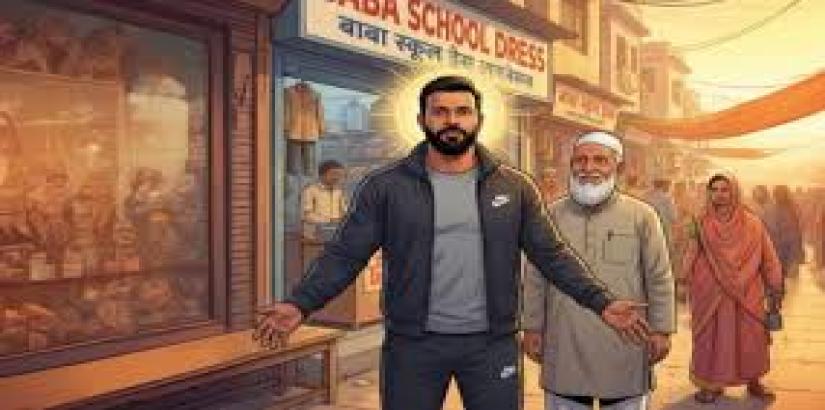
Against this grim backdrop, an incident from Kotdwar in the Pauri Garhwal district of Uttarakhand offered a glimmer of hope. An elderly Muslim man had been running a shop named “Baba School Dress” for three decades. Activists of the Bajrang Dal allegedly confronted him, objecting to the use of the word “Baba,” which they associated exclusively with Hindu identity.
A local resident, Deepak Kumar, intervened in defence of the shopkeeper. As tensions escalated, the police reportedly remained passive observers. Subsequently, FIRs were filed against Deepak Kumar and his friend, while the FIR against the Bajrang Dal activists named “unknown persons.”
It was during this confrontation that Deepak identified himself as “Mohammad Deepak” — an act of spontaneous solidarity intended to defuse the situation. Explaining his action later, he said that the name came to him instinctively, hoping it would calm tempers rather than inflame them. Instead, he now faces legal proceedings.
Yet, in that moment of moral courage, Deepak revived the spirit of India’s syncretic culture — the shared traditions where figures such as Azan Peer and Srimanta Sankardeva in Assam symbolised coexistence and dialogue. His act represents not merely personal bravery but the enduring possibility of fraternity in an increasingly fractured public sphere.
Leader of Opposition Rahul Gandhi praised Deepak, describing him as a defender of the Constitution and humanity in what he termed a “marketplace of hate.” Whether one agrees with the political framing or not, the symbolism of Deepak’s intervention resonates widely.
Reclaiming Idea of India
The Constitution of India enshrines fraternity as a foundational value alongside liberty, equality, and justice. Yet fraternity cannot survive on parchment alone; it requires everyday acts of courage. Deepak Kumar’s gesture — simple, instinctive, humane — stands in contrast to the flood of rhetoric that seeks to divide citizens along religious lines. It reminds us that the long history of Hindu-Muslim interaction in food, literature, architecture, festivals, and everyday life cannot be erased by slogans.
In times when despondency seems natural, such acts restore faith in the enduring strength of India’s plural ethos. One can only hope that more citizens — like Harsh Mander and Deepak Kumar — will continue to embody and defend the true idea of India.
(The author is a former professor at IIT Bombay and Chairman of the Centre for the Study of Society and Secularism, Mumbai. Views expressed are personal and do not necessarily reflect those of South Asia Monitor.)








Post a Comment