

Rethinking Bangladesh’s Foreign Policy: Test For a More Assertive "Bangladesh First" Doctrine
The most immediate and delicate challenge for the new government lies in its relationship with India. Following the events of August 2024 and the subsequent transitional period, the bilateral bond has faced unprecedented strain. The presence of former prime minister Sheikh Hasina in India remains a friction point, yet the early signs of 2026 suggest a pragmatic "reset." Prime Minister Narendra Modi’s congratulatory call to Tarique Rahman on February 13, 2026 signals New Delhi's recognition of the changed political reality. However, the path forward requires addressing deep-seated issues that have long simmered.
 Feb 17, 2026
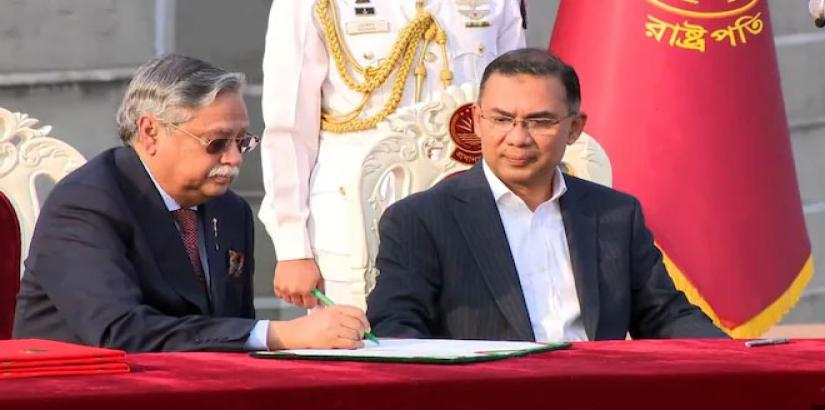
With the final ballots verified on February 12, 2026, the 13th National Election has triggered a profound transformation in Bangladesh’s diplomatic trajectory. This milestone does more than just seat a new government; it fundamentally resets the nation's engagement with the global community. Following the landslide victory of the Bangladesh Nationalist Party (BNP)—securing 209 seats and a decisive two-thirds majority—the incoming administration inherits a landscape defined by both immense volatility and strategic opportunity.
As the nation prepares for the official transition of power, the world is witnessing the birth of a "Bangladesh First" doctrine. This isn't merely a change in leadership, but a shift toward a more assertive, sovereign foreign policy aimed at navigating the complex rivalries of the 21st century.
Shifting the Narrative
The most immediate and delicate challenge for the new government lies in its relationship with India. Following the events of August 2024 and the subsequent transitional period, the bilateral bond has faced unprecedented strain. The presence of former prime minister Sheikh Hasina in India remains a friction point, yet the early signs of 2026 suggest a pragmatic "reset." Prime Minister Narendra Modi’s congratulatory call to Tarique Rahman on February 13, 2026 signals New Delhi's recognition of the changed political reality. However, the path forward requires addressing deep-seated issues that have long simmered. The new administration must prioritize the resolution of the Teesta River water-sharing treaty and take a firm stance against border killings by the Border Security Force (BSF). By shifting the narrative from a "special relationship" with a single party to a "State-to-State" partnership based on mutual respect and equity, Bangladesh aims to balance essential security cooperation with India while ensuring its own strategic autonomy.
Simultaneously, Bangladesh finds itself as a primary theater for the deepening competition between the United States and China. As of 2026, China remains Bangladesh’s largest trade partner and a dominant force in infrastructure and defense, recently evidenced by the 2025 agreement for a state-of-the-art drone manufacturing plant and ongoing discussions for J-10CE fighter jets. On the other hand, the United States, through its Indo-Pacific Strategy, is actively pitching defense alternatives and seeking to counter Chinese influence in the Bay of Bengal. The new government must master the art of "strategic hedging"—leveraging Chinese investment for development while maintaining the robust security and democratic ties that Washington demands. This balancing act is not merely political; it is survival. With 80% of Bangladesh’s exports, primarily Ready-Made Garments (RMG), destined for Western markets, maintaining favor with the U.S. and the European Union is a non-negotiable economic necessity.
Economic and Humanitarian Dimensions
Economic diplomacy is perhaps the most time-sensitive pillar of post-election foreign policy. The clock is ticking toward November 24, 2026—the scheduled date for Bangladesh’s graduation from the status of a Least Developed Country (LDC). While graduation is a mark of pride, it brings a "double whammy" of challenges: the loss of Duty-Free Quota-Free (DFQF) market access and a significant reduction in concessional financing. Projections for 2026 suggest that without new trade agreements, the country could face an annual export loss of approximately $8 billion. In the EU alone, tariffs on Bangladeshi apparel could jump from zero to an average of 12%. The incoming Ministry of Foreign Affairs must move with surgical precision to negotiate the EU’s GSP+ scheme and pursue Free Trade Agreements (FTAs) with major partners like Japan, South Korea, and the ASEAN bloc. Restoring "data integrity" is a prerequisite for these negotiations; the world requires transparent statistics on GDP and inflation, which hovered around 8.7% in early 2026, to rebuild investor confidence.
The humanitarian dimension of foreign policy also demands a renewed, more aggressive approach. The Rohingya crisis, now entering its ninth year in 2026, has reached a critical juncture. With over 1.2 million refugees in the camps of Cox’s Bazar and Bhasan Char, the "Joint Response Plan" for 2026 is facing a massive funding shortfall. The new government is expected to pivot from a policy of "patient hosting" to one of "proactive repatriation." This involves leveraging China’s mediation role more effectively and engaging directly with the evolving power structures within Myanmar, including the Arakan Army and the National Unity Government (NUG). The goal is no longer just to manage the crisis but to secure a definitive, dignified, and safe return for the Rohingya people, thereby easing the immense socio-economic and security burden on host communities.
Reclaiming Country's Agency
Furthermore, the new administration is signaling a "Look West" and "Look Middle East" expansion. Beyond the traditional focus on labor migration, the goal is to attract sovereign wealth funds from the GCC (Gulf Cooperation Council) for large-scale energy and infrastructure projects. By positioning Bangladesh as a reliable, democratic partner that respects international norms and human rights, the government hopes to diversify its source of Foreign Direct Investment (FDI). This includes a focus on the "Blue Economy" in the Bay of Bengal, where maritime security and the exploration of hydrocarbon reserves require sophisticated technical partnerships with global energy giants.
As the new cabinet takes office, the success of Bangladesh’s foreign policy will be measured by its ability to deliver tangible results for its citizens. It is a mission that requires a sophisticated blend of nationalist resolve and diplomatic finesse. The mandate of the 13th national election was about reclaiming the country’s agency on the world stage. Whether it is navigating the LDC graduation in November, managing the delicate "pivot" between superpowers, or resolving the long-standing water and refugee crises, the next five years will determine if Bangladesh can successfully transform its geographic vulnerability into a strategic advantage. In this high-stakes environment, the new government’s "Bangladesh First" doctrine will be tested daily, and its ability to adapt will define the nation’s prosperity for decades to come.
(The author is a research scholar in the Department of International Relations, Jahangirnagar University, Dhaka, Bangladesh. His research interests include South Asian politics, Terrorism and Counter-terrorism, Migration, Peace & Conflict Studies, Environmental Politics and China’s Foreign Policy. Views expressed are personal. He can be reached at md.saiful.stu2018@juniv.edu/ LinkedIn )







Post a Comment