

Strait of Hormuz: More than a Regional Flashpoint; Prolonged Instability Could Ripple Across Continents
The broader reality is that even if a political understanding emerges, restoring confidence in the Strait may take far longer than restoring a ceasefire. Shipping markets operate as much on perception of risk as on military realities. Tanker operators, insurers, charterers, and energy traders require predictability — and that predictability is currently absent.
 May 12, 2026
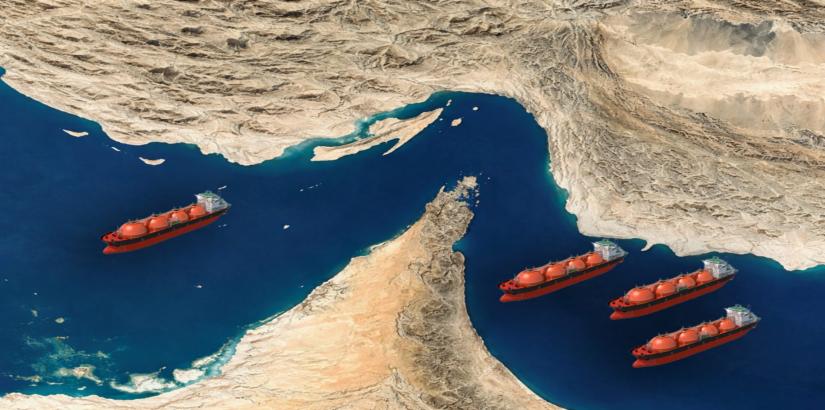
For decades, the Strait of Hormuz functioned as one of the world’s most critical free waterways, a narrow but vital maritime corridor through which oil, gas, trade, and global commerce flowed with relative continuity despite repeated regional tensions. The principle of freedom of navigation in these international waters was regarded not merely as a legal norm, but as an economic necessity for the world itself.
Today, that assumption stands severely tested.
Strait in Pre-Ceasefire Condition
The Strait of Hormuz, a chokepoint through which nearly a fifth of the world’s oil passes, has once again become the turbulent centre of the United States–Israel confrontation with Iran, as the continuing standoff between Washington and Tehran complicates efforts to bring the conflict to a close.
Iran appears to have reversed its earlier indication of reopening the Strait, and its military has reportedly opened fire on ships attempting passage after US President Donald Trump stated that Washington would continue its blockade of Iranian ports. Trump has refused to lift the blockade until a deal is finalised, while continuing to insist that discussions with Tehran have been “very good” and that the United States will not be “blackmailed.”
After a brief rise in transit attempts, ships in the Gulf have once again stayed put following reports of vessels coming under fire mid-passage and being forced to withdraw. Their retreat has effectively restored the Strait to its earlier pre-ceasefire condition, heightening the risk of a global energy squeeze and raising the possibility of renewed fighting.
Iran's No to Unrestricted Transit
Iran maintains that control of the Strait of Hormuz has returned to what it calls its “previous state,” and that this strategic waterway is now under strict management and supervision of its armed forces.
The IRGC’s joint military command has accused the United States of continuing “acts of piracy and maritime theft under the guise of a so-called blockade.”
Tehran has stated that until Washington restores full freedom of navigation for vessels travelling from Iran to their destinations and back, the status of the Strait will remain tightly controlled.
Iran’s Speaker of Parliament, Mohammad Bagher Ghalibaf, who is also Iran’s chief negotiator in talks with the US, said it would be “impossible for others to pass” through the strategic Strait without Iran’s consent. He called Washington’s blockade “ignorant” and “foolish,” warning that Tehran would not permit unrestricted transit for others while its own ships remained constrained.
Iran also maintains that major differences remain despite limited progress towards a negotiated settlement.
Trump Blows Hot and Cold
President Trump has accused Iran of violating the ceasefire agreement. In a Truth Social post, he warned: “We’re offering a very fair and reasonable deal, and I hope they take it because, if they don’t, the United States is going to knock out every single power plant, and every single bridge, in Iran.”
At the same time, Trump continues to say that the United States is engaged in “very good conversations” with Iran, while stressing that Tehran cannot use the threat of closing the Strait of Hormuz to pressure Washington.
Iran, however, insists that its tightening control over the waterway is a direct response to the US blockade of Iranian ports, which it says violates the terms of the ceasefire.
Shipping Companies Unconvinced
According to maritime monitoring agencies such as Lloyd’s List and other shipping trackers, traffic through the Strait of Hormuz remains severely disrupted despite intermittent suggestions of easing tensions.
Commercial shipping flows are reported to be far below normal levels, with some estimates suggesting that traffic remains at barely 10–15 percent of pre-conflict volumes.
Shipping companies and insurers remain unconvinced that the security situation has stabilised sufficiently for normal operations to resume. Reports continue of vessels turning back mid-transit, altered shipping routes, sharply higher insurance premiums, and growing concerns over mines, interception risks, and uncertain navigation procedures.
At the same time, Western naval deployments are increasing. Britain has reportedly moved naval assets towards the region, while discussions are underway regarding a possible multinational “freedom of navigation” mission involving the United States and France.
Iran, meanwhile, remains firm in its position that the Strait cannot function normally while Iranian shipping itself remains under restrictions.
The broader reality is that even if a political understanding emerges, restoring confidence in the Strait may take far longer than restoring a ceasefire. Shipping markets operate as much on perception of risk as on military realities. Tanker operators, insurers, charterers, and energy traders require predictability — and that predictability is currently absent.
The Strait of Hormuz has thus moved beyond being merely a military flashpoint. It has become a test of endurance involving energy security, maritime law, naval deterrence, insurance markets, and global economic stability itself.
Narrowing Space for Miscalculation
The situation has also been inflamed by increasingly sharp military exchanges and rhetoric from both sides.
In recent days, the United States claimed that three American destroyers transiting the Strait of Hormuz came under attack from Iranian missiles, drones, and fast attack craft. US Central Command stated that the attacks were intercepted and that retaliatory strikes were subsequently carried out against Iranian launch sites and command facilities.
Trump responded in characteristically forceful language, describing sections of the Iranian leadership as “lunatics” and warning that if Tehran did not quickly agree to a deal, the United States would respond “a lot harder and a lot more violently.” He has also threatened renewed large-scale bombing should Iran continue interfering with maritime traffic through Hormuz.
Iran, for its part, has warned that its missiles and drones are “locked on” to US targets in the region and has declared that any foreign military force attempting to impose control over the Strait would itself become a target. Iranian commanders continue to insist that commercial shipping must coordinate with Tehran while the present standoff continues.
The rhetoric from both sides increasingly resembles the language that preceded earlier direct confrontations in the Gulf. Even while negotiations continue in parallel, military signalling, threats, and limited exchanges of force are steadily narrowing the space for miscalculation.
For now, the ceasefire technically survives. But the Strait of Hormuz remains a heavily armed corridor where diplomacy and escalation are unfolding simultaneously, often within the same day.
Global Economy in Peril
Beyond the immediate military confrontation, the larger concern now extends to the global economy itself. Modern economies are deeply interconnected, and prolonged instability in the Strait of Hormuz has consequences far beyond the Gulf. Energy prices, shipping costs, insurance premiums, inflation, supply chains, and financial markets all react sharply to uncertainty in this narrow corridor.
In many ways, the Strait has become more than a regional flashpoint; it is now a pressure point for the world economy, where prolonged instability could ripple across continents far removed from the conflict itself.
(The author is an Indian Army veteran and a strategic affairs commentator. Views are personal. He can be reached at kl.viswanathan@gmail.com )





Post a Comment