

Two Visits and Strategic Signalling: Sri Lanka at Focal Point of Indian Ocean diplomacy
Nearly 80% of Asia’s energy imports and a large portion of global container traffic move through the Indian Ocean. With conflicts in the Middle East, disruptions in the Red Sea, and increasing great-power competition, freight security has become a strategic economic issue. Sri Lanka is positioning itself not merely as a recipient of investment, but as a regional connector between South Asia, Southeast Asia, and island maritime states.
 May 10, 2026
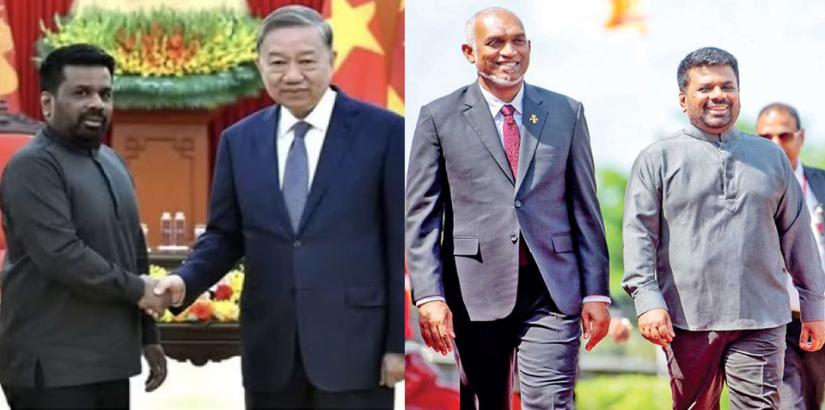
In a single week, Sri Lanka has hosted two strategically important leaders from the region, President Mohamed Muizzu of the Maldives and Vietnamese President Tô Lâm, signaling that the island-nation is emerging once again as a focal point in Indian Ocean diplomacy.
Sri Lanka, while grappling with local challenges ranging from low-quality coal, high-priced gas and suicides of suspects in major financial frauds, successfully boosted it’s international image in the field on international affairs, stressing the imperative of keeping the Indian Ocean region peaceful amidst increasing power rivalries.
President Muizzu’s state visit to Sri Lanka from May 3–6, followed immediately by President Tô Lâm’s visit on May 7–8, reflects Colombo’s renewed effort to build multisector partnerships across South and Southeast Asia.
The experiences of Vietnam, Maldives, and Sri Lanka show how ideology often yields to economic necessity. For these countries the security for freight navigation in the Indian Ocean is of extreme importance. While the official releases stated that the talks focused on trade, tourism, investment, and bilateral friendship, strategic analysts see a deeper understanding on maritime freight security, supply-chain resilience, and the need keep the Indian Ocean sea lanes free and peaceful.
New Cooperation Frameworks
Vietnam leader’s visit carries significance beyond diplomacy. President Tô Lâm’s Colombo stop came immediately after high-level talks in India, suggesting a broader Indo-Pacific strategic circuit. Sri Lankan and Vietnamese officials have highlighted logistics, trade, aviation connectivity, and investment as priority sectors. Agreement on direct flight connectivity between Colombo and Vietnamese cities was also signed during the visit.
Strategically, Vietnam brings experience as a major export and manufacturing hub, expertise in port-linked supply chains and interest in diversifying logistics routes into the Indian Ocean.
For Sri Lanka, whose location sits near one of the busiest East-West shipping corridors, cooperation with Vietnam could strengthen Colombo’s ambition to become a logistics and transshipment hub.
The visit of Vietnamese leader has generated fresh momentum and cooperation frameworks, delivering breakthroughs in key sectors, including trade, investment, agriculture, aviation, and logistics, via concrete agreements.
It also opened new avenues, particularly in the digital economy, innovation, and energy transition that match the development needs of both countries in the coming years.
Sri Lanka’s one and only southern neighbour, the Maldives, always maintained excellent relations and they were further consolidated by periodical visits by the leaders of the two countries. President Muizzu’s visit earlier this week, resulted in taking to bilateral economic cooperation to a new phase with the signing of several Memorandums of Understanding (MoUs).
Maritime Domain Awareness
The Maldives has long been a maritime partner of Sri Lanka. President Muizzu’s visit came amid growing regional focus on maritime domain awareness, fisheries protection, anti-smuggling operations, and commercial shipping security.
Sri Lanka and Maldives already share a history of maritime cooperation, including regional sea boundary agreements with India and security coordination. The results of the visit will expand cooperation in cargo route monitoring, port-to-port logistics integration, coastguard coordination and protection of freight movement against piracy, cyber disruption, and illegal drugs trafficking.
Nearly 80% of Asia’s energy imports and a large portion of global container traffic move through the Indian Ocean. With conflicts in the Middle East, disruptions in the Red Sea, and increasing great-power competition, freight security has become a strategic economic issue. Sri Lanka is positioning itself not merely as a recipient of investment, but as a regional connector between South Asia, Southeast Asia, and island maritime states.
Hence, the visits of Maldives and Vietnam presidents to Colombo signal the emergence of a new maritime dialogue, focused on securing shipping lanes, building alternative supply chains, coordinating port logistics and reducing dependence on single-power strategic blocs.
For Sri Lanka, still rebuilding economic credibility, maritime diplomacy may become as valuable as financial reform. In the geopolitics of the Indian Ocean, ports, shipping routes, and freight security are becoming the new currency of influence.
Greater Commercial Integration
Unlike Vietnam, Maldives did not emerge from Marxist revolution, but its political movements, including parties with social-democratic and left-leaning welfare commitments. Maldives also accepted market liberalization as essential. As a small island economy with limited natural resources, Maldives had little choice but to open itself to global tourism, foreign infrastructure investment, aviation partnerships, and service-sector growth. Successive governments, regardless of ideological branding, have recognized that tourism-driven capitalism, not state ownership, pays for welfare programs, education, and infrastructure.
Further strengthening cooperation, Maldives and Sri Lanka signed seven agreements focusing on key sectors including tourism, education, higher education, health, sports, youth development, archives, and defense.
President Muizzu attended the Maldives–Sri Lanka Business Forum, highlighting a move towards greater commercial integration and investment in sectors like technology, fisheries, and tourism. Discussions between President Dissanayake and President Muizzu prioritized regional security, counter-terrorism, and maritime cooperation in the Indian Ocean.
The discussions between the leaders during the visit highlighted the reality that in today’s context, even parties with Marxist or socialist roots will have to operate within that open economic framework. The debt crisis of 2022 reinforced a harsh reality: global finance, IMF-linked reforms, and investor confidence now shape economic choices more than ideological manifestos.
Vietnam, Maldives, and Sri Lanka may differ in geography, political systems, and history, but all three have reached a similar conclusion - that modern governance often means political control combined with economic openness with more Southeast Asia and South Asia linkages. .
(The author, a former Sri Lankan diplomat, is a political and strategic affairs commentator. Views expressed are personal. He can be reached at sugeeswara@gmail.com.)





Post a Comment