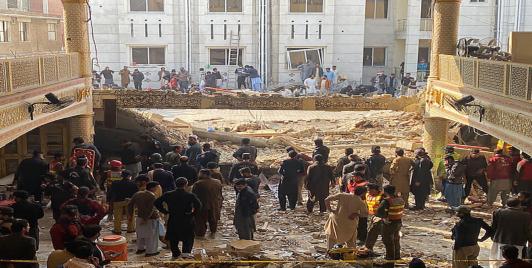
When Nawaz Sharif was Prime Minister, Aziz had hailed and justified the terror attack on the Army Public School in Peshawar, where scores of students and teachers were killed, writes Mahendra Ved for South Asia Monitor
More importantly, the alleged sabotage occurred during a period of political transition following the developments of August 2024. Institutional loyalties, political rivalries, and competing networks of influence continue to shape Bangladesh's political landscape. In such a context, any breach involving the Prime Minister's secure communications infrastructure deserves careful examination.
India's MSME sector, the backbone of its export economy, remains largely unequipped to navigate European standards and certification requirements. As ABC Live noted, the next stage will be tougher than negotiation: India must now prove that its exporters, MSMEs, regulators, ports, testing labs, and state governments can actually use the agreement. A framework signed in Gothenburg means nothing to a textile exporter in Tiruppur who cannot get a product certified to EU standards.
The central lesson is simple: unresolved India-Pakistan hostility weakens South Asia from within. It prevents trade, blocks institutions, raises nuclear risk, politicizes water, militarizes borders, and diverts attention from human development. Both countries will continue to disagree on major issues. But disagreement does not require permanent hostility. Strategic maturity means building rules to manage conflict before conflict manages the region.
The Quad's Critical Minerals Initiative provides an important platform for achieving these objectives. Through coordinated investments, technology sharing and supply-chain diversification, the initiative seeks to create resilient and transparent mineral supply networks. Australia contributes abundant mineral reserves, Japan offers advanced processing technologies, the United States brings investment and innovation capabilities, while India provides a rapidly expanding market and growing manufacturing base.
When Nawaz Sharif was Prime Minister, Aziz had hailed and justified the terror attack on the Army Public School in Peshawar, where scores of students and teachers were killed, writes Mahendra Ved for South Asia Monitor
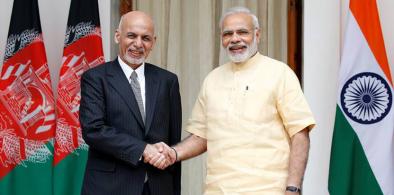
Ending the long war in Afghanistan and getting the boys back would help President Trump’s bid for a second presidential term but he may be creating a bigger Frankenstein in the combined Af-Pak region that would come to haunt America in the future, writes Lt Gen PC Katoch (retd.) for South Asia Monitor
For years Delhi government schools were known for their indifferent pedagogy, rundown buildings, large dropout percentages and were synonymous with all that was wrong with the country's public-sector education system, writes Tarun Basu for South Asia Monitor
Just before the American president sets course for India, a senior US official noted that the US wants an India that is strong with a capable military that supports peace, stability, and a rules-based order in the Indo-Pacific region, writes Cmde C Uday Bhaskar (retd) for South Asia Monitor
Having understood the American game plan, India acted swiftly to minimise the danger by ensuring that Pakistan did not get off the 'grey list' till its compliance is fully confirmed, writes Brig Anil Gupta (retd) for South Asia Monitor
The visit will be high on optics and low on substance as both Trump and Indian Prime Minister Narendra Modi seek relief from domestic pressures and revalidation before their citizens, writes Arul Louis for South Asia Monitor
The issue of polio eradication has taken a perilous form in Pakistan due to the deadly mixture of militancy and developmental issues, writes Sanchita Bhattacharya for South Asia Monitor

Technology collaboration by removing tariff and non-tariff barriers, specifically in the high technology segment, could be great lever of strategic and public policy partnerships for both countries, writes Kumar Deep (@kumar_deep) for South Asia Monitor

India may have jumped the rankings in The World Bank’s Ease of Doing Business but foreign and domestic investors seek improvements in the ease of doing business on the ground, especially in the states, writes N Chandra Mohan for South Asia Monitor

The 'tax charter' ushers India into a new era where the rights of taxpayers in terms of imposition and payment of taxes are recognized for the first time, writes Arun Anand for South Asia Monitor

India Inc’s confidence will certainly be boosted with a more transparent and non-adversarial tax regime and a business-friendly policy framework that improves the conditions for doing business on the ground, especially in the various states, writes N Chandra Mohan for South Asia Monitor

The IN has been at the forefront in supporting the country’s security and diplomatic initiatives in the region through extensive bilateral and multilateral interaction, writes Cmdre Anil Jai Singh (retd) for South Asia Monitor
If India has to progress towards deeper engagement under the ‘Neighborhood First’ policy, it has to integrate some of the genuine concerns of its strategic regional partners, writes Kumar Deep for South Asia Monitor
The enthusiasm Modi has shown towards the neighbourhood, through his numerous visits has not got translated in overall policy during these years, writes Alakh Ranjan for South Asia Monitor
Fracturing political institutions like the Election Commission, Parliament and the Judiciary are also responsible for the popular apathy and political decay in Bangladesh, writes Akmal Hossain for South Asia Monitor