

Reimagining India-Canada Relations: Towards a Mutually Beneficial Relationship for Wider Public Good
Canada hosts close to 1.9 million persons of Indian Origin (PIOs) and 3% of Canada’s population, one of the largest ethnic groups in Canada’s multiethnic and multicultural society. Although immigration policy of Canada has tightened in recent years, yet a lot of students who study in Canada prefer to stay back and work in Canada acquiring permanent residency and citizenship.
 Oct 09, 2026
From a historical perspective, the impact of Komagata Maru (1914) and the Ghadar Movement (1913) were seminal events as those major landmark markers fuelled intense anti-British sentiments among the Indian diasporas and its sympathizers in Canada and which culminated in India achieving independence from the British colonial rule in 1947. India and Canada established diplomatic relations the same year itself. Both countries have adopted federal structure in their constitutional framework as its main corner pieces. Both India and Canada are members of several multilateral bodies including G-20, Commonwealth of Nations, UN, and other bodies.
India has consistently received generous financial packages from Canada including from the Colombo Plan. Although relations have witnessed some down sliding, such as over 1974’s India’s Pokhran-1 Peaceful Nuclear Explosion project, 1998 Pokhran-2 nuclear explosions tests by India and subsequent economic sanctions that was imposed by Canada, the 2023 announcement by then Canadian Prime Minister Justin Trudeau in the House of Commons of India’s involvement in the killing of a Canadian as a ‘credible allegation’ and India dubbing it as ‘absurd and motivated.’
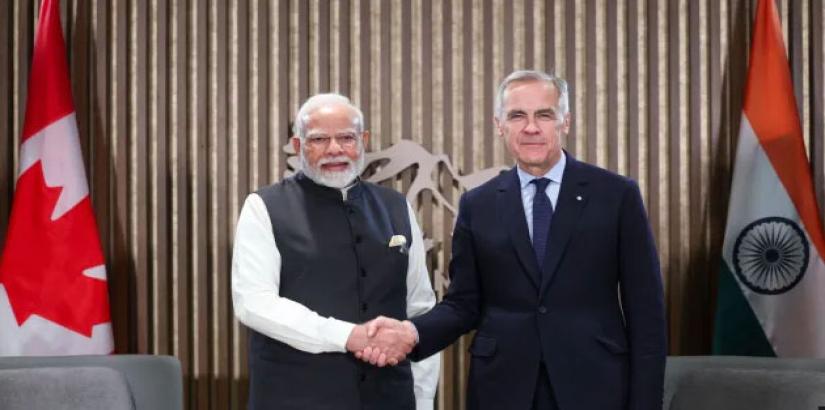
Mark Carney’s assumption as prime minister in March 2025 has brought India-Canada relations to its basics by forging a closer partnership in recent times. September 2025 G7 meeting in which PM Carney and PM Modi met in Kananaskis, Alberta, facilitated in understanding each other’s perspectives better and in emphasizing on the areas of convergence and deliverables. Carney’s visit to India in February-March 2026 can be considered as a value multiplier in the right direction.
Enhanced Trajectory in Trade and Commerce
In 2024, India was Canada’s seventh-largest goods and services trading partner, with two-way trade coming to $30.4 billion while more than 600 Canadian firms currently operate in India. Both nations aim to grow bilateral trade significantly to a $50 billion target by 2030. Canada considers India to be a reliable trading partner given its status rising to the fourth rank just after USA, China, and Germany.
Canada in sync with India also has similar ‘open, inclusive’ priority in the Indo-Pacific theatre in order to make the latter region as Canada’s second largest regional export market trading partner after the US. India can also tap into Canada’s vast trade potential as Canada has consistently figured among the top ten among the largest economies in the world with a projected 2026 GDP of approximately in the range of $2-4 trillion. Bilateral trade in services between India and Canada is approximately CAD$ 19.61 billion with potential for immense growth in areas such as pharmaceuticals, textiles from India, and from Canada: energy, critical minerals, pulses and timbers. Two-way trade remains substantial, approx. CAD 30-33 billion in 2024/2025. Comprehensive Economic Partnership Agreement (CEPA) that is being currently negotiated between India and Canada and is in its final leg is likely to give further fillip to multiple sectors including infrastructure, clean energy, bio energy, solar wind, textile, engineering goods, chemicals, semiconductors, agri-food and automotive, electric vehicles, digital and fintech, etc.
Further collaboration can expand across other areas as well such as in crude oil, LNG, LPG, uranium, and hydrogen and through Canada’s proactive participation in the International Solar Alliance and Global Biofuel Alliance as a full member. Canada can also help India in India’s critical minerals value chain, through sustainable development, enhanced market access, intellectual property protection and joint ventures in exploration, battery manufacturing, sharing refining technologies, downstream industries, digital trade, and in having a mutually beneficial resilient supply chain through strategic investment in core areas.
Indian Diaspora and Cultural Interactions
Canada hosts close to 1.9 million persons of Indian Origin (PIOs) and 3% of Canada’s population, one of the largest ethnic groups in Canada’s multiethnic and multicultural society. Although immigration policy of Canada has tightened in recent years, yet a lot of students who study in Canada prefer to stay back and work in Canada acquiring permanent residency and citizenship. There are several major cities in Canada such as Greater Toronto, Vancouver, Ottawa, Montreal, Winnipeg, Saskatoon, Halifax, Edmonton, Calgary, etc.; which have ‘Little India’ exclusive ethnic enclaves catering to the educational, community and cultural needs of the Indian diaspora residing in Canada.
In this context, it is worth noting that Canada became the first country to officially adopt a multicultural policy in 1971 and which subsequently resulted in the passage of Multiculturalism Act in 1988. There are several Canadian Indian major ethnic associations in operations along with various immigrants hailing from various Indian states across religions, customs and languages. In Vancouver, British Columbia, alone, some 800,000 Sikhs live, which by itself is the largest Sikh diaspora living outside the Indian state of Punjab. Indian cultural festivals and events take place regularly including in the Panorama India Day Parade in Toronto, Namaste Canada in Ottawa and Indian Consulates in Toronto and Vancouver.
A number of high-profile persons of Indian origin have excelled in the Canadian federal polity too including the current foreign minister, Anita Anand. In the cultural arena, areas of creative cooperation have increased manifold including in creative arts, heritage, audiovisual media, music, films, and theatre. Canada Post has issued Diwali stamps including in 2025 commemorative issues featuring a rangoli motif.
Collaborations in the Education Sector
In spite of some decline in the number of Indian students’ entry into Canada in recent years due to high living costs, visa caps, strained diplomatic ties, housing shortages, social tensions at the macro level; overall, India’s student population constitute a major chunk of foreign students in Canadian universities and institutes. India is Canada’s largest source country of most immigration categories including 392,810 study permit holders from India including students graduating from various Canadian universities. More than a quarter of new permanent residents arriving in Canada in 2024 and 2025 were also from India. Indian academics have excelled in a diverse range of research arenas including in developing patents in record number.
As part of India’s New Education Policy, NEP-2020, Indian universities including IITs will be inclined to set up campuses in Canada for greater synergy in education, advanced and cutting-edge research. Shastri Indo-Canadian Institute (SICI, created in 1968, does play a pivotal role in enhancing student-faculty mobility program as well as in organizing capacity-building workshops in affiliated universities of both India and Canada.
ICCR Chairs have been established in major universities such as Alberta, McGill, SFU, Calgary, and Guelph for fostering academic and research exchange. During Canada’s Prime minister Mark Carney’s visit to India, February 27- March 2, Canada-India Talent and Innovation Strategy was launched to support academic mobility through joint and dual-degree programs, Innovation Centers in industry-aligned skills, and research collaborations in multiple cutting edge areas in emerging technologies. This was further reinforced by PM Modi when he met PM Carney in Evian, France, on 16 June 2026 on the sidelines of the G7 summit to fast track various areas of cooperation and exchange.
Tapping AI and High-End Technology
In the field of Artificial Intelligence, Canada is considered as one of the leading countries of the world in providing necessary technology. Canada hosts about 10 percent of the world’s top notch AI researchers, the second highest concentration globally. Canada ranks first among the G7 group of nations in AI research publications as per capita. Canadian Institute for Advanced Research (CIFAR) with major hubs in Toronto, Montreal, Calgary and Edmonton, and which employs a number of researchers from India, is considered as a major center for AI and digital related research activities. Over the years, CIFAR has pioneered in the fields of AI-assisted tools for health care, logistics for small ports, space and aerospace technologies, workforce training, intellectual property strategies, sustainability in greener manufacturing, etc.
India, too, is advancing rapidly as an AI hub through the India AI Mission 2024 which was allocated $ 1.6 billion over five years to build world’s largest AI Dataset Platform for providing access to create established centers of excellence in agriculture, healthcare, and sustainable cities. India is also developing BharatGen (a multimodal LLM), Sarvam -1 and Avatar-AI for India’s multilingual and governance application. AI is also being integrated into India’s digital public infrastructure such as Aadhar, Unified Payment Interface, enabling large-scale applications in governance and citizen services. In 2025, India co-chaired the AI Action Summit, underscoring its role in shaping international AI governance. India -AI Impact Summit of 2026 further reinforced India’s commitment to enhance all aspects of AI’s research and development. Challenges remain though in areas such as data privacy concerns, divergent digital governance models, cyber risks, sensitivities surrounding defense applications, etc. In this regard, Canada’s inherent strengths in governance and sustainable infrastructure may provide an appropriate compliment to India’s stride towards AI-related technology.
India-Canada Collaboration in Critical Minerals
India endorsed the G7 Critical Minerals Action Plan in 2025, opening the door for deeper, more embedded bilateral collaboration in trade, research and technology in order to strengthen resilient critical minerals value chains. Of the 34 minerals identified by Canada as ‘critical’, 22 out of those also appear on India’s priority critical mineral list, including graphite, lithium, nickel, cobalt, copper. In this regard, Canada has to do a lot more as Canada’s mineral exports to India count for just 2 percent. Potash, Canada’s largest critical mineral export to India, has declined sharply in value from CAD $ 966 million in 2022 to CAD $ 571 million in 2023 and CAD $ 402 million in 2024. For both India and Canada, collaboration in critical minerals are essential for renewable energy techniques as used in solar panels and wind turbines.
The Future Roadmap
As both India and Canada have many commonalities and convergences on global, regional, and bilateral issues of concern, there is room for further consolidation and synergy in taking this relationship to greater heights in niche areas such as AI, green hydrogen, critical minerals, micro electrics, biofuels, climate-resistant agriculture, marine and space research.
Although there will likely be global tumult of one kind or the other in the short to medium term, what is important is to have a more feasible, practical, doable, pragmatic and sustainable roadmap by both India and Canada, reaching out to one another for wider public good and synergy and by enhancing their mutually beneficial relationship to greater heights.
(The author is formerly, Director of Research; Professor and Head, Department of Political Science, Faculty of Social Sciences, Jamia Millia Islamia University, New Delhi. The views expressed are personal. He can be contacted at mbalam786@gmail.com )







Post a Comment