

India's Push-In Policy on Suspected Illegal Immigrants: Need to Mitigate Human Suffering
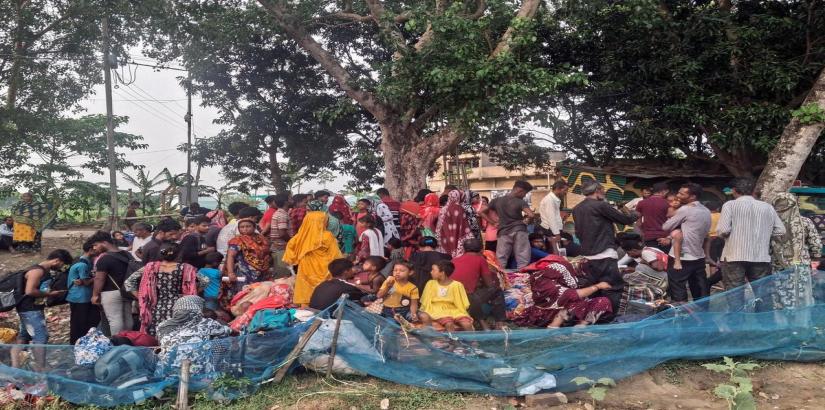
Over the past two months, a series of alleged push-in incidents along the Bangladesh-India border has reportedly left scores of people stranded in zero-line and no-man's-land areas under difficult conditions.
 Jun 22, 2026
Humanitarian concerns do not always align neatly with legal and political boundaries. However, recent developments along the India-Bangladesh border have raised serious humanitarian concerns and prompted questions about the compatibility of certain border management practices with international legal and humanitarian norms.
India reportedly pushed back at least 2,369 people between May 2025 and January 2026, among them 126 Indian nationals and 38 people from Myanmar. Indian authorities have described these actions as legal procedures involving alleged Bangladeshi immigrants, but critics have questioned both the identification process and the legal basis of some of these operations.
Bangladesh and India have traditionally enjoyed close ties, although bilateral relations have become more strained since the mass uprising in Bangladesh in August 2024. Against this backdrop, India's push-back approach, a practice more commonly associated with some American and European border management systems, has drawn increased attention to the handling of migration issues along the Bangladesh-India border.
Understanding Push-Back Policy
The "push-back" policy, often referred to as "push-ins" by Bangladesh, describes India's practice of informally and forcibly returning undocumented migrants, suspected illegal immigrants and refugees across the border into Bangladesh without going through formal and often lengthy deportation procedures.
The origins of this policy can be traced to India's long-standing concerns over undocumented migration from Bangladesh, but it gained significant momentum in the mid-2020s amid heightened political and security debates.
In May 2025, Assam Chief Minister Himanta Biswa Sarma publicly stated that India had adopted a new "push-back" strategy against alleged illegal immigrants, describing it as an alternative to lengthy deportation procedures.
The policy was intended to deter future illegal migration and address what New Delhi views as administrative obstacles in the deportation process. India has primarily applied this approach to Bangladesh because Indian authorities have long considered undocumented migration from Bangladesh a major border management and security challenge.
However, critics argue that its implementation has become problematic, particularly amid allegations of wrongful identification, forceful deportations and even instances involving Indian citizens.
Humanitarian Consequences
An important question that emerges is whether India can avoid responsibility for the humanitarian consequences arising from such actions.
If individuals are pushed across borders without proper verification of nationality, due process or adequate coordination with Bangladesh, concerns inevitably arise regarding humanitarian responsibilities.
International law and basic humanitarian principles require that all individuals be treated with dignity and protected from arbitrary expulsion. When people are forcibly displaced without adequate legal procedures, they may face family separation, insecurity, displacement and the denial of essential services.
Over the past two months, a series of alleged push-in incidents along the Bangladesh-India border has reportedly left scores of people stranded in zero-line and no-man's-land areas under difficult conditions.
Reports indicate that at least 88 people, including women and children, were left stranded near border points in Lalmonirhat, Panchagarh, Naogaon and Chapainawabganj. Separate incidents were also reported in Thakurgaon, Jashore (Benapole) and other frontier districts last month.
Many of these individuals reportedly spent between 48 and 72 hours in exposed border areas without adequate shelter, food, medical assistance or legal certainty regarding their status.
Human rights groups have expressed concern that forcing people to remain in zero-line areas, irrespective of nationality, risks creating a humanitarian crisis and undermines established repatriation mechanisms between the two neighbouring countries.
The growing number of such incidents has also added strain to bilateral relations and intensified concerns over the protection of vulnerable civilians caught between competing border policies.
Among the reported incidents, the push-in that took place on 14 June through the Goykata border in Roumari Upazila of Kurigram district was particularly distressing. The group reportedly included men, women and even a six-month-old infant, highlighting the human cost associated with such actions.
As the state initiating these measures, India has a responsibility to ensure that border management practices do not create avoidable humanitarian suffering or violate internationally accepted norms. Legitimate security concerns do not absolve any country from following lawful and humane procedures when dealing with migrants or suspected undocumented persons.
International Legal Dimensions
India's push-back policy, insofar as it involves the forcible return of individuals without due process, may raise serious questions under international law.
Such actions could potentially conflict with the principle of non-refoulement, a cornerstone of customary international law that is reflected in the 1951 Refugee Convention and prohibits returning individuals to places where they may face persecution or serious harm.
There may also be implications under the Universal Declaration of Human Rights and the International Covenant on Civil and Political Rights, particularly regarding the rights to life, liberty, security and protection from arbitrary expulsion.
Need for Bilateral Cooperation
Bangladesh, as an affected state, may continue to address the issue through diplomatic channels, seek discussions in relevant United Nations forums, engage international human rights mechanisms and call for independent monitoring of border practices.
Human rights organisations and international bodies also have an important role to play in documenting incidents and advocating accountability in accordance with international legal standards.
Ultimately, border management challenges cannot be resolved through unilateral actions that generate humanitarian distress. Sustainable solutions will require stronger cooperation between India and Bangladesh, improved verification mechanisms and adherence to established legal procedures.
Failure to strengthen bilateral coordination risks further exacerbating humanitarian challenges and tensions along one of South Asia's most sensitive borders.
(The author is a foreign policy and security analyst and educator who holds a postgraduate degree from the Department of International Relations, Rajshahi University, Bangladesh. Views expressed are personal. He can be contacted at: alaminislamshuvo16@gmail.com.)





Post a Comment