

The Architecture of Disruption: Structural Parallels Between Indira Gandhi and Donald Trump
For democracies under pressure, the lesson is sobering. Institutions do not only collapse when attacked from outside; they can also be hollowed out from within by leaders who master the language of mass appeal better than the language of internal restraint.
 Aug 07, 2026
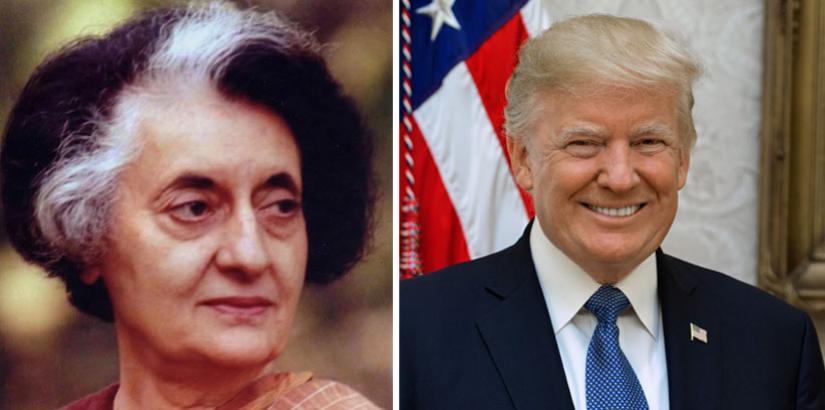
In an era often reduced to ideological labels, a structural lens can reveal how political power is actually seized and consolidated. The careers of Indira Gandhi and Donald Trump suggest that charismatic leaders can, under certain conditions, disrupt and reshape major legacy parties from within.
As a teenager in India in 1969, I witnessed Prime Minister Indira Gandhi challenge the Congress Party’s powerful "syndicate". Decades later, I observed Donald Trump mount a similar insurgency against the Republican establishment. While the institutional settings were very different, both cases show how party gatekeepers can misread the scale of a leader’s appeal.
Same Political Pattern, Elite Miscalculation
In India, the immediate rupture came during the presidential contest of 1969. Indira Gandhi backed V. V. Giri, whose victory sharpened her clash with the party old guard and helped trigger the split in Congress. The dispute was not merely about one election. It reflected a deeper contest over whether a prime minister would remain answerable to party elites or begin to dominate the party itself.
That same pattern of elite miscalculation appeared in the United States nearly half a century later. Republican donors and party leaders initially treated Trump as a temporary disturbance, not a durable force. Yet Trump challenged party orthodoxy on trade, immigration, and foreign policy so aggressively that the Republican coalition itself began to fracture. What looked like a passing rebellion became a durable realignment because Trump understood that party discontent could be converted into a direct personal mandate.
When constrained by their respective establishments, both leaders turned directly to the public. Gandhi’s “Garibi Hatao” campaign helped her overcome the “Indira Hatao” alliance in 1971 and broadened her mandate well beyond the party organization. Trump likewise mobilized working-class voters who felt displaced by globalization and cultural change, building loyalty that often bypassed traditional party brokers.
Support From Voters, Internal Conquest
This shift also changed the emotional logic of politics. Once a leader can claim a direct bond with voters, internal party resistance no longer looks like ordinary disagreement; it begins to look like obstruction. That is one reason both leaders were able to present themselves as outsiders even while operating inside powerful institutions. The party became less important as an organization and more important as a vehicle for identity, grievance, and symbolic struggle.
This direct appeal mattered because it changed the source of legitimacy. For both leaders, support from voters became more important than approval from party elders. That shift allowed them to argue, implicitly or explicitly, that they represented the “real” public while the internal party establishment stood in the way.
Personal Loyalty, Populist Disruption
A second parallel lies in the centralization of authority. After her decisive victory, Gandhi consolidated power around herself through the “New Congress,” making personal loyalty more important than old factional ties. Trump, though operating in a different system, similarly weakened the influence of traditional Republican factions and turned the party into a far more personality-driven organization.
This is where the comparison becomes most revealing. Gandhi did not create a new movement from scratch; she captured and redirected a historic party. Trump, too, did not build a new party; he transformed an existing one by forcing it to revolve around his coalition and style. That kind of internal conquest of a legacy institution is uncommon in democratic politics.
The legal and institutional backlash each leader faced also became politically useful. Gandhi’s post-Emergency troubles allowed her to frame opposition as elite resistance to a popular mandate, a theme that aided her later comeback. Trump, in turn, has converted investigations, indictments, and other legal pressures into evidence of establishment hostility in the eyes of many supporters. In both cases, conflict with institutions strengthened the emotional bond between leader and base.
A further parallel is that both cases reveal how quickly institutions can lose their authority when they appear detached from public sentiment. Party elites often assume that procedure, seniority, and precedent will preserve control. But when a leader taps a deeper social mood, those formal advantages can weaken rapidly. In that sense, the real contest is not simply between one leader and one faction. It is between an old internal order and a new form of mass legitimacy.
The comparison also helps explain why populist disruption can be so durable. A leader who speaks directly to voters, absorbs the language of grievance, and turns conflict into proof of authenticity can often outlast internal opposition. That is true whether the party is the historic Congress of the Nehru-Gandhi era or the Republican Party of Lincoln and Reagan. In both cases, the leader’s authority grows not because institutions are strong, but because institutions fail to defend their own legitimacy.
There is, of course, an important limit to the analogy. Gandhi and Trump operated in very different political systems, faced different constraints, and left behind very different legacies. Gandhi presided over a parliamentary democracy with a dominant-party tradition; Trump emerged in a polarized presidential system with far greater media fragmentation. Even so, the structural pattern is instructive.
Misreading Public Sentiment
For democracies under pressure, the lesson is sobering. Institutions do not only collapse when attacked from outside; they can also be hollowed out from within by leaders who master the language of mass appeal better than the language of internal restraint.
Indira Gandhi and Donald Trump each showed, in their own political worlds, how disruption becomes most powerful when it captures the machinery it is supposed to challenge. That is why the study of such figures should not stop at ideology or personality; it should ask how parties lose internal balance, how gatekeepers misread public sentiment, and how charismatic leaders convert crisis into enduring control.
(The author is Director, Reddy Center for Critical and Integrated Thinking. A former R&D executive holding 30 U.S. patents, he focuses on the analysis of human behavior, public health, and global affairs, drawing on an interdisciplinary background. The views expressed are personal. He can be reached at mpreddy54@yahoo.com, mpreddyinsights.com, https://lnkd.in/gn2zQJbs )





Post a Comment