

China-US: Rivalry, Restraint, a New Equilibrium - and an Emerging Geopolitical Order
BRICS is acquiring greater visibility, while countries of the Global South continue to seek a greater voice in the international system. The desire for a more multipolar world is becoming increasingly evident. Over the next decade, this could produce a geopolitical configuration rather different from the one we have known since the end of the Cold War.
 Sep 26, 2026
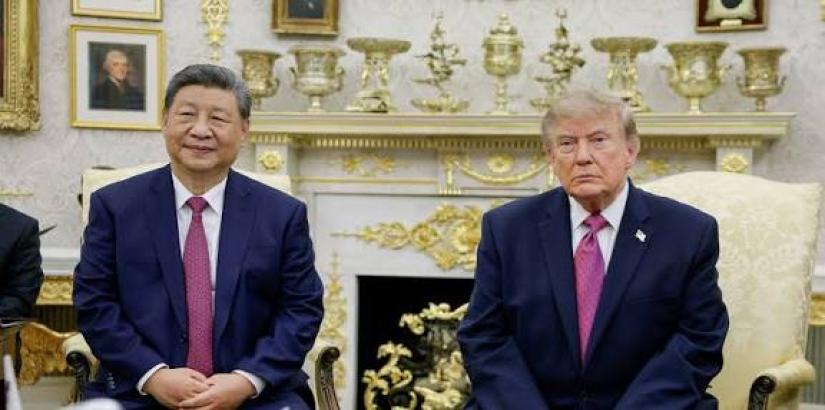
China and the United States are fundamentally different in their political and ideological systems. Yet, economically, technologically and strategically, neither can afford to ignore the other. The two countries are too deeply intertwined and too consequential to the world economy to treat each other as anything less than major powers.
This makes the China - US relationship rather different from the US–Soviet relationship during the Cold War. The Soviet Union and the United States were ideological adversaries with relatively limited economic interdependence. China and the US, in contrast, are competitors whose economies remain deeply connected.
This does not mean that cooperation has replaced rivalry. Far from it. Technology, artificial intelligence, trade, investment, supply chains, critical minerals and strategic influence have all become areas of competition.
The recent Trump-Xi summit in Washington has once again brought this complicated relationship into focus.
The Summit: Optics and Substance
The summit was heavy on ceremony and symbolism. Xi Jinping received an elaborate welcome, including a military review and a state dinner. The White House clearly placed considerable emphasis on the optics of treating the Chinese President as an important state guest.
Trump, who has often been openly hostile to communism, rolled out the red carpet for the leader of Communist China. The red carpet was, of course, literally there for the visiting president - but there was perhaps a little more symbolism in that colour than meets the eye.
There was, however, little in the way of a dramatic breakthrough. The two sides extended their trade truce, while issues such as tariffs, rare-earth supplies, technology restrictions, agricultural purchases and investment remain subjects of negotiation. Artificial intelligence also featured prominently in the discussions.
The biggest headline, in a sense, was simply that they met. That itself is significant.
Neither Washington nor Beijing appears to want direct confrontation. Both have too much at stake. The economic consequences of a serious conflict would extend far beyond the two countries and affect the global economy.
The summit therefore looked less like a grand settlement and more like an attempt to keep the relationship under control.
Xi wanted China to be treated as an equal major power. Trump, for whatever reason, played along with that requirement. The elaborate welcome gave Xi the visuals he could take back to his constituency and project to the world.
The media arrangements around the visit also attracted attention. CNN, MS NOW and Politico were among the organisations initially excluded from covering the visit, although the restrictions were subsequently challenged in court and the organisations were readmitted.
Whatever the calculations behind the decision, the effect was that the domestic American television coverage of the visit was different from what might normally have been expected for a summit of this importance.
Whether calculated or not, the optics were clearly part of the summit. But optics apart, the substantive message was more restrained. There was no dramatic joint declaration announcing a new strategic relationship. Nor was there any indication that the fundamental differences between the two countries had disappeared.
The two leaders may therefore continue to circle each other in the ring, watching for a kink in the other's guard, without actually landing punches.
What the Summit Tells Us
The more important question is what it tells us about the larger China-US relationship. The relationship may be moving towards what could be described as competitive coexistence.
It is neither a new Cold War nor a genuine strategic reset. It is a recognition that competition and coexistence have to continue simultaneously.
China and the United States have different political systems, different strategic objectives and different visions of the international order. Yet neither can realistically wish away the other.
China has been emphasising the idea that the relationship need not be zero-sum. Trade, investment, technology sharing and people-to-people exchanges can, in China's formulation, create benefits for both sides.
The US concern, however, is not simply whether trade takes place. It is about whether the relationship is fair and reciprocal. This is where the real contest lies.
Technology is one major arena. Artificial intelligence is another. Semiconductor technology, computing capability, and access to advanced technologies are increasingly intertwined with economic and strategic power.
Critical minerals are another. China has considerable leverage through its position in the processing and supply chains of rare earths and other critical minerals. That gives Beijing an important card in negotiations with Washington.
China is therefore holding some significant cards - particularly through its leverage over critical minerals and global supply chains.
But the United States also holds major cards.
Its technological ecosystem remains powerful. The US financial system continues to occupy a central position in the global economy. The dollar remains the dominant international reserve and transaction currency.
At the same time, the growing efforts by China and BRICS countries to reduce dependence on the dollar in international trade deserve attention.
The issue is not whether the dollar will suddenly disappear. That is unlikely. The issue is whether the gradual development of alternative arrangements can, over time, dilute the degree of dependence on the dollar.
For the United States, this question assumes greater importance because of its very large and continuing debt burden.
Thus, the China-US contest is not confined to tariffs or bilateral trade. It is a much wider contest involving technology, finance, supply chains, resources, investment and influence. Neither country can afford an uncontrolled confrontation. That is probably why the relationship keeps oscillating between confrontation and accommodation. A tariff dispute is followed by negotiations.
Restrictions on technology are followed by attempts to create exceptions. Competition over critical minerals is followed by discussions on supply. Strategic disagreements continue even as trade and investment remain important.
This is not a relationship based on trust. It is a relationship based increasingly on an understanding of mutual dependence and mutual vulnerability. And that may be the most important message from the summit.
The BRICS and India Dimension
The larger equation becomes even more interesting when India is brought into the picture. The United States has close relationships with Japan, South Korea and Australia, all of which are geographically and strategically connected to China's immediate neighbourhood. Their interests and security concerns inevitably add another layer to the China-US equation.
India occupies a somewhat different position. India is a member of the QUAD along with the United States, Japan and Australia. But QUAD is not a military alliance.
At the same time, India's strategic autonomy gives it room to maintain relationships with different major powers while pursuing its own interests.
India's relationship with China has also been showing signs of a thaw after several years of serious tension. That does not mean that all differences have disappeared. But the possibility of stabilising the relationship creates a different strategic environment for India.
There is another development that should not be overlooked.
BRICS is acquiring greater visibility, while countries of the Global South continue to seek a greater voice in the international system. The desire for a more multipolar world is becoming increasingly evident. Over the next decade, this could produce a geopolitical configuration rather different from the one we have known since the end of the Cold War.
The China-US relationship will remain central to that configuration. But it will not necessarily be the only defining relationship.
India's relationship with China, its relationship with the United States, its role in the QUAD, its engagement with BRICS and its broader relationship with the Global South could all become important elements of the emerging order.
Managing Rather Than Settling
The Washington summit may therefore be seen less as a settlement and more as another step in managing a relationship that neither side can afford to break. China and the United States will continue to compete. They will also continue to need each other.
That is the paradox and perhaps the reality - of competitive coexistence.
(The author is an Indian Army veteran and a contemporary affairs commentator. The views are personal. He can be reached at kl.viswanathan@gmail.com )





Post a Comment