

The Mecca Joint Defense Agreement: What It Means for South Asia
New Delhi’s official response has been measured, almost pointedly so, a statement that India is “looking into the implications” rather than any dramatic condemnation. That restraint is wise, and should be read as strength rather than uncertainty. India’s ties with Saudi Arabia are too economically consequential, too carefully cultivated over the past decade, for Riyadh to jeopardize them by handing Pakistan a blank check.
 Aug 19, 2026
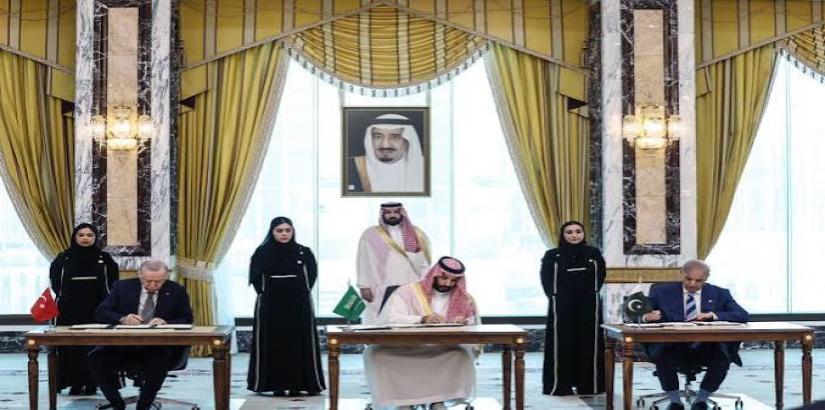
On August 7, 2026, in the holy city of Mecca, three flags were raised together in a way the region had not quite seen before. Saudi Crown Prince Mohammed bin Salman, Turkish President Recep Tayyip Erdoğan, and Pakistani Prime Minister Shehbaz Sharif signed the Mecca Joint Defense Agreement, declaring that an armed attack on any one of the three states would be treated as an attack on all three. Islamabad and Riyadh lit up their skylines in each other’s colors that night, and Pakistani commentary could barely contain itself. This was spoken of as a civilizational moment, the Muslim world finally standing shoulder to shoulder.
Strip away the pageantry, though, and what remains is a document that will quietly reshape South Asia’s strategic map for years. Not because it declares war on anyone, but because of what it signals about who Pakistan is becoming, and what India, Bangladesh, and the rest of the region must now think through carefully, without panic or wishful thinking.
The SMDA Prelude
On September 17, 2025, Saudi Arabia and Pakistan signed the Strategic Mutual Defense Agreement (SMDA) in Riyadh, with almost identical language: “any aggression against either country shall be considered an aggression against both.” That was the real turning point.
Eight days before that signing, Israel struck Hamas negotiators inside Doha, Qatar, a country hosting the largest American military base in the Middle East, attacking on its soil while Washington did nothing to stop it and little afterward to punish it.
For Gulf capitals, that was the moment the illusion cracked. If Qatar, under an American umbrella with over ten thousand US troops on its soil, could be struck without consequence, what was that umbrella actually worth? Riyadh drew its conclusion fast and reached for the one Muslim-majority state with a standing army built for exactly this anxiety and, unspoken but never absent from the conversation, nuclear weapons: Pakistan.
The SMDA formalized a relationship seven decades in the making, Pakistani officers training Saudi forces since the 1960s; Pakistani special forces helping put down the 1979 Grand Mosque siege; Pakistani troops periodically stationed in the Kingdom ever since. What changed was not the friendship. What changed was that Riyadh needed, publicly and urgently, to show Washington it had options. Mecca, eleven months later, simply widened that circle to include Turkey and gave the arrangement a grander stage. Anyone reading Mecca without the SMDA behind it is reading the second chapter of a book and calling it the whole story.
Hedging, Not Brotherhood
The broader pattern is unmistakable once you see it laid out. Gulf states have spent the past year watching American guarantees look increasingly conditional, Doha struck, Saudi Arabia absorbing missile and drone attacks from Iran and its allies, Washington offering sympathy more readily than shields under a transactional presidency more interested in deals than defense commitments.
Riyadh’s answer was redundancy: first bilaterally with Pakistan through the SMDA, then trilaterally in Mecca by pulling in Turkey, whose drones and NATO-trained military have already proven themselves in Libya, Syria, and Nagorno-Karabakh.
The pact has invited comparisons with an “Islamic NATO.” It would be premature to brand it a Muslim alliance or, more narrowly, a Sunni one. Saudi Arabia brings money and energy leverage. Turkey brings drones and defense-industrial muscle. Pakistan brings battle-hardened manpower and, again, the one thing the other two conspicuously lack. Analysts are right that the agreement does not formally extend Pakistan’s nuclear umbrella to Riyadh or Ankara. Pakistan’s own defense establishment has been careful on this point. But intentions written into a treaty text are not the same as perceptions formed in a region’s collective imagination, and in South Asia, perceptions move markets, militaries, and elections just as forcefully as facts do.
What Pakistan Gains
The Mecca Joint Defense Agreement with Saudi Arabia and Turkey offers Pakistan important strategic gains, particularly in the Middle East. The pact strengthens Islamabad’s position in the region, expands defense cooperation, and could create opportunities for arms deals and deeper military partnerships with Turkey and other Muslim-majority states. It may also increase Pakistan’s relevance to Washington by contributing to regional deterrence and burden-sharing.
The agreement’s benefits for Pakistan’s immediate neighborhood, however, are less straightforward, a question worth returning to once the case for the pact has been made in full. For Pakistan, Mecca is the SMDA’s sequel and a genuine diplomatic achievement on its own terms. It lets Islamabad tell a story about itself it has wanted to tell for a long time: not a country defined by its rivalry with India, not a state perpetually asking others for bailouts, but a security provider courted rather than courting. Field Marshal Asim Munir, who has driven much of this assertive turn since the Doha strike, has real reason to feel vindicated. The economic upside matters too. Deeper Saudi investment and defense contracts tend to follow closer military ties, and Pakistan’s fragile economy needs every lever it can get.
But here is the question Pakistani strategists keep sidestepping, and it deserves to be asked plainly: what happens the next time an India-Pakistan crisis erupts, as it periodically does, and Islamabad discovers its new partners were never obligated and almost certainly unwilling to intervene militarily against a nuclear-armed neighbor on its behalf? Although the pact reportedly treats an attack on one member as an attack on all, both pacts are in practice framed around external aggression, not South Asian rivalries.
Riyadh has too much riding on New Delhi, trade, and roughly 2.7 million Indian workers whose remittances flow home from the Kingdom, to risk any of it over Kashmir. Turkey, for its part, has little interest in being drawn into a conflict between two nuclear-armed South Asian rivals. So Pakistan gains prestige and economic breathing room. What it does not gain is additional protection against the one adversary its doctrine has been built around for seventy-five years.
That gap between symbolism and substance need not mean the pact is hollow, only that its usefulness lies elsewhere. Mecca may prove most valuable not as a shield against India but as a diplomatic instrument closer to home, encouraging Saudi and Turkish mediation in Pakistan's disputes with Afghanistan, where Islamabad’s leverage has been thinner than its rhetoric. If that is where the agreement ultimately delivers, it will have done something real for Pakistan. It just will not be the thing Rawalpindi’s deepest anxieties are actually about.
India’s Calculated Calm
Predictably, the Mecca Agreement has provoked a strong reaction from Israel’s right-wing government, which sees it as a serious security threat, while India, concerned about Pakistan’s key role in the trilateral pact, has reportedly deepened its security cooperation with Israel. On August 7, the day the agreement was signed, Indian Prime Minister Narendra Modi and Israeli Prime Minister Benjamin Netanyahu discussed their Special Strategic Partnership by phone, reportedly recognizing a shared strategic challenge from a bloc combining Saudi money, Turkish technology and a nuclear-armed Pakistan, alongside Islamabad’s deepening defense relationship with Beijing.
New Delhi’s official response has been measured, almost pointedly so, a statement that India is “looking into the implications” rather than any dramatic condemnation. That restraint is wise, and should be read as strength rather than uncertainty. India’s ties with Saudi Arabia are too economically consequential, too carefully cultivated over the past decade, for Riyadh to jeopardize them by handing Pakistan a blank check.
What should genuinely concern New Delhi is not a phantom nuclear extension but the slower effects: deeper defense-industrial cooperation improving Pakistan’s conventional capabilities over time, and Pakistan’s naval presence in the Arabian Sea growing more entangled with Saudi and Turkish interests, complicating India’s ambition to be the Indian Ocean’s principal security guarantor.
However, India should not assume the pact is directed against it. The three signatories have created a valuable political and economic shield. During a future India-Pakistan crisis, uncertainty over what constitutes an attack on Pakistan could complicate New Delhi’s calculations though Riyadh and Ankara have no intention of becoming involved.
Riyadh maintains strong energy, investment and political ties with New Delhi and has incentives to avoid importing South Asian rivalry into Gulf security. Ankara, too, would follow the similar trajectory ahead. A measured response involving influence in Riyadh, seeking consultation on Pakistan-related contingencies, deep economic engagement in the Gulf, and proper defense innovation at home would best serve India’s interest.
View From Dhaka and Beyond
For Bangladesh and the smaller states of South Asia, the Mecca agreement is a reminder of an uncomfortable truth: the region’s security architecture is no longer being written solely, or even primarily, in South Asian capitals. It is being shaped in Riyadh and Ankara, with South Asian states reacting rather than authoring. Bangladesh’s own post-2024 recalibration, such as its warming ties with Pakistan and search for partnerships beyond overreliance on any single power, unfolds against this same backdrop of a fraying American security order and rising middle-power assertiveness. Dhaka would do well to watch not just what the Mecca pact says, but what it implies: regional middle powers that move early to build flexible coalitions gain leverage, while those waiting for old guarantees to hold risk being left exposed when they finally give way.
A Region Reordering Itself
The Mecca Joint Defense Agreement is not, despite its dramatic language, a new NATO. It is unlikely to be tested by war, and its signatories have every incentive to keep it that way. Its real significance lies elsewhere, in what it tells us about a Middle East and South Asia no longer content to wait on Washington’s word, and a Pakistan actively working to redefine itself on the world stage.
South Asia’s states would be foolish to dismiss it as theater. They would be equally foolish to panic. The honest response is neither applause nor alarm, but clear-eyed recalculation, because the old assumptions about who guarantees whose security in this part of the world are quietly, unmistakably, coming apart. And the pact begins to bridge the Gulf and South Asian security within a common framework, and its ultimate test will be whether it can make aggression more costly without making escalation more likely.
(The author is a master's student, Department of International Relations, Jahangirnagar University, Bangladesh. The views expressed are personal. He can be reached at anwargop499@gmail.com. )





Post a Comment