

From Uprising To Uncertainty: Why The Bangladesh Transition Risks Losing Public Confidence
Muhammad Yunus has not yet successfully connected with the broader public or the key grassroots actors of the July movement, creating a perceptible disconnect. Without national consensus, holding peaceful and participatory elections remains difficult. Excluding the deposed ruling party from upcoming elections could undermine political inclusivity, depress voter turnout, and trigger unrest.
 Nov 07, 2025
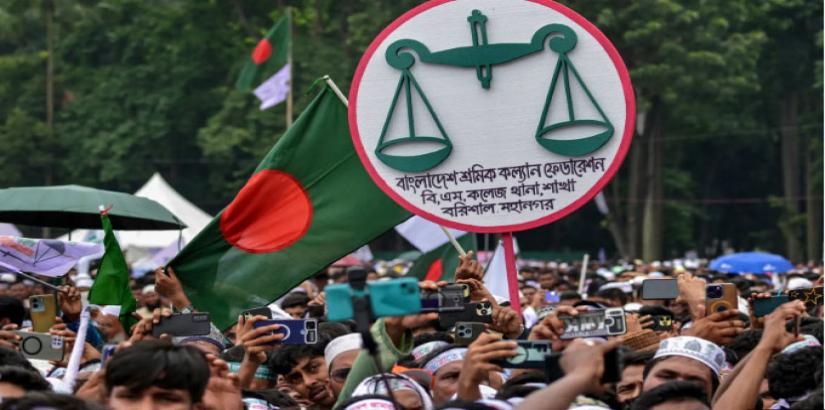
The leaders of the students and janata (masses) revolutionary movement chose Nobel Laureate Muhammad Yunus to lead the post-revolutionary government of Bangladesh. As the Chief Advisor of the Interim Government, Yunus raised the ideals of the revolution to a higher plane, imbued with the aspirations of the people and emotion-laden tributes to the fallen. Yunus seemed to savor the opportunity to lead the nation.
Fall Of Previous Regime
Leading up to the change of government on August 5, 2024, it is estimated that up to 95% of the people participating directly or indirectly in the movement demanded the resignation of the authoritarian ruler. About 40% of those on the streets and their supporters from the ruling Awami League attempted to stem the tide of the movement — consisting of around 20% core loyalists and an equal number of hired supporters.
Amid sporadic violence and clashes, a large silent majority observed events unfolding from a distance — through television, mobile devices, rooftops, windows, balconies, and the roadside. The spirit of the movement was shared widely across society, and law enforcement agencies deployed to defend the regime were unable to resist the advancing crowds. The larger portion of the population supporting the revolution engaged in direct clashes with the security forces. Change soon appeared inevitable.
Violence and Confrontation
The momentum of the revolution spread rapidly across districts, upazilas, and thanas. Political violence gripped the country as police used tear gas, rubber bullets, stun grenades, and live ammunition, while protesters retaliated by targeting symbols of the government. Police personnel, heavily deployed in urban centers and rural junctions, sometimes retreated and regrouped for tactical advantage.
Ruling party cadres, often accompanied by armed supporters and incentivized through patronage and payment, joined the confrontations. Meanwhile, around 3% of the population remained neutral — comprising elites or those uninterested in politics.
Shift In Political Alignment
The configuration of political support changed significantly following the appointment of Mohammad Yunus as Chief Advisor. With the fall of the Awami League leadership, many hired adherents lost access to patronage networks and withdrew from active politics. Some shifted allegiance to the rising influence of the Bangladesh Nationalist Party (BNP) and the Jamaat-e-Islami.
During the 15 months from August 2024 to November 2025, this led to a contraction of the anti-revolutionary support base from 40% to the core loyalists of about 20%. Under Yunus — an idealist economist and internationally respected figure — disappointment among revolutionary supporters may also lead to erosion of the pro-revolution base.
This shifting landscape indicates the possible emergence of a third political force.
Concerns Over Election Plan
The election tentatively scheduled for February 2026 has raised concerns across the political spectrum. The reason is straightforward — the reform agenda that was expected to secure democratic rights, institutional safeguards, and economic justice remains largely unimplemented.
In the absence of meaningful governance reforms and amid continued disorder, the announcement of early elections appears premature. This risks reigniting political violence and undermining the credibility of the transition. Yunus’s inclination toward symbolism and public sentiment over pragmatic statecraft may be contributing to this precarious situation.
Exclusion of Awami League
A key concern is the possible exclusion of the Awami League from participating in the upcoming polls. The Interim Administration has focused on negotiations with leading political parties, appearing at times more like power-sharing dialogue than a democratic reconciliation process.
Muhammad Yunus has not yet successfully connected with the broader public or the key grassroots actors of the July movement, creating a perceptible disconnect. Without national consensus, holding peaceful and participatory elections remains difficult. Excluding the deposed ruling party from upcoming elections could undermine political inclusivity, depress voter turnout, and trigger unrest.
(The author is a strategic analyst and Managing Partner, Enertech International, Inc., Transaction Advisors, Dhaka-1209, Bangladesh. Views expressed are personal. He can be contacted at: sheikhR2020@gmail.com)





Post a Comment