

2004 Chittagong arms seizure: Then Bangladesh government severely compromised national and regional security
An analysis of Chetia's and Singh's interviews alongside the court's detailed judgement brings out several crucial points. Firstly, there was a concerted effort to transform Bangladesh into a sanctuary for ULFA and other rebel factions from India's northeast, facilitated by Pakistan's intelligence agency.
 Apr 01, 2024
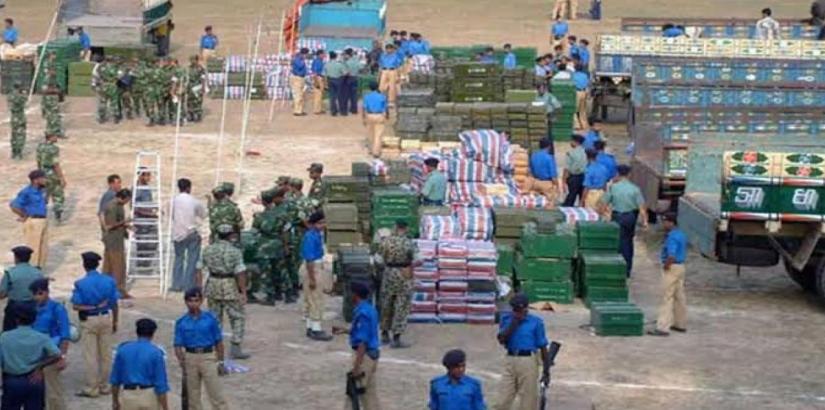
On the night of April 1, 2004, Bangladesh's law enforcement agencies conducted an operation at the Chittagong Urea Fertilizer Factory Limited (CUFL) jetty, seizing a substantial cache of arms and ammunition necessitating the use of at least 10 trucks for transportation. The illicit cache had been smuggled into the country through the Bay of Bengal and the Karnaphuli River. The legal proceedings about this incident commenced on July 6, 2005, marking it as the infamous "10 Truck Arms Case" in Bangladesh's history, constituting the largest arms smuggling episode ever uncovered within the nation's borders.
Public prosecutor Kamal Uddin Ahmed elucidated that, besides the accused individuals, various witnesses testified in court, attesting through their confessions that the seized arms and ammunition were intended for the banned Indian separatist organization ULFA (United Liberation Front of Asom), purportedly entering Bangladesh via its territorial waters. The haul comprised 463 boxes containing 790 MTT, SMG, and Tomi guns, 27,000 grenades, 150 rocket launchers, 620 magazines, and 11,43,520 rounds of ammunition, approximated at a value of 2,700 crore taka. The staggering magnitude of this arms seizure reverberated across the nation, prompting widespread astonishment at how such a vast quantity of weaponry had infiltrated the country without detection by law enforcement authorities.
Subsequently, on April 3, 2004, Ahadur Rahman, then Officer-in-Charge (OC) of Karnaphuli Police Station, lodged two cases under Section 25(b) of the Special Powers Act of 1974 and Section 19(a) of the Arms Act of 1878. The Criminal Investigation Department (CID) was subsequently assigned to investigate these cases, uncovering the underlying narrative behind the incident.
The 514-page verdict delivered by Judge S.M. Majibar Rahman of the erstwhile Special Tribunal-1 regarding the two cases arising from the arms seizure exposed alarming revelations. It elucidated how the government at the time, with explicit support, transformed the country into a sanctuary for separatist factions from another nation, thereby compromising Bangladesh's sovereignty.
Starting revelations
Recent resurgence of this matter stemmed from interviews conducted with Anup Chetia, the founder-general secretary of ULFA, and former Deputy Director General Major General Gaganjit Singh of India's Defense Intelligence Agency (DIA), disseminated through media channels. These interviews disclosed that the massive arms haul seized in Chittagong in April 2004 was not solely intended for ULFA but also targeted various other insurgent groups from India's northeastern region, with the aim of destabilizing the region and country.
An analysis of Chetia's and Singh's interviews alongside the court's detailed judgement brings out several crucial points. Firstly, there was a concerted effort to transform Bangladesh into a sanctuary for ULFA and other rebel factions from India's northeast, facilitated by Pakistan's intelligence agency. Secondly, the BNP administration of the time not only endorsed but actively facilitated this endeavor. Thirdly, the individuals orchestrating these actions held positions within pivotal and sensitive state institutions.
Sanctuary to separatists
It is profoundly disconcerting to contemplate how an elected government could betray public trust by compromising national sovereignty and harboring separatist elements. Electoral mandates represent a sacred covenant with the populace, yet the actions of the erstwhile government transgressed this covenant by compromising national security and harbouring separatist elements, thereby betraying the foundational principles upon which Bangladesh's independence was secured, at the cost of the sacrifices of countless martyrs. Such actions not only besmirched Bangladesh's international standing but also contravened the fundamental tenets of SAARC (South Asian Association for Regional Cooperation), posing a threat to the security not only of Bangladesh but of the entire subcontinent.
Equally distressing is the revelation that individuals involved in these nefarious activities occupied positions within critical state institutions. While institutions themselves cannot be held accountable for the transgressions of individuals, those who, propelled by ambition and corruption, engage in activities detrimental to the nation's interests and the reputation of their respective institutions, warrant severe action. Furthermore, stringent measures must be instituted against those who sanctioned or facilitated the misconduct of these individuals at the time. Any leniency shown towards such offenders would set a pernicious precedent within society.
While democracy affords space for diverse viewpoints and political pathways, no ideology or agenda should imperil the nation's existence or compromise its interests. In Bangladesh, political endeavors must prioritize national and security and the welfare of the nation above all else.
(The writer is a Dhaka-based columnist and activist. Views are personal. He can be contacted at fbzahir@gmail.com)





Post a Comment