

Gulf Crisis: Pakistan Hosts the Table; India Influences the Room (Part V)
India’s role in the Middle East crisis is defined not by presence at negotiation tables but by its ability to sustain stability around them.While Pakistan facilitates talks between the US and Iran in Islamabad, India underwrites the broader security architecture through its maritime presence, economic weight, and multi-aligned diplomacy.
 Apr 14, 2026
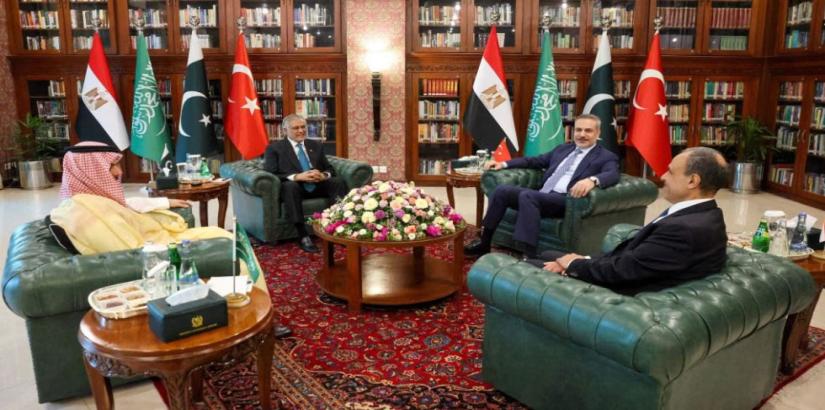
The Middle East crisis has entered a sharper, more complex phase. What began as coordinated US and Israeli airstrikes on February 28 has evolved into a wider geopolitical contest, disrupting energy flows from the Strait of Hormuz, rattling energy markets, and prompting urgent diplomacy.
In a notable development, a US delegation led by the US Vice President and Iranian delegation headed by the Speaker of the Iranian Parliament met in Islamabad. Despite 21 hours of delegation level discussion these remanned inconclusive with little or no meeting ground.
What is equally important is Pakistan has positioned itself as an mediator, leveraging its close ties with both Washington and Tehran. This is despite its mutual defence pact with Saudi Arabia.
Seen in the context of Indian perspective, there is no doubt Pakistan has performed an important role in getting the two antagonists to Islamabad. Equal reality is that Pakistan is in the room as a mere facilitator. This creates a layered reality. Pakistan may be hosting the conversation, but is in no way shaping the environment.
In so far India is concerned it is not at the negotiation table. However given its political, economic and military strength and its maritime presence, and strategic partnerships it is an important player whose role as a security anchor that inspire confidence and an important anchor of regional stability cannot be overlooked.
Economic Stakes That Anchor Influence
India’s influence is rooted in tangible economic realities that cannot be overlloked and remain central to regional stability, directly affecting its energy security and trade dependencies.
Trade figures reinforce this depth. In FY 2022–23, the Gulf accounted for 15.8 per cent of India’s total trade, surpassing even the European Union. Between April and November 2025, exports to the Middle East and North Africa (MENA) region remained strong. The UAE alone accounted for $25.47 billion, while Oman recorded $2.90 billion, a 10 per cent increase. Egypt reached $2.68 billion, up 21 per cent.
Investment commitments underscore long-term trust. Saudi Arabia’s $100 billion pledge and the UAE’s $75 billion commitment are not short-term bets. They reflect confidence in India as a stable, long-term partner, even amid regional volatility.
Diaspora as India’s Strategic Multiplier
India’s diaspora transforms economic ties into lived connections. Of the 35.4 million Indians abroad, nearly 40 per cent of the $118.7 billion in remittance inflows in FY 2023–24 come from this community, fostering pride and trust in India's enduring regional presence.
The UAE alone contributes 19.2 per cent, followed by Saudi Arabia at 6.7 per cent and Qatar at 4.1 per cent. These figures underscore how deeply Indian workers are embedded in to the Gulf economies.
In times of crisis, this diaspora becomes a stabilising force. As Gulf countries begin planning for reconstruction and consider labour restructuring after Iranian strikes, India’s workforce stands out for its competence and reliability. This positions India as a natural partner in rebuilding efforts, where efficiency and cost will outweigh politics.
India as the Silent Security Provider
While diplomacy unfolds in Islamabad, security in the region is being maintained elsewhere. This is where India’s role becomes more visible.
Disruptions in the Strait of Hormuz have made maritime security critical. India, as an active Quad member, a leading voice in the Indo-Pacific, the BRICS Chairman, a former G20 president, and an invitee to the G8, brings both capability and credibility to this space.
Since May 2023, India has played an active role in Combined Maritime Forces operations, including CTF-154. Through exercises such as MSET, Compass Rose, and Northern and Southern Readiness, it has helped secure vital sea lanes against piracy, trafficking, and instability.
What distinguishes India is its balanced naval presence. By operating without provoking Iranian suspicion, India's approach reinforces stability and reliability, positioning it as a provider of security rather than a source of tension.
At the same time, access to Iran’s Chabahar port allows India to link maritime security with continental trade routes, strengthening its role across multiple domains.
Multi-Alignment in Action
India’s diplomatic approach demonstrates strategic flexibility by engaging with all sides, enabling it to maintain influence across competing regional and global powers.
Relations with Israel remain strong, particularly in defence and technology. Between 2016 and 2020, India accounted for 43 per cent of Israel’s arms exports. During Prime Minister Narendra Modi’s 2026 visit, ties expanded into artificial intelligence, cybersecurity, and agriculture.
At the same time, India has sustained its relationship with Iran, built over 75 years. External Affairs Minister Jaishankar’s January 2026 visit to Tehran signalled continuity even amid conflict. Energy security and connectivity through Chabahar remain key priorities. This is seen in preference being given to Indian vessels struck in Hormuz Straits, realising Indian dependence on oil and gas imports.
Engagement with the Gulf continues to anchor India’s regional presence. Strategic partnerships with the UAE, Saudi Arabia, and Oman span trade, energy, and security.
Initiatives such as I2U2 allow India to expand cooperation without being locked into rigid alliances.
This “de-hyphenation” approach allows India to operate across competing blocs while maintaining credibility.
Pakistan Facilitates, India Shapes
The Islamabad talks highlight an important distinction. Pakistan is facilitating dialogue, but strategic limitations and economic fragility constrain its leverage.
India's ability to shape the regional environment extends beyond the Islamabad talks, drawing on its economic, maritime, and diplomatic strength to influence outcomes across the Middle East and beyond.
As a Quad member, BRICS chairman, former G20 president, and G8 invitee, India sits at the intersection of multiple power centres. This position enables it to engage the US, balance China, and maintain ties across the Middle East simultaneously.
In effect, while Pakistan hosts the table, India influences the room.
Reconstruction: The Next Strategic Frontier
As talks continue, attention is shifting to what comes after the conflict. Reconstruction across parts of the Middle East, including Iran, will require scale, speed, and cost efficiency.
India is well placed here. Its engineering and EPC firms have a strong track record of delivering large infrastructure projects across the region. Combined with its existing labour base, India offers both expertise and affordability.
Chabahar port strengthens this advantage; this, too, would need repair, having been targeted in the recent bombings, providing a gateway to Iran and Central Asia. Meanwhile, the India-Middle East-Europe Economic Corridor (IMEC), though slowed by conflict, could regain momentum as stability returns.
This phase may ultimately offer India more influence than the conflict itself.
Challenges and Strategic Risks
India’s position is strong, but not without risks. Energy price volatility remains a major concern. The safety of its diaspora in a conflict-prone region is another persistent challenge.
Geopolitical competition adds pressure. China’s $273 billion in investments in the Middle East between 2005 and 2022 reflect its growing ambitions. A potential shift in US-Pakistan relations could also complicate India’s strategic calculations.
Yet India’s strength lies in flexibility. By maintaining multiple partnerships without formal alliances, it retains room to adapt.
A Security Anchor, Not a Spectator
India’s role in the Middle East crisis is defined not by presence at negotiation tables but by its ability to sustain stability around them.While Pakistan facilitates talks between the US and Iran in Islamabad, India underwrites the broader security architecture through its maritime presence, economic weight, and multi-aligned diplomacy.
It is not a mediator. It is a system-shaping player.
In a region marked by uncertainty and shifting alliances, India’s steady, calibrated approach positions it as a long-term security anchor, not a spectator to events, but a force quietly shaping their direction.
(Lt Col Manoj K Channan, an Indian Army veteran, is a strategic analyst. Views expressed are personal. He can be reached at manojchannan@gmail.com; linkedIn www.linkedin.com/in/manoj-channan-3412635; X @manojchannan.
Brig Arun Sahgal, PhD, an Indian Army veteran, is the Director Forum for Strategic Initiatives. He was previously the founding Director of the Office of Net Assessment, Indian Integrated Defence Staff (IDS), Ministry of Defence and Centre for Strategic Studies and Simulation, United Service Institution of India)





Post a Comment