

One Year of Operation Sindoor: India’s Message of Strength and a New Normal
Military analyst Cooper argued that beyond battlefield outcomes, the operation exposed Pakistan’s inability to deter Indian strikes or mount a damaging counter‑response. He suggested the psychological impact of India’s operations triggered panic within Pakistan’s leadership, eventually driving Islamabad to seek international intervention.
 May 10, 2026
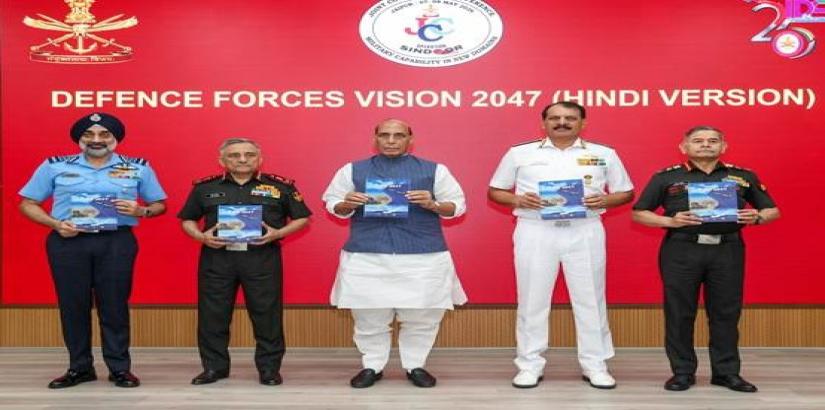
Marking the anniversary of Operation Sindoor, India reflects on a campaign that continues to reverberate across global strategic forums. Launched as a decisive response to Pakistan‑backed cross‑border terrorism, it has since come to symbolize a turning point in India’s security posture, anchoring a doctrine of calibrated firmness and sustained resolve.
At the Joint Commanders’ Conference in Jaipur, the Indian Defence Ministry released a 28‑minute documentary chronicling the operation. The film describes Sindoor as a “punitive and targeted campaign” designed to dismantle terror infrastructure across the Line of Control and deep inside Pakistan‑occupied Jammu and Kashmir (PoJK). According to its account, more than 100 anti-India militants were eliminated. The documentary portrays the operation as a carefully coordinated effort, underpinned by synchronized political and military decision‑making.
Prime Minister Narendra Modi, featured prominently in the film, declared that India would “identify, track and punish every terrorist and their backers,” warning that any attack on Indian soil would invite an “overwhelming response” on India’s terms. The Deputy Chief of the Army Staff (DCOAS), Lieutenant General Rajiv Ghai, echoed this stance, emphasizing that “the mission was not an end but the beginning of India’s sustained campaign against terrorism.” Against this backdrop, one can conclude that Operation Sindoor will not end as long as Pakistan persists in weaponising jihadist terrorism against India.
The Trigger: Pahalgam Massacre
The immediate catalyst for Operation Sindoor was the massacre of 26 civilians in Pahalgam’s Baisaran Valley, Jammu and Kashmir, on April 22, 2025. The attack was carried out by The Resistance Front (TRF), a proxy of the Pakistan‑based terrorist group Lashkar‑e‑Taiba (LeT), backed by the Pakistan Army and Inter‑Services Intelligence (ISI).
On 17 April 2025, Pakistan’s Army Chief General Asim Munir declared that “we are different from Hindus in every possible way,” describing Kashmir as Pakistan’s “jugular vein.” Just five days later, Hindus were targeted and killed in broad daylight. The timing of the attack left little doubt about Pakistan’s intent and reinforced the perception that terrorism remains central to Islamabad’s policy towards India.
India’s Doctrine of Decisive Response
Between 6 and 10 May 2025, India launched a limited but forceful offensive against Pakistan’s terror infrastructure. The strikes carried a blunt message: nuclear threats would not deter decisive military action, and security would not take a back seat to diplomacy.
Operation Sindoor has since been described as India’s most significant military campaign since the 1971 war. It underscored a new doctrine—short‑range, calibrated offensives designed to inflict heavy casualties and establish battlefield dominance. American military analyst John Spencer noted that Pakistan’s countermeasures—including drone swarms, missile launches, and rocket fire—were blunted by India’s integrated air defence network. India relied on its indigenous Integrated Air Command, Control and Communication System (IACCCS), involving Akashteer, to repel attacks. Spencer concluded that India emerged “strategically on top.”
Beyond counter‑terrorism, Op Sindoor showcased India’s growing military superiority in the region. Austrian aerial warfare analyst Tom Cooper was unequivocal: “The winner is absolutely clear. India has had successful retaliation strikes on major terror camps inside Pakistan, which were considered outside of India’s range. India has not only blocked Pakistan’s efforts to retaliate, but also delivered very precise damage to Pakistani air defences and air bases. New Delhi has sent a clear message: we can hit whatever we want to hit in Pakistan, and you cannot stop us.”
Breaking the Old Constraints
Prime Minister Modi’s remarks following the campaign marked a decisive shift in India’s security posture. “We will not tolerate nuclear blackmail,” he declared. “We have established a new normal. Now we will not distinguish between terrorists and those who nurture and support terrorists. Both are enemies of humanity.”
For decades, Pakistan had treated India as a “soft state,” confident that nuclear deterrence would shield its reliance on terrorism. Analysts argue that Modi, alongside National Security Adviser Ajit Doval, introduced a new theory of deterrence: India could break free from the constraints imposed by nuclear weapons and respond forcefully to major terror attacks. Operation Sindoor became the practical demonstration of that theory, signaling that New Delhi would no longer be restrained by the fear of escalation.
The Information War
Equally significant was the battle of narratives. During Operation Sindoor, Pakistan’s military and intelligence services sought to shape the information environment. Islamabad attempted to fuel confusion over the scale of India’s retaliation and fabricated claims of shooting down Indian aircraft. Pakistan even asserted that the Air Force (PAF) had downed eight Indian fighter jets during the brief military conflict between the two sides.
In reality, Indian forces targeted Pakistani air defence sites on May 8, including early warning radars at Chunian and Pasrur, as well as at least one HQ‑9 long‑range surface‑to‑air missile battery. Further strikes followed on May 9. Reports that U.S. President Donald Trump had brokered peace talks remained unsubstantiated, with his statements often contradicting themselves. Ultimately, Pakistan, unable to withstand the sustained attacks, requested a ceasefire.
Military analyst Cooper argued that beyond battlefield outcomes, the operation exposed Pakistan’s inability to deter Indian strikes or mount a damaging counter‑response. He suggested the psychological impact of India’s operations triggered panic within Pakistan’s leadership, eventually driving Islamabad to seek international intervention.
A Doctrinal Shift
Operation Sindoor confirmed one thing: Pakistan‑sponsored terrorism inside India is not merely subversion but war. India’s answer, therefore, was war on Pakistan. In that sense, Sindoor mission represents a doctrinal shift—a new normal in confronting state‑sponsored terrorism.
The operation was not a one‑off retaliation but a demonstration of sustained military superiority. Over five days of conflict, India established clear dominance. For India, the lesson is unmistakable: deterrence lies not in restraint but in readiness to strike. Sindoor institutionalised that resolve, ensuring that Pakistan’s reliance on terrorism will be met with overwhelming force.
A Pivotal Moment
One year on, Operation Sindoor continues to stand as a pivotal moment in India’s evolving security doctrine. It was a campaign marked by military precision, political resolve, and strategic clarity. More significantly, it reshaped perceptions of India’s posture against terrorism, signaling a readiness to act with firmness when national security is at stake.
As the lessons of Operation Sindoor are absorbed into policy and practice, its legacy lies not only in the actions taken but in the enduring message it conveys: that safeguarding peace requires both strength and foresight. In this balance between resolve and responsibility, India’s security doctrine finds its renewed direction.
(The author is Founding Director, Centre for Strategic Studies–Trincomalee (CSST), Sri Lanka, and a geopolitical analyst. Views expressed are personal. He can be contacted at jjathi@gmail.com / director@trincocss.org / www.trincocss.org.)





Post a Comment