

South Asia’s Cities Are Growing - But May Not Remain Livable
What is unfolding across South Asia’s cities is not just an urban crisis, it is a reflection of deeper tensions within development itself. Growth is happening, but it is not translating into stability. Opportunities exist, but they are unevenly distributed. Systems are expanding, but not fast enough to keep up with demand. Cities, which have long been seen as places where people come to improve their lives, are increasingly becoming spaces where people struggle to sustain them.
 Mar 22, 2026
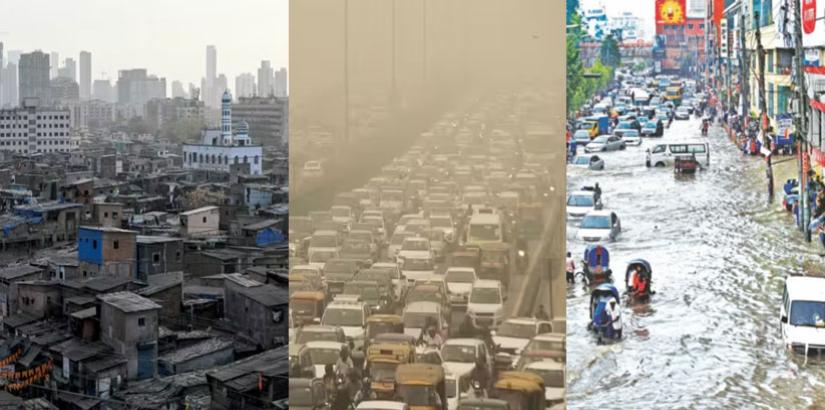
In early 2026, a familiar yet more troubling pattern unfolded across South Asia. Delhi’s winter air once again turned hazardous, Lahore shut schools due to smog, Dhaka continued to grapple with untreated wastewater flowing into its rivers, and Karachi witnessed a deadly fire that exposed how fragile basic urban safety systems remain. But what stands out this time is not any one crisis, it is how all of them are happening at once, across countries, in different forms.
From Kathmandu’s worsening air quality to Colombo’s cost-of-living pressures and Kabul’s humanitarian strain, cities across South Asia are beginning to feel like variations of the same story. The Asia-Pacific SDG Progress Report 2026 captures this shift bluntly: the region is likely to miss 88% of measurable SDG targets, with environmental decline and inequality actively reversing development gains. In other words, this is no longer a set of isolated urban problems, it is a deeper crisis of how development is unfolding.
The Many Fault Lines of Cities
This becomes even clearer when we look at how these pressures are experienced on the ground. The 2026 UNDP–ESCAP–ADB Inclusive Urban Futures report shows that nearly 697 million people in Asia-Pacific cities live in slum-like conditions, 65% of urban workers are in informal employment, and over 2.3 billion people are exposed to unsafe air pollution. These are not just statistics, they describe a lived reality where insecurity is layered. A family may have work, but not stable income; a roof, but not safe housing; a city address, but not clean air. This is the key shift: cities are no longer simply engines of opportunity, they are increasingly places where multiple vulnerabilities overlap and reinforce each other.
At the heart of this lies a basic contradiction: cities are growing faster than they are creating secure livelihoods. World Bank analyses of South Asia’s urban transition show that while people continue to move into cities, the expansion of formal, productive jobs has not kept pace. So, migration continues, but security does not follow. What emerges is not just poverty, but a quieter, more complex condition: urban precarity. People are working, but remain one shock away from the crisis. This explains why cities that are economically expanding are also seeing growing informal settlements and widening inequality. Growth, in this sense, is happening, but it is not being felt evenly.
This fragility shows up most sharply in something as basic as food. South Asia has long struggled with hunger, but what is changing is where it is being felt. Recent global food security assessments show that urban populations are increasingly vulnerable due to rising prices, informal work, and climate disruptions. The result is a growing group of people who are employed, yet food insecure. This challenges one of the most fundamental assumptions about cities that they are pathways out of poverty. Instead, they are becoming spaces where poverty is reshaped into new, less visible forms.
Layered onto this is the environmental reality that now defines daily life. Air pollution, for instance, is no longer just a seasonal or local issue, it is a shared regional condition. Scientific studies show how pollution moves across borders in the Indo-Gangetic plains, linking cities in India, Pakistan, Nepal, and Bangladesh into a single ecological system. Data from recent analyses confirm that pollution levels remain persistently hazardous during winter months. What this means in practice is simple: no city can solve the problem alone, yet cooperation remains limited. The crisis, therefore, is not just environmental, it is political.
At the same time, everyday urban systems, water, waste, drainage, are struggling to keep up with the scale of demand. In cities like Dhaka, research highlights how inadequate sewage systems and industrial discharge are contributing to severe water contamination and public health risks. Across the region, similar patterns appear: infrastructure exists, but not at the scale or efficiency required. When extreme weather hits floods, heatwaves; these weaknesses become visible all at once. What might otherwise be manageable challenges turn into widespread disruption.
Yet, perhaps the most important layer of this crisis is how unevenly it is experienced. Not everyone in a city lives the same reality. Some are able to shield themselves through better housing, cleaner environments, private services, while others remain constantly exposed. The Inclusive Urban Futures report underscores this imbalance, showing how access to clean air, safe housing, and basic services is deeply unequal. This divide is further shaped by gender, with women in informal settlements facing greater challenges in safety, mobility, and access to services. Over time, this creates not just inequality, but fragmentation; cities that feel like entirely different worlds depending on where you stand.
All of this is happening within a broader context of instability. Cities are increasingly absorbing pressures from outside; climate migration, economic shocks, even conflict. Yet the systems meant to manage these pressures remain reactive and stretched. The SDG Progress Report 2026 makes it clear that institutional capacity is struggling to keep pace with the complexity of these challenges. The issue, therefore, is not just limited resources; it is the mismatch between the scale of problems and the way they are being governed.
Making South Asian Cities Livable
The first priority should be repairing core urban systems where failure is most visible and most damaging. Instead of large, capital-intensive mega-projects that take years, cities can adopt a modular approach: ward-level sewage treatment units, decentralised waste sorting centres, and mandatory annual fire-safety compliance audits for high-density markets and residential clusters. These are already technically feasible and administratively within municipal control. The key shift is political; treating these not as routine maintenance issues, but as public safety imperatives, similar to policing or disaster response.
Second, cities must stabilize the everyday economy of the urban poor, particularly around food and housing. Rather than designing new welfare systems, governments can expand what already exists. Public distribution systems can be made portable across cities through digital IDs, allowing migrant workers to access subsidised food anywhere. At the same time, rental regulation and low-cost housing registries can be introduced to prevent exploitative pricing in informal settlements. These are not radical reforms, they are extensions of current systems that directly reduce survival stress.
Third, climate adaptation needs to move from planning documents to enforceable labour rules. Heatwaves, for example, are predictable events. Cities can mandate staggered working hours during peak heat, require shaded rest areas at construction sites, and impose penalties on contractors who violate safety norms. Similarly, flood-prone neighbourhoods can be mapped and prioritised for pre-monsoon drainage clearance drives with strict accountability timelines. These are low-cost interventions, but they require consistent enforcement, which is where most policies currently fail.
Fourth, there is an urgent need to make municipal governance operational rather than reactive. Most South Asian cities already generate large amounts of data, on waste collection, hospital admissions, water supply, and traffic flows. The problem is not data scarcity, but fragmentation. Integrating this into simple, real-time dashboards at the city level can help administrators identify stress points early, whether it is a spike in air pollution, water contamination, or disease outbreaks. This is not about “smart city” branding; it is about basic administrative coordination.
When Cities Become Spaces of Survival
What is unfolding across South Asia’s cities is not just an urban crisis, it is a reflection of deeper tensions within development itself. Growth is happening, but it is not translating into stability. Opportunities exist, but they are unevenly distributed. Systems are expanding, but not fast enough to keep up with demand. Cities, which have long been seen as places where people come to improve their lives, are increasingly becoming spaces where people struggle to sustain them. Clean air, secure work, affordable food, safe housing; these are no longer guarantees, but uncertainties.
And that is the real shift. When everyday life in cities becomes defined less by opportunity and more by negotiation, of risk, of cost, of survival, it signals something larger than urban decline. It points to a model of development that is no longer delivering on its most basic promise.
If that model is not rethought, South Asia’s cities will continue to grow. But they may not remain livable.
(The author is a final year political science student and geopolitical researcher specializing in great power politics, South Asian studies, and international strategic affairs. She writes on contemporary global issues with a policy-oriented lens. Views expressed are personal. She can be contacted at manyarastogi812@gmail.com )





Post a Comment