

Why Can't South Asia trade with itself? Tariff Shock Can be Turned Into Opportunity
South Asia’s tragedy is not geography or lack of industrial capacity. It is the failure to convert proximity into predictable partnerships. Trump’s tariff threats could remain episodic political theatre, or they could signal a more protectionist global environment. Either way, South Asia’s dependence on Western concessions exposes it to recurring uncertainty. Reviving SAFTA in spirit and substance would not eliminate trade with the West. It would diversify risk and embed value creation within the region.
 Mar 20, 2026
As Donald Trump starts a global tariff war, economists argue South Asia has an overlooked shield: deeper regional trade. Without it, the region risks remaining dependent on Western concessions and vulnerable to external pressure. At a time when U.S. President Donald Trump is threatening tariffs across the world, experts say that if South Asian countries, India, Pakistan, Afghanistan, Bangladesh, and others enter into meaningful trade deals among themselves, they would not need to remain dependent on the West for trade concession largesse.
Instead, the region appears locked in a westward scramble. India celebrates a sweeping free trade agreement with the European Union. Bangladesh negotiates tariff relief with Washington D.C. Pakistan highlights preferential access to European markets. Each announcement is framed as a diplomatic win, a breakthrough in export competitiveness.
But beneath the celebratory optics lies a structural vulnerability. South Asia conducts less than 5 percent of its trade within the region. By contrast, roughly 60 percent of European Union trade takes place internally. The Association of Southeast Asian Nations (ASEAN) economies trade between 20 and 25 percent within their bloc. The result is a paradox. South Asia is outwardly integrated yet internally fragmented.
In trade theory, the gravity model predicts that countries trade more with neighbours because proximity reduces transport and information costs. South Asia should be a textbook case for regional integration. It hosts nearly a quarter of the world’s population. It has one large economy, India, surrounded by smaller markets with complementary production structures. Yet geography fails to translate into commerce.
India’s exports crossed 778 billion USD in 2023–24. Only 3.3 percent went to South Asian neighbours combined. Bangladesh accounted for 1.4 percent. Pakistan and Bhutan each absorbed less than 0.2 percent.
Too Many Roadblocks
Dhriti Mukherjee Pipil, lead for trade at TheNewsSite and a doctoral researcher at the Indian Institute of Foreign Trade, describes South Asia as one of the most striking empirical anomalies in global trade. “Proximity fails to translate geographical advantages into commercial integration,” she argues. “Institutional unreliability and policy discretion dominate physical proximity.”
Exports from the region have expanded dramatically over the decades, from $21 billion in 1980 to over $540 billion by 2024. Imports approach $930 billion. The region is not isolated from globalization. It is bypassing itself.
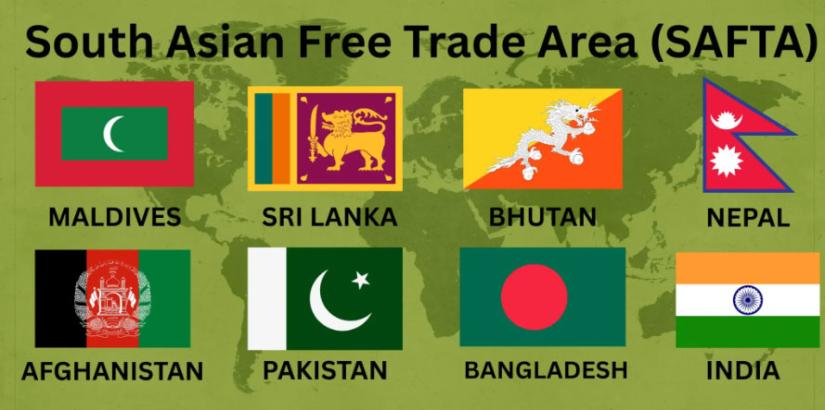
The South Asian Free Trade Agreement (SAFTA), launched in 2006 under the South Asian Association for Regional Cooperation, followed the 1995 South Asian Preferential Trade Agreement. It envisioned gradual tariff reductions to between 0 and 5 percent and the creation of a tariff-free zone across India, Pakistan, Bangladesh, Sri Lanka, Nepal, Bhutan, the Maldives, and Afghanistan.
The model drew inspiration from the European Union and ASEAN. Development gaps were not seen as barriers but as opportunities for specialization. India’s scale in pharmaceuticals, chemicals, and machinery could complement Bangladesh’s garment assembly, Pakistan’s cotton and textile base, Sri Lanka’s higher-value apparel finishing, and Nepal’s hydropower potential.
On paper, the industrial hierarchy resembled successful regional blocs. In practice, value chains never formed. Instead of an integrated flow such as India to Bangladesh to Sri Lanka to the world, trade routes leapfrog the region. India ships to Europe. Bangladesh exports to the EU and the U.S. Sri Lanka targets American buyers. The region trades with the world but not with itself.
Why does integration flourish elsewhere but stall in South Asia? Across the region, trade policy remains deeply discretionary. Governments prioritize food security, fiscal stability, and strategic concerns. Export bans on food grains, cotton, and intermediate inputs disrupt predictability. Border closures linked to security tensions raise risk premiums. Customs processes remain documentation-intensive and time-consuming.
According to World Bank indicators, border compliance times in South Asia are two to three times higher than in East Asia despite shorter distances. For many firms, especially small and medium enterprises, it is easier and more predictable to trade with Rotterdam than with a neighbouring capital.
“Economic integration within the region remains limited despite geographic proximity and strong complementarities among member countries,” comments Jyoti Vij, director general of the Federation of Indian Chambers of Commerce and Industry. She points to the lack of trade facilitation and customs harmonization as major obstacles. Trade formalities remain complex, involving multiple approvals and procedural steps that increase costs and uncertainty. Such inefficiencies discourage firms from building cross-border supply chains.
India-Pakistan Chokepoint
When SAFTA was launched, both countries committed to a Trade Liberalization Programme aimed at reducing tariffs to between 0 and 5 percent. But geopolitics repeatedly intervened. After the Pulwama attack and the revocation of Article 370 in Jammu and Kashmir, India raised customs duties on Pakistani imports to 200 percent. Pakistan suspended trade. The Wagah-Attari border closure forced traders to reroute shipments through Dubai, Singapore, and Colombo. Costs rose sharply. Bilateral trade, valued at $2.41 billion in 2018, had nearly halved by 2024.
Yet a decade earlier, a serious attempt to normalize trade nearly succeeded. But political timing and electoral calculations derailed economic initiatives, even when the technical groundwork was complete. In March 2014, the initiative was abruptly shelved. At the time, many in Islamabad speculated that the military establishment had intervened. But accounts that surfaced later pointed in a different direction.
Before 2014, Pakistan was about to grant the status of most favoured nation to India. After a series of meetings with the industry and trade bodies in Pakistan, it was approved by the Pakistani cabinet. The schedule date for the meeting of the commerce ministers of both countries was also set. But in the beginning of 2014, a close confidant of then Gujarat Chief Minister and National Democratic Alliance prime ministerial candidate Narendra Modi approached Pakistan’s ambassador in Washington D.C., Jalil Abbas Jilani. The message was discreet but clear: Delay the signing of the trade deal.
“The gentleman told me to ask Pakistan to defer signing the deal then, as it would be seen as Pakistan interposing in giving advantage to the Congress party and Congress could use this as a poll plank to their advantage,” Jilani told Sapan News over a phone call from Islamabad.
“With the Manmohan Singh government nearing the end of its term and elections imminent, the argument was that it would be politically prudent to let a new government in New Delhi formalize the agreement,” he added.
Jilani then relayed the outreach to Islamabad. Pakistani authorities are understood to have verified the credentials of Modi’s emissary through their high commissioner in New Delhi before deciding to hold back. Such a step, the envoy also suggested, would allow Modi, if elected, to begin his tenure on a constructive note in relations with Pakistan. Modi assumed office in May 2014. The anticipated revival of the trade normalization process, however, never materialized.
In 2023, South Asia exported over 78 billion USD in textiles. Only a negligible share circulated within the region. Western markets compensate for distance with higher unit prices, enforceable contracts, and regulatory predictability. Even with higher freight costs, they appear economically closer because policy frameworks are stable.
Sidra Ahmed, professor at Bahria University in Karachi, told Sapan News that economic interests in the neighbourhood form the foundation of political stability. “If countries ignore regional integration, instability will remain,” she added. “No nation in the region can achieve sustained development while neglecting its neighbours.”
Trump’s renewed tariff rhetoric intensifies this vulnerability. If U.S. duties rise sharply, export-dependent sectors in South Asia will feel immediate strain. Without a regional cushion, each external shock translates directly into domestic stress.
Political Will Missing
The European Union emerged from the devastation of two world wars by embedding economic interdependence in rules-based institutions. Production networks across ASEAN deepened despite significant income disparities. In both cases, predictability fostered trust.
South Asia’s tragedy is not geography or lack of industrial capacity. It is the failure to convert proximity into predictable partnerships. Trump’s tariff threats could remain episodic political theatre, or they could signal a more protectionist global environment. Either way, South Asia’s dependence on Western concessions exposes it to recurring uncertainty. Reviving SAFTA in spirit and substance would not eliminate trade with the West. It would diversify risk and embed value creation within the region.
As Pipil suggests, proximity without predictability is economically empty. And as a former member of the National Assembly in Pakistan Khurram Dastagir Khan experience shows, technical solutions often exist. What is missing is sustained political will. If South Asia chooses to insulate regional trade from political volatility and anchor it in credible rules, it could transform a tariff shock into an opportunity for integration. If not, it will remain outward-facing but internally fractured, vulnerable to every shift in Washington’s trade winds.
(The author is an independent journalist and author based in New Delhi. She is also engaged in India-Pakistan Track II peace initiatives and reconciliation efforts. By special arrangement with Sapan)





Post a Comment