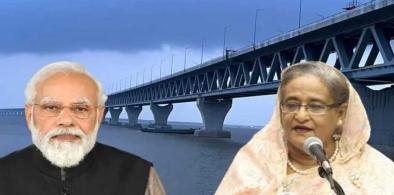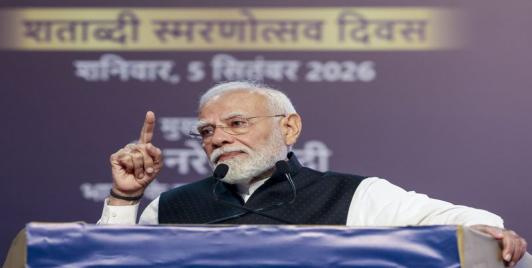

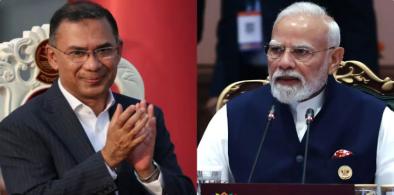
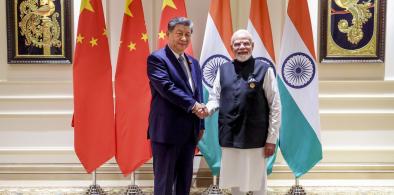

India's Prime Minister Narendra Modi meets Bangladesh's interim government head Muhammad Yunus

Bangladesh–India Relations at a Crossroads: Needed Recalibration, Not Rupture

The current strains in Bangladesh–India relations should therefore be seen not as an inevitable deterioration, but as a test of diplomatic maturity. Bangladesh and India share more than geography and history; they share a responsibility to ensure that temporary political frictions do not harden into structural mistrust. In a time of regional uncertainty, neither country benefits from a relationship defined by grievance or miscommunication. 

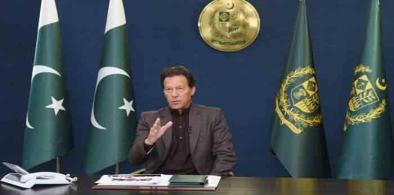
A Dangerous Power Grab in Pakistan; Unpredictable Consequences For Region

The 27th Amendment, celebrated by its proponents as a security reform, is in reality a political coup executed through constitutional means. It marks not only Munir’s personal triumph but the institutional victory of the military over all other state authorities. As history warns, empowering any unelected institution above the republic’s elected will invites instability—not strength. Pakistan may soon discover that consolidating military power does not secure the nation’s future, but instead places it at greater risk

How Foreign Digital Influencers Are Tarnishing India’s Global Image

India must now transition from conventional soft-power thinking to visibility governance—the systematic management of how the country appears, circulates, and is emotionally interpreted across global platforms. Failure to do so will leave India’s global image increasingly shaped by commercial incentives outside Indian control.  

Afghanistan Should Not Get Caught In The India-Pakistan Strategic Rivalry

The strengthening of Taliban-India ties runs counter to Pakistan’s interests. The more border clashes intensify between the Taliban and Pakistan, the more secure the Kashmir region and the Line of Control (LoC) become for India. Under such conditions, Pakistan will remain preoccupied with its northwestern border, giving India a unique opportunity to consolidate its control over Kashmir and potentially weaken, drive out, or eliminate Kashmiri militant groups 

More on Spotlight

India should keep open communication channels with Taliban to protect its Afghanistan interests

After all, how can a major political and military force like India stay on the sidelines when the US, the Chinese, of course, the Pakistanis, and even the Russians begin talks, open business and prepare for collaborations with the Taliban? writes Jagdish Rattanani for South Asia Monitor

Can sports be the harbinger of a new dawn in India-Pakistan relations?

Amid the thorny political and diplomatic issues, sports can act as the much-needed balm to remove distrust and promote understanding between India and Pakistan, writes Sirshendu Panth for South Asia Monitor

US ends a 20-year-war in Afghanistan in confused retreat: Is Taliban now an enemy turned partner?

A Taliban-run Afghanistan that eschews support for international terrorism and global Islam and follows a Sharia regime like that of US ally Riyadh – in effect an oil-less Saudi Arabia – and, as it happened this week, both cooperating to fight common enemies may be Biden's dream scenario, writes Arul Louis for South Asia Monitor

Afghan refugees crisis: Collective international action need of the hour

The Afghan conflict has already turned shelterless a massive number of people, and it will not end until a morally inclined humanitarian intervention takes place, write Azeemah Saleem and MD. Imtiyaz for South Asia Monitor

Lessons from the Taliban: Only a secular democracy can keep India integrated

Implications for India are more worrisome since the Taliban now has overt support of China and Russia apart from its patron Pakistan, writes Brig Deepak Sethi (retd) for South Asia Monitor

Strong policies, asset management skills can raise mutual funds’ popularity in South Asia

Among many commonalities, South Asian nations have a large hi tech-savvy young population, and the asset management companies should tap this section to deepen mutual fund penetration significantly, writes Ram Krishna Sinha for South Asia Monitor 

Transparency, institutional checks and balances must for success of India’s ambitious asset monetization plan

If asset monetization is undertaken with strict oversight, it can be the most effective remedy to dispel the pervading gloom of an ailing economy, writes N Chandra Mohan for South Asia Monitor

Will Afghanistan provide the strategic depth that Pakistan has long been seeking against India?

Beijing will quickly establish a ruthlessly transactional and pragmatic relationship to exploit Afghanistan’s rich mineral resources as well expand its much-cherished Belt and Road Initiative (BRI) from Pakistan, writes Mayank Chhaya for South Asia Monitor

The blind men of Capitol Hill: Kabul bombings are America’s self-inflicted wound

Finally, the US has given the biggest boost to global terrorism - and will eventually have to face the consequences. A coupling between the ISIS and Taliban should not be considered an impossibility, writes Lt Gen P. C. Katoch (retd) for South Asia Monitor

Biden risks further Afghan entanglement in a who-is-fighting-who in Afghanistan

Biden's speech had an eerie echo of former President George Bush's September 20, 2001, address to Congress when he set the course for what became the 20-year war, writes Arul Louis for South Asia Monitor

Growing Bangladesh-Sri Lanka trade and investment ties have positive implications for the region

If a free trade agreement is signed, then only the sky would be the limit for Bangladesh-Sri Lanka business relations, writes MD Pathik Hasan for South Asia Monitor

Equitable vaccine distribution a must for South Asia's economic recovery

The Asian Development Bank has stated that in South Asia the new wave of Covid-19  between March and June 2021 has somewhat dampened the economic outlook of the region, writes Partha Pratim Mitra, for South Asia Monitor

The Taliban’s return in Afghanistan will reinforce the Al Qaeda threat

Al Qaeda is leading a scattered existence along the Afghan-Pakistan border and its leadership is undergoing a constant shift, writes Anuttama Banerji for South Asia Monitor

Afghanistan's grim future and its huge regional implications

India won’t let the developments in Afghanistan affect its interests, more so because Pakistan and China are rubbing their hands in glee, waiting to move in to fill the vacuum in Afghanistan left by the United States, writes Mehraj udin Bhat for South Asia Monitor 

The American debacle in Afghanistan: Did US negotiators know early in 2020 that the Taliban could take over easily?

It is hardly surprising that in a mockery of the so-called US intelligence projection that Kabul could fall in 30 to 60 days, the capital caved in within 48 hours, writes Mayank Chhaya for South Asia Monitor