

Anti-Taliban Front Growing: Former Afghan National Army Soldiers Mount Armed Resistance to Repressive Rule
The Afghanistan Freedom Front was formed in March 2022 under the leadership of Gen. Yasin Zia, the former Chief of General Staff of the Afghan National Army. The force comprises mainly the former members of the Afghan National Security Forces, trained soldiers and experienced officers, former defenders of Afghanistan against the Taliban under a democratically-elected government who are now stateless, exiles, and warriors once again.
 May 26, 2026
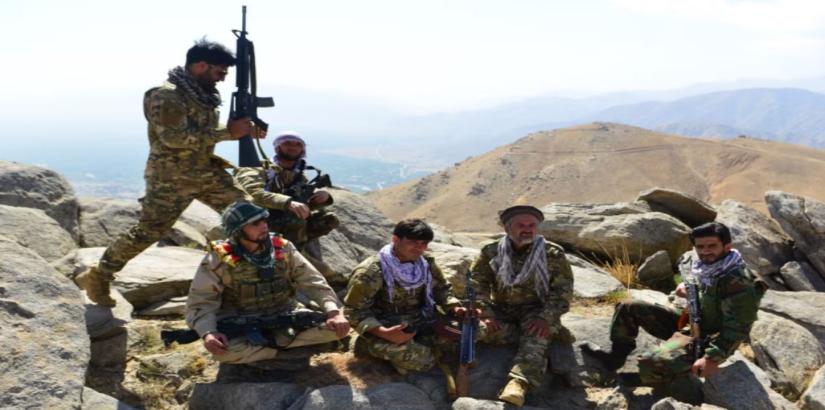
In the evening of May 24, 2026, an assault on Taliban logistics vehicles was launched in the Surobi district of capital Kabul. One Taliban fighter died, and three sustained injuries. An organization calling itself the Afghanistan Freedom Front (AFF), which initiated the operation, described it as yet another attempt to impose pressure on the Taliban regime. This is not something that happens accidentally; rather, it seems to be the next step of a prolonged war that comes right out of the ashes of oppression.
In the midst of other global conflicts and hotspots, the world seems to have forgotten about Afghanistan. But underneath the seemingly uneasy peace, tensions is growing steadily among different factions, fronts, and freedom fighters, the people who have experienced oppression in the past.
Institutionalized Discrimination Against Women
Since taking control of Kabul in August 2021, the Taliban regime has not been governing but ruling with a feudal fist. The list of edicts has been long and exhaustive. There is no schooling for girls beyond elementary school and no university for women. They cannot be employed in non-government organizations and the government. They cannot access recreational facilities such as parks, gyms, or even the streets. In effect, more than 80 decrees and directives have stripped Afghan women of their freedom and livelihoods.
The UN Special Rapporteur on Human Rights in Afghanistan, Richard Bennett, could not put it better as he described the process in question as “an institutionalized system of discrimination, segregation, disrespect for human dignity, and exclusion of women and girls.” The numbers speak for themselves as close to 80% of young Afghan women have been deprived of their educational, economic, or vocational opportunities, which is four times more compared to the same number of young Afghan men.
The Taliban suspended the employment of female civil servants whose salaries had already been cut since 2021 without any notice or compensation. Medical graduation tests have taken place for two successive years without any female students after a decision was taken to deny admission to women in medical studies. Nearly 180 individuals, comprising of both men and women, have been caned during the first quarter of 2025 on account of alleged immorality. The human rights report published by UNAMA says that these punishments were handed down in front of Taliban officials in attendance.
Seeds of a Growing Rebellion
Similarly, the socio-economic effects have been just as dire. Some 21.9 million people, accounting for about 45% of the total population of Afghanistan, will need humanitarian aid in 2026, according to UNHCHR. The sudden discontinuation of aid following the takeover of power by the Taliban, the freezing of central bank resources, and the persistent drought situation have created not just a survival crisis for a large segment of the population but a legitimacy crisis for the regime.
An armed uprising in reaction to Taliban rule became almost predictable after a while. When a regime incarcerates one half of its citizens, strips away any future it may hold, and shoots down anyone from the second half of its population who dares protest, experience shows that some kind of rebellion is only natural. The unusual thing about the Afghan situation was how rapidly this has developed.
The Afghanistan Freedom Front was formed in March 2022 under the leadership of Gen. Yasin Zia, the former Chief of General Staff of the Afghan National Army. The force comprises mainly the former members of the Afghan National Security Forces, trained soldiers and experienced officers, former defenders of Afghanistan against the Taliban under a democratically-elected government who are now stateless, exiles, and warriors once again.
There is no denying that the operation of the AFF is significant. To date, since its formation, the group claims to have conducted 322 operations against the Taliban regime. In the first eight months of 2025, the organization had claimed 88 attacks and more than 200 deaths among the Taliban. According to the United Nations Security Council, in a December 2025 report, Taliban opposition groups conducted 116 attacks from January through July 2025, affirming the existence and the rising nature of the resistance.
The critics are right that the AFF is significantly weaker and does not enjoy the territorial presence that could make it a danger to Taliban rule. Even the UN Security Council recognized that despite its persistence, the violence from the opposition did “not pose a serious threat to Taliban rule” yet. But the main point was missed by doing so. The environment of their activity has changed completely.
The groups do not represent terrorists who loot the local area. It is an organized group of former soldiers of the national army who act according to the principles of democracy and equality. The existence of such groups should not be viewed as the reason for instability, but rather the result of it. The Taliban is experiencing armed rebellion due to its repressive actions, while regular Afghans endure its consequences, and people continue fighting for freedom.
(The author is an independent academic researcher with Masters in Peace and Conflict Studies from National Defence University, Pakistan. Views expressed are personal. She can be contacted at farwaaimtiaz@gmail.com )







Post a Comment