

India–Japan Summit: Strategic Convergence in a Changing Indo-Pacific Order
Japan has also proposed developing a Bay of Bengal–Northeast India Industrial Value Chain aimed at transforming the region into an integrated industrial zone. As part of the Free and Open Indo-Pacific vision, this includes strengthening cross-border connectivity with Bangladesh, Myanmar, Nepal and Bhutan.
 Jul 01, 2026
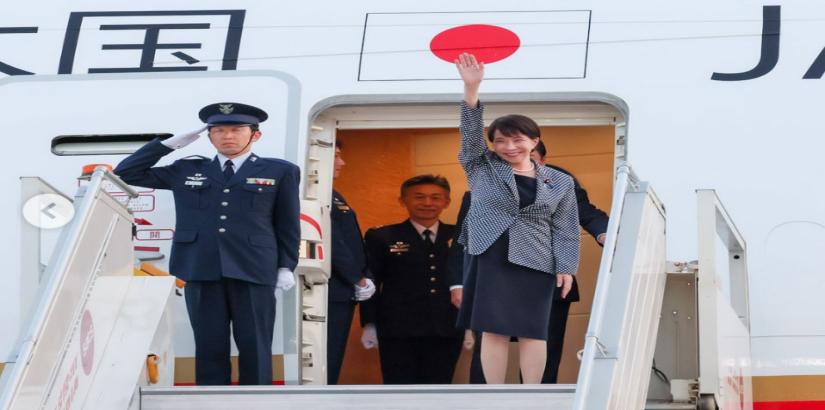
Japanese Prime Minister Sanae Takaichi arrived in New Delhi on Wednesday (July 1) for a three-day official visit, her first bilateral trip to India since assuming office. The visit coincides with the 16th India-Japan Annual Summit, the principal mechanism guiding one of Asia's most important strategic partnerships.
While the agenda includes familiar themes such as trade, investment, infrastructure, defence, advanced technology, artificial intelligence, supply-chain resilience and Indo-Pacific security, this summit assumes greater significance against a rapidly changing geopolitical and economic landscape. From proposals for yen-rupee trade settlement to deeper cooperation in emerging technologies and defence, the outcomes could shape the next phase of India-Japan relations.
The visit comes less than a year after Prime Minister Narendra Modi travelled to Tokyo, where Japan committed to more than doubling its investment in India to over $61 billion during the coming decade.
Strengthening Special Strategic and Global Partnership
The visit also marks her first official trip to India since taking office and is expected to further strengthen the Special Strategic and Global Partnership between the two countries.
Prime Minister Takaichi is scheduled to hold summit-level talks with Prime Minister Modi, with discussions expected to focus on expanding cooperation in trade, investment, technology and innovation. The two leaders are also expected to discuss ways to build resilient supply chains, particularly in semiconductors and critical minerals, while exploring closer cooperation in maritime security, defence technology, and the development of an industrial value chain linking the Bay of Bengal with Northeast India.
The summit will also provide an opportunity for both sides to review the full spectrum of bilateral ties and exchange views on key regional and global developments. The visit follows Prime Minister Modi’s trip to Tokyo last year and underscores the growing strategic partnership between India and Japan.
Japan and India’s Northeast: A Strategic Convergence
There is one important aspect often under emphasised in general discussions — Japan’s engagement with India’s Northeast. Japan’s historical ties with India’s Northeast during the Second World War left an enduring emotional connection. However, Northeast India did not receive sustained attention in Indo-Japan engagements until relatively recently.
It was only about a decade ago that the region began appearing more prominently in official dialogues between the two countries.
FOIP and India’s Act East Policy: Growing Synergy
Connecting Southeast Asia with South Asia gained importance only in recent years as part of Japan’s Free and Open Indo-Pacific (FOIP) vision. India’s Act East Policy, unveiled in 2014, created strong synergy with this approach.
Given its geostrategic location, Northeast India has naturally become a focal point in bilateral engagement between India and Japan.
Infrastructure Cooperation and Early Commitments (2014–2015)
In September 2014, during Prime Minister Narendra Modi’s visit to Japan, both leaders affirmed their commitment to infrastructure development in Northeast India.
In December 2015, Prime Minister Shinzo Abe announced an ODA loan for road connectivity projects in Assam, Mizoram, and Meghalaya, marking one of the earliest structured interventions in the region. Japan is among the first foreign development partners allowed to undertake major projects in Northeast India.
In 2017, India and Japan launched the Act East Forum to deepen coordination and promote connectivity within the region and between Northeast India and Southeast Asia.
Building the Bay of Bengal–Northeast Industrial Value Chain
Japan has also proposed developing a Bay of Bengal–Northeast India Industrial Value Chain aimed at transforming the region into an integrated industrial zone. As part of the Free and Open Indo-Pacific vision, this includes strengthening cross-border connectivity with Bangladesh, Myanmar, Nepal and Bhutan.
Japan, through JICA and other mechanisms, has supported road, rail and port projects aimed at improving regional connectivity. This includes highway upgrades in Mizoram and projects linked to the Kaladan Multi-Modal Transit Transport corridor connecting India and Myanmar.
People-to-People Ties and Cultural Diplomacy
Beyond infrastructure, Japan has also expanded cultural and people-to-people engagement.
Since 2018, Japan has supported Meghalaya’s Cherry Blossom Festival and has invited youth from Northeast India under exchange programmes such as IRIS.
Since 2021, the Japanese Embassy in India and Asian Confluence have jointly hosted the Indo-Japan Intellectual Conclave, bringing together policymakers, academics and entrepreneurs.
ODA Leadership and Long-Term Development Partnership
India remains the largest recipient of Japan’s Official Development Assistance (ODA), much of which is directed toward connectivity and infrastructure projects.
Japan’s sustained involvement in Northeast India reflects the depth of trust between the two countries and reinforces the region’s growing importance in their shared strategic outlook.
As India and Japan jointly expand infrastructure and development cooperation in the Northeast, it is expected to form a stronger foundation for the next phase of bilateral engagement.
(The author is an Indian Army veteran and a commentator on contemporary strategic and emerging technology issues. The views expressed are personal. He can be reached at kl.viswanathan@gmail.com )







Post a Comment