

Regional Geopolitical Powerplay a Challenge for Improved India-Myanmar Relations
China is a major defence exporter for Myanmar, but it has been arming both the Tatmadaw and the rebel forces. China’s aim is to secure its strategic highway through Myanmar to the Bay of Bengal and counter American and Indian influence in the region, including Myanmar and Bangladesh.
 Jun 03, 2026
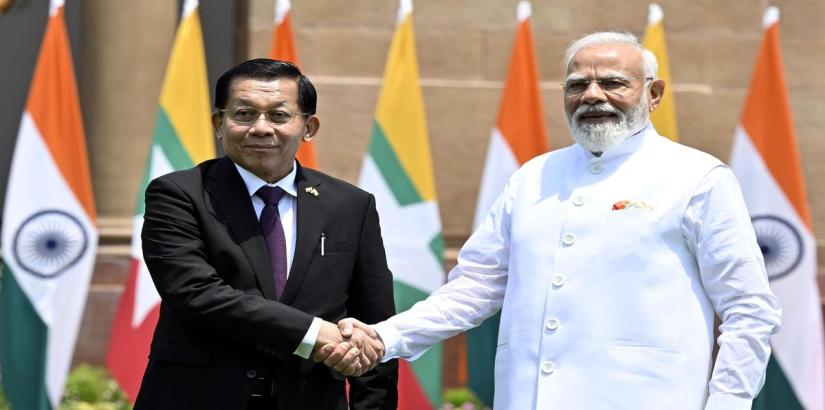
At the invitation of Prime Minister Narendra Modi, President U Min Aung Hlaing of Myanmar arrived on a four-day visit to India on May 30, accompanied by five cabinet ministers, three deputy ministers, senior government officials, Buddhist clerics and business representatives.
Hlaing began his visit by offering prayers at the Mahabodhi Temple in Bodh Gaya, meditated under the Bodhi Tree, prayed at the Sujata Temple in Bakraur and visited the Burmese Monastery in Bodh Gaya.
Hlaing called on President Draupadi Murmu, held wide-ranging discussions with PM Modi, participated in the Myanmar–India Business Forum, and business and industry interactions and site visits, like NTPC facilities for clean-energy initiatives and emerging technologies.
Strategic Importance of Myanmar
Modi and Hlaing discussed deepening bilateral ties to further collaboration in trade, investment, connectivity, development, capacity building, defence and security, border management, development assistance and cultural exchanges. Ironically, India is yet to fully optimize its strategic depth in Buddhism at regional and global levels.
Modi conveyed that India remains Myanmar's trusted neighbour, and first responder in times of crisis, in line with India’s Neighbourhood First, Act East and MAHASAGAR policies. Earlier, Modi had met Hlaing on the sidelines of the SCO Summit in Tianjin (China) last year to discuss defence, security, border management and trade.
India and Myanmar have agreed to accelerate the Kaladan Multimodal Transit Transport Project (KMTTP) and the India-Myanmar-Thailand (IMT) Trilateral Highway. (https://x.com/Sputnik_India/status/2061390346945286204?s=20).
Hlaing’s visit is in backdrop of the US lifting sanctions on several individuals/companies linked to Myanmar's military junta in July 2025, and reports in September 2025 of the Kachin Independence Army (KIA), which controls the rich Chipwe-Pangwa mining belt in Myanmar, gathering rare earth elements (REE) samples at India’s request https://www.thestrategicperspective.org/great-game-myanmar/).
Opposition and rebels in Myanmar (in touch with India) complain of New Delhi hosting Hlaing who “killed democracy in a military coup”. But Hlaing won recent elections and India embraced undemocratic Taliban who strip women/girls of basic rights (https://x.com/AmuTelevision/status/2061031390771028324?s=20)!
There is hype over Hlaing visiting India before China. But Hlaing visited China twice after the military coup in February 2021 – in November 2024 and September 2025. China’s Foreign Minister Wang Yi visited Myanmar in July 2022, May 2023, and April 2026. Qin Gang, Wang Yi’s predecessor, visited Myanmar in May 2023., and Jiang Xi, President Xi Jinping's Special Envoy and Vice Chairperson CPPCC, attended the presidential inauguration of Hlaing in April 2026.
Myanmar is China’s strategic highway to the Bay of Bengal. The China-Myanmar-Economic Corridor (CMEC) and the deepwater Kyaukphyu Port has the same strategic importance for China as the China-Pak-Economic Corridor (CPEC) and Gwadar Port in Pakistan.
For India, the strategic importance of Myanmar as the gateway to the East and its Act East Policy (AEP) cannot be overstated. The fighting within Myanmar has been forcing anti-Tatmadaw rebel elements into India and the prolonged violence has stymied the progress on the KMTTP and the IMT Trilateral Highway projects in which India is deeply invested.
Hlaing Assurance to India
Myanmar is now relaunching offensive against the rebel forces, including for gaining control of the REE mines. As per reports in March 2025, 240+ REE sites (2/3rd of total in Myanmar) came up in Kachin State after an emergency was imposed in February 2021. In the same period, China imported 170,000 tons of REEs from Myanmar.
The insurgent Arakan Army (AA) with a strength of about 45,000, including about 13,000 in Rakhine and Chin states, controls almost all of Rakhine State and about 40% of Chin State. Rakhine State and its maritime ports is viewed more as a potential export and transit corridor from the landlocked Kachin mines, but transporting REEs requires massive infrastructure investments (logistical, financial, and reputational risks) through rugged, active war zones
India plans to fence the Indo-Myanmar border but the border is not fully demarcated and dense forests would require additional troops to guard the fencing as aerial/drone surveillance may not suffice. Many anti-India Northeast insurgent groups are based in Myanmar and Chins of Mizoram want free transborder movement.
India and Myanmar would need to launch a series of joint operations to neutralize insurgents/militant groups along the Indo-Myanmar border belt, akin to Operation 'Sunrise' launched in 2019 (https://www.spsmai.com/experts-speak/?id=666&q=Operation-Sunrise-Joint-Indo-Myanmar-Operation).
Hlaing has assured that Myanmar territory would not be allowed for anti-India operations. However, to expect the situation to normalize anytime in the near future would be naïve, not only because of the magnitude of rebel forces in Myanmar, but also the geopolitical power play in the region.
Growing Chinese, US activity
China is a major defence exporter for Myanmar, but it has been arming both the Tatmadaw and the rebel forces. China’s aim is to secure its strategic highway through Myanmar to the Bay of Bengal and counter American and Indian influence in the region, including Myanmar and Bangladesh.
The US, as always, is playing a double game, softening sanctions against Myanmar officials, while supporting and arming Myanmar rebels through Bangladesh. America aims to restrict Chinese influence in Myanmar and would love an India-China war to draw strategic and economic advantage
The US-China competition in Bangladesh is on the rise, which may have adverse fallouts for India. China continues to draw Bangladesh into its strategic sphere. Bangladesh has now allowed US Navy/other military vessels access to Chittagong and Matarbari ports. Both countries will share military, security-related intelligence and jointly monitor maritime and military activities. This significantly increases US presence and influence in the Bay of Bengal region.
Finally, the question is will the India-Myanmar relationship be allowed to grow in the manner both countries want, including successful completion and operationalizing of the KMTTP and the IMT Trilateral Highway, or will this be hostage to the US-China geopolitical rivalry in the region?
(The author is an Indian Army veteran. Views expressed are personal)





Post a Comment