Banaz Mahmod and Mukhtar Mai, victims of so-called ‘honour’ violence whose cases became powerful testimonies. Banaz through her repeated pleas for protection that went unanswered, and Mukhtar through her public resistance and survival. Screenshots: Good Morning Britain report and TEDx Talk interview (2011).

'Honour’ Still Tries to Silence Women With Community-Sanctioned Enforcement

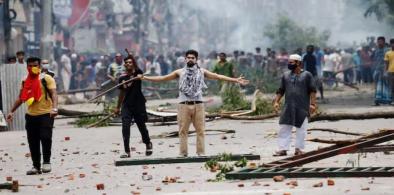
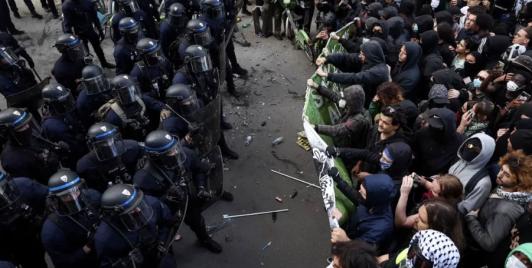
What links these cases — Pakistan, Britain, India, the Netherlands — is not geography or faith, but backlash. ‘Honour’ is used as a pretext to kill not because women are obedient, but because they are not. It is activated when women seek education, choose partners, leave abusive homes, testify in public, or simply insist on being treated as full human beings.


Challenges Facing an AI-Geared World: A Robot Called Out the Failings in India’s Higher Education System

How do our regulators allow a university to function with almost every leadership position, academic and administrative, occupied by a member of the promoter family? How does patent filing become a game, as alleged in this case, or how does a paper authored under the university on banging vessels to kill the coronavirus get written? The incident brought to sharp light how India has slipped into an education system run on high fees by private institutions with questionable credentials.

BNP Rule in Bangladesh May Not Augur Well For India

Under the BNP, particularly during Khaleda Zia’s rule, four major anti-India terrorist camps were being run in the Chittagong Hill Tracts. Notably, these terrorist training camps had Al Qaeda and Pakistan ISI/military instructors. As a young officer, Pervez Musharraf (later president of Pakistan) also served as an instructor in these terrorist training camps. To assume that the radical elements of the BNP will not be in league with the JeI will be the height of naviete.

Four Stars of Destiny: Questions The Debate Is Missing

India needs to evolve a comprehensive and integrated strategy for the defence of the LAC, one that brings together military preparedness, diplomatic engagement, infrastructure development, technological surveillance, economic resilience, and informed public communication. Such a strategy cannot remain confined to closed institutional silos; while operational specifics must remain confidential, the broad contours of national intent and preparedness should be placed in the public domain. Transparency at the strategic level strengthens public confidence, builds national consensus, and signals clarity of purpose to adversaries.

More on Perspective

Crying for justice: Need for Indian government to make speedy justice delivery a mission

The time for half-hearted attempts, and/or conventional methods, has gone by when it comes to delivering justice in India.

Bangladesh Army's stellar role in bringing peace and development to CHT

Local sources claim that multiple tribal terrorist groups are holding hundreds of thousands of people in the Chittagong Hill Tracts as hostages. These groups are active in controlling and influencing their areas through various sabotage and terrorist activities, extortion, kidnapping for ransom, attacks, and counter-attacks.

India celebrates Navy Day commemorating its operational power and maritime history

Indian Navy celebrates Navy Day on 4 December to commemorate "Operation Trident", the Navy’s lethal attack on Karachi harbour during the 1971 war.

COP28 commitments: Need for India to go beyond lip service and gimmicks

The pollution severely affecting the health of the population is of no consequence to India's politicians. It is high time our policymakers look at themselves in the mirror.

Roots of terrorism: Wrong to blame it on a religion

In recent years, a central phenomenon that spurred the rise of terrorist groups has been the United States cultivating fundamentalist Islamist groups through the CIA in client states such as Pakistan. 

Underwater Domain Awareness (UDA) framework needs incorporation in India's Blue Economy vision

The Ministry of External Affairs (MEA) is working towards making the UDA framework an agenda for the multilateral forums in the IOR. 

Free food and election promises: Why India's food security system needs an overhaul

The Niti Aayog estimates using a multi-dimensional approach, that poverty has fallen below 15 percent. Why then are 58 percent of Indians getting free food? Or even if their food security needs have to be addressed, would this be better served by direct benefit transfers?

Why RSS is paying lip service to Ambedkar: Two poles of Indian political spectrum

Ambedkar was for implementing the concept of fraternity; on the contrary, the politics of majoritarianism has spread hatred against minorities, leading to violence and polarization of society.

Furore over 70-hour work week: The message Narayana Murthy could have given instead

It may serve Infosys to have zombies but it can never serve the nation to valorise this as the route to a national revival. Many in India suffer low wages, zero benefits and long work hours. Murthy’s remarks will be used to legitimise these malpractices. 

Amid growing Chinese presence, resumption of old ferry service will boost India-Sri Lanka connectivity

Sri Lanka has always been a very important and strategically critical Indian Ocean neighbour and removing the bottlenecks in their relationships has been a top priority for New Delhi.

Need to put an end to India-Canada friction

Justifiably, India and Sri Lanka are unhappy that the Canadian government is giving the freedom to operate to separatist movements in Canada and is keeping its eyes and ears closed to the violent objectives of the separatists.

Fighting hunger in India that the government refuses to acknowledge

The report notes that India has the highest child-wasting rate in the world, at 18.7 per cent, reflecting acute undernutrition. It places India way below a neighbour like Bangladesh, which has a score of 19, a rank of 81 and is categorised on the GHI Severity of Hunger Scale as “moderate” – a class jump over the Indian numbers.

Same-sex marriage verdict militates against human rights

The verdict certainly is an impediment to the quest for self-respect, individuality and self-esteem of its citizens.India could have set an example with positive affirmation of this right as only Nepal and Taiwan have recognized same-sex unions in Asia.

India needs to pay greater attention to urban planning to avoid future disasters

Townships in our hilly regions are mushrooming in a grossly unplanned and unscientific manner, generating excessive pressure on the rock surface, which can manifest in catastrophes. 

Pakistan has strict protocols in place to prevent chemical and biological terrorism

Pakistan’s CWC Act 2000, Pakistan Bio Safety Rules 2005 and Pakistan Export Control Act 2004 are the evidence of Pakistan's sincerity to the implementation of CWC and BWC. Because of the dedicated efforts of science and policy leaders in Pakistan, the country is on the road to becoming a regional role model in ensuring biosafety and capacity for biosecurity.