

Bangladesh’s Democratic Transition and the Regional Reimagining of South Asia
Bangladesh’s centrality to South Asia is grounded as much in material realities as in symbolic politics. As one of the region’s fastest-growing economies and a strategic gateway to the Bay of Bengal, Dhaka plays a pivotal role in initiatives such as BBIN and BIMSTEC. Its ports and transport corridors provide critical access for landlocked neighbors, while its manufacturing sector integrates regional supply chains. Cross‑border electricity trade with India and Nepal, along with prospective hydropower cooperation with Bhutan, highlights Bangladesh’s emerging role as an energy and connectivity hub.
 Feb 18, 2026
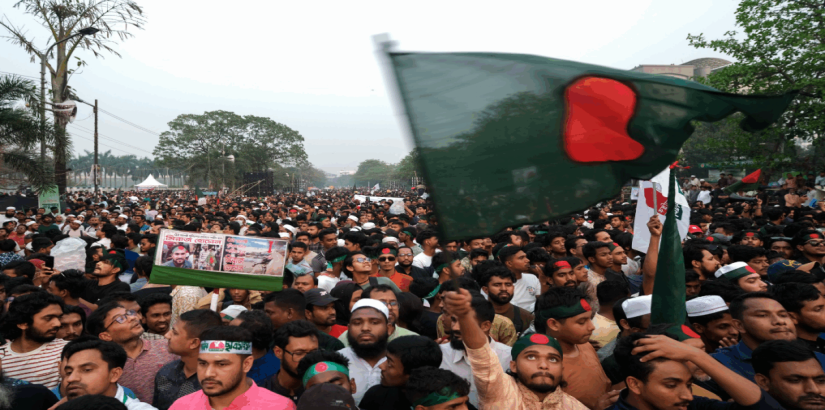
Bangladesh stands at a moment of democratic renewal as the newly elected parliament and government took oath at the South Plaza of the Jatiya Sangsad Bhaban in Dhaka. Led by Tarique Rahman as the incoming prime minister, the ceremony was more than a constitutional formality; it was a moment of political re-foundation. The presence of South Asian dignitaries—including Bhutan’s Prime Minister Tshering Tobgay, India’s Lok Sabha Speaker Om Birla, Nepal’s Foreign Minister Bala Nanda Sharma, Maldives President Mohamed Muizzu, and Pakistan’s Planning Minister Ahsan Iqbal—together with participation from Sri Lanka, and China, underscores how Bangladesh’s political trajectory resonates across South Asia and beyond. In the language of Jean-Jacques Rousseau, the French political philosopher, the oath represents a renewal of the social contract—one that now carries implications beyond the nation-state.
This transition will endure only if its domestic foundations of democratic institutions are strong. Bangladesh’s political history has been marked by cycles of polarization, contested legitimacy, and institutional mistrust and recurring tensions over electoral credibility and institutional neutrality. The restoration of competitive politics following the 2008 general election generated expectations of democratic consolidation, yet these gains were complicated by the abolition of the caretaker government system in 2011 and subsequent disputes over the conduct of elections. Opposition boycotts, allegations of irregularities, and concerns over the politicization of administrative institutions have contributed to a persistent deficit of trust between political actors and the electorate. In this context, the current transition is not merely a procedural change of government but an opportunity to rebuild confidence in the integrity of democratic processes—an outcome that will determine both domestic stability and Bangladesh’s credibility as a regional partner. Bangladesh’s democratic transition will shape not only its domestic stability but also its capacity to act as a credible and constructive force in South Asia, making internal legitimacy the foundation of regional engagement.
The new government’s foremost challenge is therefore not only to govern but to reconcile—bridging divides between political parties, state institutions, and citizens. As Hannah Arendt, the German political theorist, reminds us, politics is defined by the capacity to begin anew through collective action. The oath is not merely procedural—it is a test of democratic credibility to restore trust and rebuild democratic legitimacy. Without such internal cohesion, Bangladesh’s capacity to act as a credible regional actor will remain constrained.
Importance of Regional Presence
The regional presence at the ceremony reinforced this imperative. Diplomatic participation functions not only as protocol but as political signaling. India’s decision to send its parliamentary speaker underscores an emphasis on institutional continuity, while participation from Pakistan, Maldives, and Nepal reflects a broader recognition that Bangladesh’s stability affects the strategic equilibrium of South Asia. In the framework of Jürgen Habermas, such ceremonies can be understood as “communicative acts”—symbolic gestures that open space for dialogue in a region often defined by mistrust. The oath-taking, therefore, is not only a national ritual but a regional conversation. Bangladesh’s democratic renewal is not confined within national borders; it will reverberate across South Asia, influencing both regional cooperation and the balance of trust among neighbors.
Bangladesh’s centrality to South Asia is grounded as much in material realities as in symbolic politics. As one of the region’s fastest-growing economies and a strategic gateway to the Bay of Bengal, Dhaka plays a pivotal role in initiatives such as BBIN and BIMSTEC. Its ports and transport corridors provide critical access for landlocked neighbors, while its manufacturing sector integrates regional supply chains. Cross‑border electricity trade with India and Nepal, along with prospective hydropower cooperation with Bhutan, highlights Bangladesh’s emerging role as an energy and connectivity hub. At the same time, Dhaka has established itself as a global voice for climate justice, particularly in negotiations on Loss and Damage. The challenge now is to translate this international leadership into regional collaboration—an effort that could redefine South Asia’s collective resilience and position Bangladesh as both a connector and a catalyst for shared adaptation.
Navigating Between Competing Powers
This interconnectedness is particularly evident in Bangladesh’s relationship with India. Bilateral ties have experienced periods of strain, especially during phases of political transition, when questions of legitimacy and trust complicated cooperation on trade, connectivity, and security. The presence of India’s speaker at the oath-taking ceremony signals a potential opening for recalibration. Revitalizing stalled initiatives under BBIN and BIMSTEC, expanding cross-border energy trade, and strengthening climate cooperation could redefine the relationship. Such engagement must ensure that the gains of regional integration are distributed equitably, benefiting not only state elites but also ordinary citizens.
At the same time, Bangladesh’s engagement with China introduces an additional layer of strategic complexity. Economic ties—particularly through infrastructure investment and trade—have expanded under the Belt and Road Initiative. These partnerships offer opportunities for industrialization and energy security, yet they also raise concerns about debt sustainability and geopolitical alignment. The challenge for Dhaka lies in navigating between competing powers without becoming subordinated to either. Bangladesh’s diplomatic strength lies in its ability to convert economic relationships into symbolic capital—positioning itself as a bridge rather than a battleground.
Beyond the major powers, Bangladesh’s engagement with smaller South Asian states is equally consequential. For Nepal and Bhutan, access to Bangladeshi ports represents a critical economic lifeline, while cooperation in hydropower can reshape regional energy markets. With the Maldives, shared vulnerabilities to climate change create opportunities for joint adaptation strategies, while Sri Lanka offers avenues for collaboration in trade and maritime security. These relationships demonstrate Bangladesh’s potential to act as a connective node—linking smaller states into a more integrated regional framework.
The challenges facing Bangladesh are, in many respects, regional in scope. Poverty reduction, youth employment, and inclusive growth remain pressing concerns across South Asia. With one of the world’s youngest populations, the region stands at a demographic crossroads: without sufficient opportunities, the risk of social instability looms; with effective policies, the potential for economic transformation is immense. Climate change presents an even more profound challenge. Rising sea levels threaten Bangladesh and the Maldives, glacial retreat affects Nepal and Bhutan, and erratic monsoons disrupt livelihoods in India and Pakistan. These are not isolated crises but shared vulnerabilities that demand collective solutions.
Within these challenges, however, lie opportunities for regional reimagining. Cooperation in trade, energy, and connectivity can unlock new pathways for growth, while joint climate initiatives can enhance resilience. Bangladesh’s democratic renewal—if consolidated through inclusive governance—positions it to play a leading role in this transformation. The legitimacy derived from internal cohesion can translate into credibility abroad, enabling Dhaka to champion a more cooperative regional order.
Bangladesh as a Connective Force
The oath-taking of Bangladesh’s new government is more than a ceremonial transfer of power; it is a test of whether democratic legitimacy can be restored and translated into regional leadership. At home, the promise of this moment will be judged by the government’s ability to bridge divisions, rebuild trust, and ensure that institutions command genuine public confidence. Without such credibility, Bangladesh’s ambitions abroad will remain constrained.
Yet if this renewal succeeds, its implications extend far beyond Dhaka. In a region often defined by mistrust and fragmentation, Bangladesh has the potential to act as a connective force—advancing cooperation in trade, energy, climate resilience, and migration. The challenge is not merely to participate in regional frameworks, but to help redefine them around shared interests rather than competing nationalisms.
The oath taken February 17 is therefore both a commitment and a proposition: that democratic legitimacy at home can underpin cooperation abroad. If Rousseau’s social contract begins at home, its extension into South Asia requires what Amartya Sen calls "public reasoning" across borders. Bangladesh’s democratic renewal is therefore both a national covenant and a regional experiment in solidarity. If it succeeds, it may contribute to a more cooperative regional environment; if it falters, longstanding challenges are likely to persist.
(The author is Professor and Chair of the Department of Economics, International University of Business Agriculture and Technology (IUBAT), Dhaka. His research focuses on regional trade, sustainable development, and South Asian economic cooperation. Views expressed are personal. He can be reached at golam.grasul@gmail.com)





Post a Comment