India’s basmati exports are significantly affected as over one-third of production is shipped to West Asia, Europe, North Africa and North America via the Red Sea.
These myth-based narratives reveal a deeper psychological impulse: the desire to anchor Sinhalese Buddhist identity within a framework of global uniqueness and divine purpose. While Sri Lanka’s diplomatic relations with Israel have fluctuated since independence, Sinhalese Buddhist nationalist sentiment continues to exhibit a strong emotional affinity toward Israel.
India’s youth are growing up in an ecosystem defined by continuous stimulation and accelerated consumption of information. Attention is fragmented, patience for complexity is declining, and long-form engagement—essential for policy, administration, and strategic thinking—is increasingly marginal. This is not a cultural lament. It is a structural shift with direct consequences for how future administrators, policymakers, and institutional leaders are formed.
By engaging Jordan, Ethiopia and Oman, India demonstrated its capacity to operate across geopolitical divides while remaining anchored in Global South solidarity. These visits were not isolated diplomatic events but part of a sustained effort to reshape international engagement through inclusivity, responsibility, and shared growth. As global uncertainties persist, India’s outreach to West Asia and Africa strengthens its claim to leadership rooted in partnership and a collective vision for a more equitable world order.
The security situation deteriorated further in 2025. A terrorist attack on a Gilgit-Baltistan Scouts checkpost resulted in two fatalities and one injury, heightening tensions. Protests later resumed in Sost, disrupting trade between Pakistan and China via the Khunjerab Pass. The year culminated in two high-profile attacks on October 5, when unidentified gunmen ambushed Maulana Qazi Nisar Ahmed, Ameer of the Ahl-e-Sunnat wal Jamaat in Gilgit-Baltistan and Kohistan, near the police headquarters in Gilgit, injuring him and several others. On the same day, Malik Inayat-ur-Rehman, the Chief Court Judge of Gilgit-Baltistan, narrowly escaped an assassination attempt near the City Hospital.
India’s basmati exports are significantly affected as over one-third of production is shipped to West Asia, Europe, North Africa and North America via the Red Sea.
India-US defence cooperation has made fair headway leading to INDUS-X which has initiated the information network and regulatory mechanisms to deepen defence technology collaboration that is poised to strengthen the bonds of US-India partnership, innovation and deterrence.
The Indian Science Congress has for the last many years been accepting papers that have no scientific basis and are based on mythology. Pained by this all prominent scientists came together and issued a statement calling upon the government to stop the undermining of scientific methods and thinking
The overall contribution of agriculture to GDP growth this year will be below 1 percent as per the latest estimates. This is worrying for various reasons, most importantly for what it means for the livelihoods and incomes of rural families.
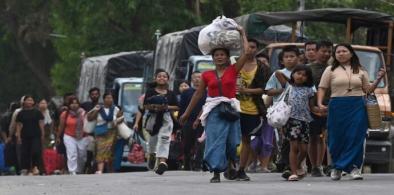
Manipur appears to be veering toward massive armed attacks against the tribals – both the Kuki-Zo and Naga, with the state administration remaining ambivalent. This is a dangerous development - civil war in a state bordering Myanmar which itself is experiencing rising violence.
While the government employees belong to organized class, there are an estimated 300 million people in India who belong to the unorganized class living on daily wages or are self-employed without economic and social security.
In a chapter titled “Choice before Capitalists”, Gandhi writes, “At present, there is no proportion between the wholly unnecessary pomp and extravagance of the moneyed class and the squalid surroundings and the grinding pauperism of the ryots in whose midst the former are living.”
At present, there aren’t even any direct flights between Pakistan and Nepal, even as Kathmandu promotes itself as the meeting place of South Asia, noted journalist Kanak Mani Dixit.
While the Army, Navy and Air Force are doing whatever is required to maintain their battle effectiveness, there is a dichotomy that prevails in how New Delhi is dealing with China and Pakistan.
India did not get subdued by colonial culture in totality. What we are facing today is the promotion of religiosity and conservatism. Since politics is stalking the streets in the garb of religion, India's traditional syncretic culture is coming under attack from conservative and orthodox values.
But what cannot be rejected is the increasing need to recognise the role of cities and make them the vanguard in combating climate change.
Unless there is a quantum jump in the expenditure on (quality) education and a massive generation of productive employment, the youth and the poor will remain marginalised and excluded.
This exercise which began with just four countries and has now reached a participation level of over twelve times that number goes to show the recognition of India as a naval power and as a regional maritime security provider.
It is noteworthy that a strong and vociferous point of view against the developments in Ayodhya has come from religious leaders rather than the political opposition, which has struggled to frame its line of argument clearly.
I feel one of the important reasons for rural migration is the non-availability of good high schools. Too often good people go to big cities for better schools for their children. Excellent schools in rural areas can help attract good educated and professional people to these areas which in turn can also benefit from their contributions in various fields.