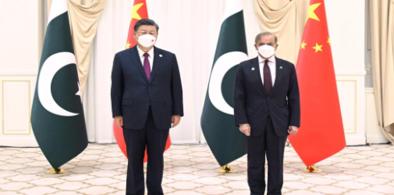
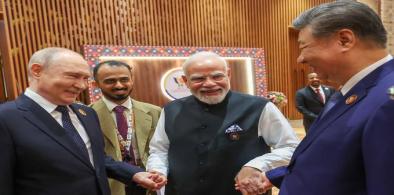
Khamenei and his successor Mojtaba Khamenei, Trump and Netanyahu

Khamenei's Assassination and a Fractured Iran: Regional and Global Ramifications of a War of Attrition

Khamenei’s assassination terminates an epoch of ideological confrontation, yet inaugurates profound uncertainty. Legally and normatively, it imperils protections for sovereign leaders; strategically and politically, it probes Iran’s institutional fortitude; religiously and narratively, it unveils unifying and divisive societal forces. Diplomatic containment—through intermediaries such as Oman or Qatar—must prioritise the transition's fragility without incitement. Absent such prudence, this strike risks catalysing a wider regional conflagration, where initial tactical triumphs yield enduring strategic costs.

Reimagining a Cooperative South Asia: A Next-Gen Agenda to Revive SAARC

The revival of SAARC will not come from dramatic diplomatic breakthroughs. Instead, it will emerge through incremental cooperation in education, digital infrastructure, disaster response and trade facilitation. Crucially, the future of South Asian regionalism may depend on a generation that increasingly experiences the region not through borders but through shared digital, economic and cultural networks.

US–India Tariff Framework: Trade Concessions Should not Dictate Foreign Policy Choices

Trade adjustments between major economies inevitably reverberate beyond bilateral channels. Bangladesh’s potential tariff advantages in textiles could redirect labour-intensive supply chains. Pakistan, operating within the China-Pakistan Economic Corridor framework, may use India’s perceived alignment with Washington to advance its own strategic narratives. China itself will interpret these developments within the broader context of great-power competition and recalibrate its economic and strategic posture accordingly.

Why Nepal’s Gen Z Succeeded Where Bangladesh’s Failed

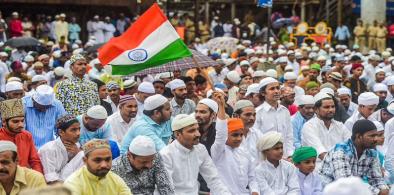
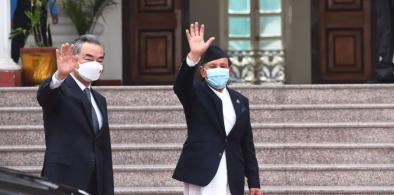
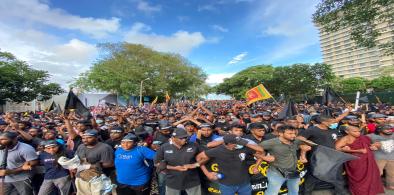
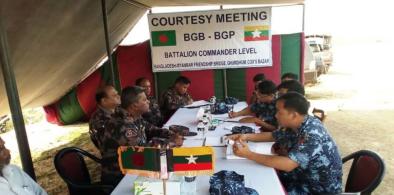
A more comprehensive lesson about 21st-century youth politics can be learned from the story taking place between Kathmandu and Dhaka. Gen Z has extraordinary mobilization skills. Protests can grow quickly and upend established power structures thanks to social media networks. But mobilization is insufficient on its own. Successful political transformation requires organization, leadership, and institutional strategy. Nepal’s youth built those structures quickly. Bangladesh’s did not.

More on Spotlight

Has quest for 'strategic depth' become Pakistan’s tactical disaster?

As of now, Pakistan’s much-sought ‘strategic depth’ with a friendly government in Afghanistan has proved elusive, writes Mahendra Ved for South Asia Monitor

Why Indian money rules world cricket

Millions of Indian cricket fans across the globe are the real foundation of the Indian cricket board's financial power, writes Qaiser Mohammad Ali for South Asia Monitor

In India's hijab row, Muslim girls' education trapped between extremists of both religions

The Hindu rightwing gets its due provocation from Muslim communalism and extremism. Is there any role of Muslim communalists in fueling the hijab row?, writes Ram Puniyani for South Asia Monitor 

Nepal power: Caught between Chinese capital and Indian market

Nepal will be permitted to export power to Bangladesh via India at a later time in order to fulfill the expanding energy demands of that country, writes Benedict B. George for South Asia Monitor 

After Beijing, its destination Moscow for Pakistan PM Imran Khan: Can Russia take Islamabad at its word?

Russia is well aware of how Pakistan has been facilitating the movement of ISIS cadres from Iraq-Syria into northern Afghanistan at the behest of the US, writes Lt Gen P.C. Katoch (retd) for South Asia Monitor 

An adrift Congress in India is a serious problem for democracy

It takes no great political intelligence to point out that a tumultuous democracy like India desperately needs a credible national counter to Modi’s BJP, writes Mayank Chhaya for South Asia Monitor

Growing presence of women in India’s armed forces: An issue that should not be politicized

One major reason the Indian Army has not allowed women officers in fighting arms and would not like to do so is that it does not want them captured by the enemy, writes Col Anil Bhat (retd) for South Asia Monitor

The interplay of caste and politics in India's most populous state

The recent trends in elections have shown undeniable evidence that women no longer remain passive voters, writes Shraddha Nand Bhatnagar for South Asia Monitor

Bangladesh has stake in peace and stability in India's Northeast

Connectivity and infrastructural development with Bangladesh will also open up new routes to India's Northeast, Bhutan and Nepal, writes Benedict B. George for South Asia Monitor

India’s intangible heritage: Its composite, living culture carries a multidimensional message in trying times

Such recognition by UNESCO, whether of Durga Puja or Srinagar as a Creative City, helps to underline that India’s culture is a living culture, writes Amb Bhaswati Mukherjee (retd) for South Asia Monitor

The Nightingale has fallen silent: Lata Mangeshkar's music had universal appeal

Numbers have defied easy recording, whether Lata sang 25,000 songs or 30,000, for an estimated 1,000 films, writes Mahendra Ved for South Asia Monitor

India must not politically or economically appease China

The fact remains that as long as India, Nepal and Bhutan do not protest Chinese aggressive moves because of political compulsions China will keep having its way, writes Lt Gen P. C. Katoch (retd.) for South Asia Monitor

Sri Lanka will come out of its present crisis stronger

With heightened external geopolitical fissures in the region, balancing infrastructure diplomacy between China, India and the US is indeed a daunting challenge for Sri Lanka, writes Sugeeswara Senadhira for South Asia Monitor

Why does Pakistan lag far behind Bangladesh?

Although Bangladesh was a part of Pakistan, it has already surpassed Pakistan in almost all socio-cultural and economic indicators, writes Jebeda Chowdhury for South Asia Monitor

Appropriating Subhas Chandra Bose: He was equally critical of both Muslim and Hindu communal streams

Bose was very clear that in independent India equal opportunities should be thrown open to all, irrespective of caste, creed or religion, writes Ram Puniyani for South Asia Monitor