
The Sufi Storyteller

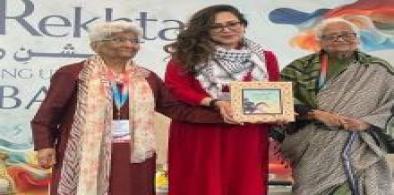
Sufi, Spirit and Resistance: A Layered Work Grounded in South Asian Storytelling Traditions

The Sufi Storyteller speaks to a wider South Asian moment, where Sufi traditions are increasingly invoked as counterpoints to narrowing religious and cultural orthodoxies. By foregrounding storytelling as both a spiritual and political act, Mansab gestures toward the enduring power of narrative to sustain pluralism, recover marginalized voices, and imagine more expansive forms of belonging.

From Death to Immortality: The Mahabharata is Worth Reading - And Questioning

A young woman reading Draupadi's story today and feeling angry about it is not being irreverent. She is doing exactly what you are supposed to do with a text this old and this serious, which is to feel it in your own body and think hard about what it means for where you actually are. We do not honour the Mahabharata by protecting it from that. We honour it by continuing to argue with it

AI and Children: Proper Teaching of AI in Schools a Must to Fire Creativity

Recent evidence also suggests that AI chatbots are being used by teens to plan violence and other harmful activities. Like all technologies, AI is a double-edged sword. It can either be used for very creative work or destructive activities. Thus, there is a tremendous responsibility for teachers to teach the children and youngsters about the positive aspects of AI.

Unity Without Uniformity: Why Diversity Is the Foundation of Peace

If diversity and unity are to guide the future, education must change.Most schools and universities today serve industrial monoculture and economic growth. They train the intellect — the “left brain” — to produce administrators and managers. Rational analysis is important, but it is only half of human potential. We also have a “right brain”: intuitive, holistic, relational. An education that neglects creativity, empathy and ecological awareness produces imbalance. It strengthens uniformity and weakens diversity.

More on Medley

The Indian diaspora's 'indentured route' - and a 'lost' children's quest for identity

Ironically, the forced migration also laid the seeds of a diaspora in countries where Indians of another generation looking for better economic opportunities would not have normally settled.

Why was the Aragalaya movement in Sri Lanka personal to me?

What had started as unrest – in response to decades of failed promises, nepotism – had been reduced to a mob seeking revenge. The question remains on how to preserve the spirit of the former whilst recognising the nature of the latter.

A South Asian film festival in Lahore - and the allegory of a sacrificial lamb

A well-connected and bonded youth of the region can ensure a much happier, more creative society and contribute to a better future.

The Eurocentric Nobel Prizes: Smacking of biases and double standards

After all how objective or desirable can the Nobel Prize for Peace be if Mahatma Gandhi, the greatest messenger of non-violence the world has seen for centuries, never got it? His name was nominated several times but Sweden did not want to annoy Britain. 

A World Cup without boundaries? Musings of a South Asian cricket fan

I am thrilled that Pakistan will be playing in India. I’m thrilled that this format allows an India-Pakistan encounter. Obviously, it’s something any cricket fan would look forward to. This is the World Cup and not a bilateral series, so it’s extra special.

How a South Asian film festival grew to an Oscar-qualifying cinema platform

And now Rita’s idea for a Tasveer Art Center, a progressive, secular, and inclusive safe place that would house a state-of-the-art auditorium, filmmaker's studio, art gallery, and a hall to hold up to 300 people among other cutting-edge facilities, is her latest dream project.

Ashrams for education: Remembering Gandhi, Tagore and their holistic approach to learning

As we think of the relevance of ashram ideals in the thought of both Tagore and Gandhi, we realise that they were ecologically inspired. Gandhi Jayanti 2023 may help us consider the importance of an education engaging with our natural environment.

King Khan opens up a bold new space for Bollywood

The industry prefers a winning formula to creative exploration, particularly in big-budget films populated by rocking stars with fancy fees. Will that change from hereon with the success of ‘Jawan’? We have on offer a new path for Bollywood, a path that can use its huge and unrivalled soft power to drive home some significant messages of the kind and in a way it has rarely attempted in a big-budget extravaganza.

When the music died: Afghanistan’s performing arts fall silent under Taliban rule

The famed Afghanistan National Institute of Music, the country’s only music school, had to shut down its campus in Kabul after the Taliban's crackdown. It has temporarily relocated to Lisbon, Portugal, where 273 students, faculty members and staff have been granted asylum.

Audacity to play: The remarkable story of women’s cricket in Pakistan

That the writer is Indian and male makes this book all the more remarkable. Puthran has captured not just the state of the sport in Pakistan but also the social, political, religious and administrative challenges women cricketers here face at every step. 

Empowering youth for carbon neutrality: Making campuses living laboratories for Net Zero

India's pledge to attain Net-Zero carbon emissions by 2070, articulated by PM Modi at COP26 in Glasgow, UK  underscores the nation's determination to combat climate change. In this context, higher education institutions take center stage for moulding future-ready policymakers.

A Bollywood film and a tragic tale: Poor road safety awareness remains region's blight

In India alone, some 150,000 people lose their lives to road crashes every year, with more than five times that number injured or maimed for life. Pakistan, Bangladesh, Nepal and Sri Lanka have equally dismal or worse statistics in the matter of road safety.

Mantra of happiness: Live in the moment

Too much planning brings misery because we cannot predict the forces of the future and hence have no control over them. This obviously leads us to worry about the outcome. We should therefore follow the American maxim; “We will cross the bridge when we come to it”.

“Oppenheimer” and the Bhagavad Gita: How the Hindu scripture became the American physicist's moral compass

There was something profoundly moving to note that a deep philosophical insight given by Krishna Dvaipayana better known as Ved-Vyasa, the creator of the Gita and the Mahabharat, many millennia ago, should come to underpin the most defining event of the 20th century and beyond.

When folk culture gets commercialised, the visual language of nature gets lost

What we see in the problematic use of folk culture in Modern Indian art is the way the celebration of nature has been privatised and turned into a consumer item that becomes a part of the art industry.