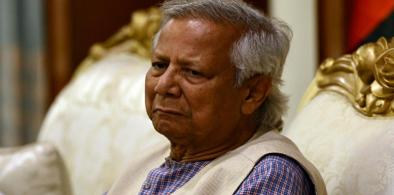


India's Prime Minister Narendra Modi meets Bangladesh's interim government head Muhammad Yunus

Bangladesh–India Relations at a Crossroads: Needed Recalibration, Not Rupture

The current strains in Bangladesh–India relations should therefore be seen not as an inevitable deterioration, but as a test of diplomatic maturity. Bangladesh and India share more than geography and history; they share a responsibility to ensure that temporary political frictions do not harden into structural mistrust. In a time of regional uncertainty, neither country benefits from a relationship defined by grievance or miscommunication. 

A Dangerous Power Grab in Pakistan; Unpredictable Consequences For Region

The 27th Amendment, celebrated by its proponents as a security reform, is in reality a political coup executed through constitutional means. It marks not only Munir’s personal triumph but the institutional victory of the military over all other state authorities. As history warns, empowering any unelected institution above the republic’s elected will invites instability—not strength. Pakistan may soon discover that consolidating military power does not secure the nation’s future, but instead places it at greater risk

How Foreign Digital Influencers Are Tarnishing India’s Global Image

India must now transition from conventional soft-power thinking to visibility governance—the systematic management of how the country appears, circulates, and is emotionally interpreted across global platforms. Failure to do so will leave India’s global image increasingly shaped by commercial incentives outside Indian control.  

Afghanistan Should Not Get Caught In The India-Pakistan Strategic Rivalry

The strengthening of Taliban-India ties runs counter to Pakistan’s interests. The more border clashes intensify between the Taliban and Pakistan, the more secure the Kashmir region and the Line of Control (LoC) become for India. Under such conditions, Pakistan will remain preoccupied with its northwestern border, giving India a unique opportunity to consolidate its control over Kashmir and potentially weaken, drive out, or eliminate Kashmiri militant groups 

More on Spotlight

Unlimited lessons from a limited war: Questions that need to be asked

Trump equated India and Pakistan when he spoke on the ceasefire, erasing the genuinely-earned and the increasingly well-accepted de-hyphenation of two neighbours that were born at the same time but have walked very different paths – India as a secular nation that is an economic powerhouse while Pakistan as a failing democracy that faces economic uncertainty. This re-hyphenation is a sorry picture because it dwarfs India and keeps the nation confined and limited

War is not a solution: India and Pakistan's priorities lie in dealing with human suffering, building on core strengths

So, instead of becoming two adversaries and wasting money and men on terrorism and war, both nations should focus on education, health, employment and on building nation specific infrastructure projects. Today, the breed of strong global leaders with ethics and morality is fast disappearing. War between nations is exploited to boost weapon trade.

How Modi’s India is Rewriting the Rules of Warfare and Reshaping Regional Dynamics

The consequences are dangerous. Both sides now feel compelled to respond forcefully, fearing that restraint might be perceived as weakness. Pakistan, already grappling with economic and political instability, faces increased pressure to retaliate. For India, any future terror attack is likely to provoke immediate military response. The threshold for conflict has lowered significantly—creating a volatile environment where a single militant operation could ignite full-scale war.

The India-Pakistan Conflict and Its Impact on Sri Lanka

Sri Lanka often finds itself navigating a diplomatic tightrope. While it shares strong cultural, economic, and historical ties with India, it also engages with Pakistan through trade, defense training, and political goodwill. The India-Pakistan rivalry sometimes limits Sri Lanka’s foreign policy options and restricts deeper ties with one country for fear of antagonizing the other.

Operation Sindoor marked a paradigm shift in India’s counter-terrorism posture

Pakistan, on the global stage, once again struggled to maintain credibility. In a widely viewed CNN interview, Pakistan’s Defence Minister Khawaja Asif failed to present evidence supporting claims of downed Indian jets. When pressed, he deflected by citing “Indian social media,” culminating in a moment of international embarrassment.

India must fortify Chicken's Neck: Is Bangladesh Becoming A Platform For Regional Destabilization?

It is no exaggeration to say that if Bangladesh were to fall further into the orbit of India’s adversaries, the Chicken’s Neck becomes a chokehold. In wartime, an adversarial Bangladesh could cut off India’s northeast with little provocation. Even peacetime sabotage—intelligence disruptions, smuggling of insurgent arms, or cross-border terrorist infiltration—could cripple India’s internal security.

South Asia’s Media at a Crossroads: Freedom, Control, and Crisis

South Asia’s media is at a crossroads, where its democratic function as a watchdog is at odds with its struggle for financial viability. While the ever-expanding digiverse continues to offer immense opportunities for journalism and its potential to expose corruption and human rights violations as well as challenge mainstream and official narratives, the big question remains – how does the media sustain itself?

India’s Unprecedented Retribution Against A 'Rogue State': The Battle Against Terror Should Not Go Unfinished

Reportedly, the Kirana Hills—near the fortified underground nuclear storage site at Mushaf-Sargodha—were struck by a BrahMos missile. According to idrw.org, the strike on Rawalpindi’s Noor Khan base sent shockwaves through the Pakistan Army leadership, especially its chief, General Asif Munir. The operation exposed critical vulnerabilities in Pakistan’s nuclear deterrence. 

Pakistan' State Sponsorship Of Terror: World Cannot Afford To Look The Other Way

Kashmir is no longer a remote valley; it is the litmus test of global resolve against state-sponsored terror for reasons other than the wellbeing of its people. Pakistan’s duplicity is an open dossier. FATF grey-listing (2018-22) barely dented its war-chest because petrodollars kept the financial arteries open. Arun Shourie labelled this “strategic mendicancy milking Western fears of a failing nuclear state while fertilising jihad". The Pahalgam attack proves the scam endures. 

India-Pakistan Tensions and Abstract Justice: Who Lost, Who Gained?

Perhaps, the truth lies elsewhere, in the gaping holes of a failing system, the persistent lapses in security, intelligence and governance. And this, despite allocating billions in public funds, our money, our labour, to national security year after year. And yet, it is ordinary citizens who remain vulnerable, targeted again and again.

Operation Sindoor: India’s Strategic Shift in Deterrence Against Pakistan

India’s Operation Sindoor is not just a military retaliation—it is a signal of strategic transformation. With an emphasis on long-term credible deterrence, operational depth, and multi-domain pressure, New Delhi is redefining the rules of engagement with Pakistan. Islamabad would do well to recalibrate its approach and recognize the new reality: any miscalculated aggression will now face an overwhelming and multi-layered response.

Messaging in Times of Conflict: Fielding Muslim And Hindu Women Officers at Indian Media Briefing Was Smart Move

For the Modi government generally and the prime minister particularly, who has mastered the art of messaging and social media optics, deploying the two women is widely seen as a smart symbolism. Their gender and religions, incidental in the context of the armed forces, carried a strong message for Pakistan and the rest of the world.

Post-Pahalgam Kashmir mourns with nation like never before: Need to bridge gap between communities

But this time, the condemnation is unanimous and intense. I cannot recall another instance where all of Kashmir shut down in protest against terrorists who were not only Muslims but also backed by Pakistan, a country that once enjoyed sympathy among a significant section of the population. 

South Asia: Terror, Misinformation and Communal Politics

If South Asia is to overcome its myriad challenges—from religious extremism to geopolitical rivalries—it must reaffirm its commitment to secularism, inclusion, and regional cooperation. The costs of continuing down the current path are too high—not only in lost opportunities but in human lives.

Pahalgam Tragedy: Need to Reclaim Peace and Trust in Kashmir

Terrorism cannot be fought through centralization and alienation. Disempowering local leadership and repeatedly failing in intelligence and security—as seen in Pulwama and now Pahalgam—are grave concerns. Kashmir, as an integral part of India, must be given the dignity of full democratic participation.