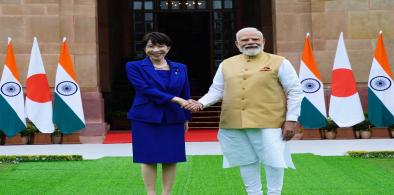

Representational Photo

Who Will Govern AI? Its Consequences Will Shape Global Order

Humans have always pretended we can resist new inventions, from the printing press to electricity to computers, only to discover that the world shifts regardless. AI is different only in degree, not in pattern. It moves faster than our debates, scales faster than our regulations, and integrates faster than our instincts. The question is no longer whether AI will matter. It is whether we will matter in deciding how it is used.

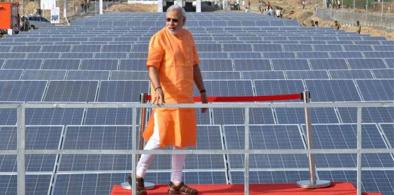
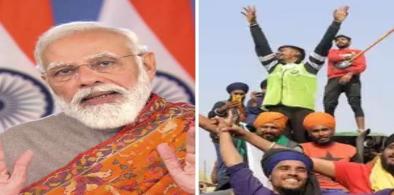
Modi’s Israel Visit and India’s Expanding Role in West Asia

The broader geopolitical implications of Modi’s visit are equally significant. India’s expanding footprint in West Asia reflects its transition from a traditionally non-aligned actor to a proactive participant in regional affairs. Unlike major powers that often approach the region through rigid alliances, India seeks flexible partnerships rooted in strategic autonomy. Its engagement spans Israel, the Gulf monarchies, and Iran, allowing it to maintain a diversified diplomatic portfolio. 

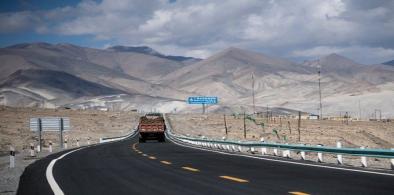
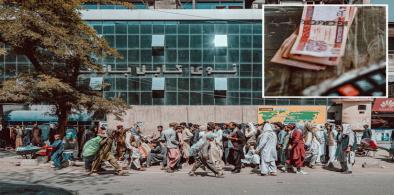
Pakistan’s Afghan Blowback: Strategic Depth Turns Strategic Liability

The larger lesson is sobering. Pakistan’s experience illustrates the perils of instrumentalising militant proxies for short-term strategic gain. Strategic depth, once viewed as a force multiplier, has become a source of strategic vulnerability. As Islamabad turns to air power to manage a problem decades in the making, the deeper fracture lies not just along the Durand Line—but within the logic of proxy warfare itself.

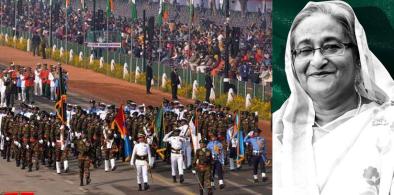
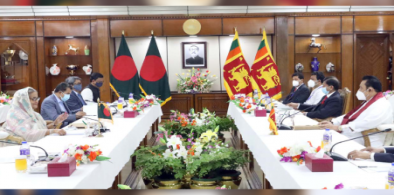
India’s Global Power Trajectory: Strategic Implications for Bangladesh and Region

However, a balanced assessment suggests that India’s superpower trajectory could also generate opportunities for Bangladesh. Enhanced regional connectivity, expanded market access, greater investment flows, and improved regional stability could benefit Dhaka—provided cooperation and mutual respect remain central to bilateral engagement. Ultimately, the impact on Bangladesh will depend not only on India’s power trajectory but also on how both countries manage diplomacy, trust-building, and regional cooperation in an evolving geopolitical landscape.

More on Spotlight

La Perouse: Quad emerges as strategic fulcrum of like-minded nations

Over the last year, both UK and Germany have also indicated that they propose to send their naval units to the IOR periodically for joint exercises, given the salience now accorded to the Indo-Pacific as a region, writes Cmde C Uday Bhaskar (retd) for South Asia Monitor

Is India turning its back on its benevolent past to shut doors on immigrants?

This is another aspect of the ‘Idea of India' on which the ruling party differs from the views of its opponents who swear by India’s multicultural society against the “one nation, one people, one culture” concept of the Hindu right, writes Amulya Ganguli for South Asia Monitor

The overseas Indian and the false notion of Indianness

It is simplistically assumed that no matter what, the overseas Indian considers himself/herself to be, first and foremost, Indian. When the person does not conform to such expectation, there is a sense of betrayal and of feeling let down, writes Amb Amit Dasgupta (retd) for South Asia Monitor 

Pakistan’s 1971 war debacle: A Bengali judge's report lies buried with little accountabilty

The five-year effort of Justice Rehman and two high court chief justices, and their damning indictment, seem to have made no impact either on the political class or the military in Pakistan in the long run, writes Mahendra Ved for South Asia Monitor 

Can the UAE bring India and Pakistan back on dialogue path?

Had the Pakistan government had the moxie to act on recent thawing developments on the trade front, it could have given a golden opportunity for both nations to start discussions and dialogue, opening new doors to enhance bilateral, social, political, and economic relations, writes Asif Rameez Daudi for South Asia Monitor

South Asia needs strategic integration for closer economic cooperation

The COVID-19 pandemic which has brought about a common set of challenges to all countries of the South Asia region necessitates the need for developing and strengthening a common agenda for trade and economic cooperation, writes Partha Pratim Mitra for South Asia Monitor

Kathmandu’s deteriorating air quality: Nepal should seek compensation from China, India

Nepal has all the right to claim compensation from its two neighbouring countries – China and India - two of the world’s biggest polluters, write Jivesh Jha & Alok Kumar Yadav  for South Asia Monitor

Pakistan a responsible nuclear state: Uses nuclear energy for economic progress, social prosperity

Pakistan is in a position not only to use nuclear energy for its national programmes for development and progress, but also can provide assistance to other countries of the region in the peaceful uses of nuclear energy, writes Rabia Javed for South Asia Monitor

China will dominate Persian Gulf through strategic pact with Iran; major implications for region

The PLA presence in Iran, which may rise, should be seen in conjunction with PLA presence in Pakistan, Sri Lanka, and in the garb of civilians in development projects around the world, the Middle East and Oman included, writes Lt Gen Prakash Katoch (retd) for South Asia Monitor

India’s vaccine gift to UN peacekeepers: Helping humanity fight pandemic

India’s initiative in supplying vaccines to UN peacekeeping forces and also to a large number of poor countries is a masterstroke of Narendra Modi’s government in vaccine diplomacy, writes Rajendra Shende for South Asia Monitor 

Modi visit to Bangladesh: Much to celebrate amid hard political realities

The Modi visit, as well as previous high-level visits on both sides, have without any shadow of doubt made these two neighbours secure a bilateral partnership that can potentially lead to a larger regional role with greater possibilities, writes Sreeradha Datta for South Asia Monitor 

Quad a forceful idea: EU must have a more strategic China policy

The EU, part of the western alliance, can no longer remain a balancing power between America, the Quad and China, writes Amb Bhaswati Mukherjee (retd) for South Asia Monitor

Instability in Nepal fuelling Terai autonomy movement

The Terai autonomy movement has been going on since 2007 and has recently gained traction with the armed outfit renewing its political vows at a time when Nepal is facing a host of internal issues, writes Shushant VC for South Asia Monitor

Modi’s catch-the-rain awareness campaign will help India conserve scarce water (World Water Day is on March 22)

Prime Minister Modi clearly laid out the importance of collective responsibility towards water conservation in February. He called for a 100-day campaign to clean up water bodies and prepare them for rainwater harvesting before the monsoon of 2021, writes Rajendra Shende for South Asia Monitor

Modi visit: Bangladeshi radicals cant derail the dynamism of growing India-Bangladesh ties

Regardless of the fundamentalist rhetoric on both sides of the border, the governments of Modi and Hasina are focused on improving connectivity, trade, and people-to-people relations, writes Subir Bhaumik for South Asia Monitor