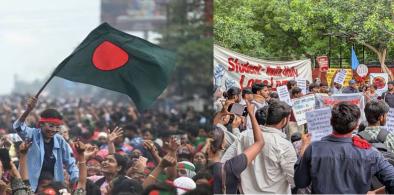
Bangladesh, Sri Lanka, India, and Nepal are not producing a series of unconnected national episodes. They are producing a young, educated, and increasingly connected generation that is redefining what citizens expect from the state
Golam Rasul is Professor and Chair of the Department of Economics at IUBAT—International University of Business Agriculture and Technology, Bangladesh. He is a scholar and policy commentator specializing in sustainability, political economy, globalization, and development transitions in Asia. His research and writing focus on the intersection of economic transformation, environmental governance, resource security, and geopolitical change. He regularly contributes commentary and analysis to regional and international platforms, including South Asia Monitor and East Asia Forum as well as leading South Asian newspapers. His recent work examines Asia’s growth model, fragmented globalization, climate and resource governance, and systemic sustainability challenges in the Global South. He has also written extensively on water-energy-food nexus governance, regional cooperation, and sustainable development policy.

Bangladesh, Sri Lanka, India, and Nepal are not producing a series of unconnected national episodes. They are producing a young, educated, and increasingly connected generation that is redefining what citizens expect from the state
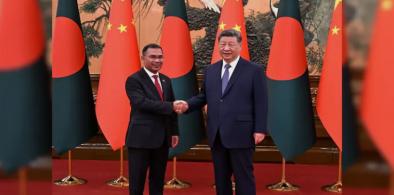
New Delhi's wariness is not really about the river, or even the defence talks in isolation. It is about what Chinese capital and now a nascent security channel, both sitting in a border-adjacent basin, imply for India's own economic and security position.
When economic transformation outpaces institutional renewal anywhere in South Asia, the gap between aspiration and opportunity becomes fertile ground for frustration, alienation, and political discontent. The leaked papers in India were only the trigger
A military confrontation in the Gulf can raise food prices in South Asia, accelerate inflation in Africa, disrupt supply chains in Europe, and unsettle financial markets across the globe. The reopening of the Strait of Hormuz is therefore more than a maritime development; it is a reminder of the profound interdependence that defines the…
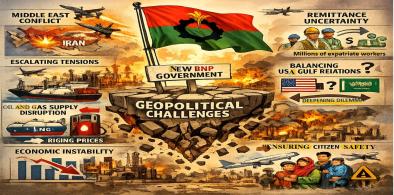
The current war has exposed Bangladesh’s structural vulnerabilities: dependence on imported energy, fragile reserves, and narrow fiscal space. For the new government, the stakes are clear—stabilize fuel and food supplies now while building resilience through diversified energy, broader exports, and stronger social protection. Wars in the Gulf…
India’s aspiration to be a leading maritime power rests not only on naval capability but on the trust of smaller regional states—from Sri Lanka to Maldives and Indonesia. These states increasingly look to New Delhi as a stabilizing presence in the Indian Ocean. If India appears unwilling to defend diplomatic norms in its own maritime…
The strikes on Iran are not just another flashpoint in the Middle East. They are a reminder that the rules of the system are applied through hierarchy. Law speaks the language of equality; power writes the terms of enforcement. For smaller states, this is not a philosophical dilemma — it is a strategic one. Their sovereignty is rarely absolute…
Bangladesh’s centrality to South Asia is grounded as much in material realities as in symbolic politics. As one of the region’s fastest-growing economies and a strategic gateway to the Bay of Bengal, Dhaka plays a pivotal role in initiatives such as BBIN and BIMSTEC. Its ports and transport corridors provide critical access for landlocked…
Bangladesh, though Muslim‑majority, has historically significant Hindu, Buddhist, Christian, and Indigenous minorities. Removing secularism would create a profound democratic dilemma as it is the safeguard against majoritarian dominance and structural exclusion. The South Asian experience shows the risks of privileging religion in constitutions…
When cricket is weaponized against Bangladesh while India’s own internal challenges are ignored, the message is unmistakable: power, not principle, is guiding moral judgment. This undermines the very spirit of Neighborhood First, which depends on trust and even‑handedness. Over time, such practices erode confidence, deepen asymmetry,…