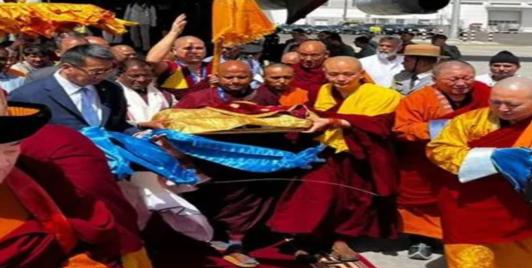

Relics of Arahant Mahamogallana and Arahant Sariputta being received in the Mongolian capital Ulaanbataar on May 30, 2026 after they were brought from India

India-Mongolia Buddhist Partnership: A Civilisational Bridge Linking India’s Buddhist Heritage with Mongolia’s Contemporary Revival

The profound emotional connection was vividly evident in 2022 when, as the Indian delegation accompanying the relics entered the Gandan monastery, members of the crowd reached out to touch them, expressing their reverence for those who had come "from the land of the Buddha".

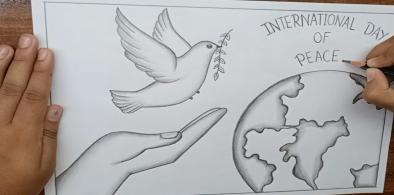
In the Undying Quest for Peace and Harmony in South Asia: Reflections of a Veteran 'Peacemonger'

One idea which both young and senior activists are exploring is about the possibility of a series of visits by youth teams to the South Asian capitals to meet with the leadership. They want to explain how deeply young people are affected and committed to address the crisis of climate change, global warming, and especially the fragility of the mountain regions as witnessed in the recent devastation in Nepal.

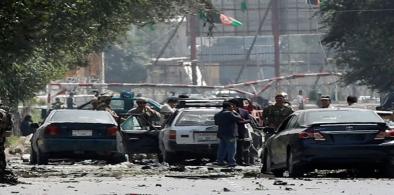
When the Machinery of Terror Becomes Television Spectacle: Taliban's War Museum Reporting Needs Broader Contextualisation

The Taliban may curate the museum. The newsroom must curate the context. Without that context, international television risks giving an extremist movement something it has always sought, not necessarily agreement, but attention; not necessarily legitimacy, but spectacle. 

Three Young Karachi Rappers: And a Working-Class Neighborhood Becomes its Own Historian


For an Indian audience, the most meaningful response to W.R.A.P. is not the comforting declaration that Indians and Pakistanis are identical. Such a claim can erase real histories and differences as readily as nationalism exaggerates them. 

More on Soft Power, Culture and Society

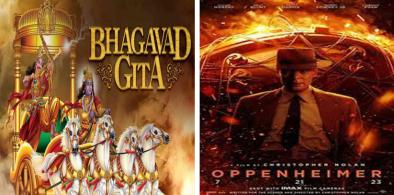
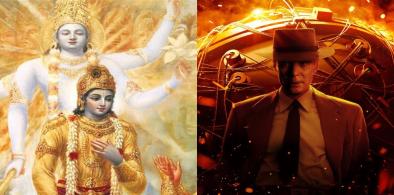
“Oppenheimer” and the Bhagavad Gita: How the Hindu scripture became the American physicist's moral compass

There was something profoundly moving to note that a deep philosophical insight given by Krishna Dvaipayana better known as Ved-Vyasa, the creator of the Gita and the Mahabharat, many millennia ago, should come to underpin the most defining event of the 20th century and beyond.

When folk culture gets commercialised, the visual language of nature gets lost

What we see in the problematic use of folk culture in Modern Indian art is the way the celebration of nature has been privatised and turned into a consumer item that becomes a part of the art industry. 

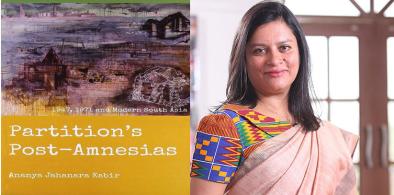
Partition stories and intertwined histories: Beyond religious hatred and political rivalries

The nation-states of Pakistan, India and Bangladesh categorise their citizens by nationality alone, with no room for emotion or relationship. People are separated from each other through violent narratives and intractable borders.

Why India's federal system holds over Pakistan's

The elite in Pakistan was not committed to pre-independence reorganization, and the lack of this linguistic federal adjustment created tensions that India survived.

Was Oppenheimer's Gita quote accurate?

In Gita (Chapter 11, Verse 32) Lord Krishna says that “I am the "Kal" (Mighty Time) – destroyer of the world”.  Oppenheimer said “I am become Death, the destroyer of worlds”, and this is extensively quoted.

Is reading your mind now going to be a reality? Breakthrough device by Indian American student

The creation of the device has opened exciting possibilities in the field of brain-computer interface technology.

Cinema that defies norms and transcends borders in South Asia

The discussion highlighted how Pakistani movie and theatregoers lament the banning of Indian films in Pakistan and Indian audiences clamour for Pakistani dramas. Commonalities of language, music and culture developed over thousands of years cannot be erased, as elements in both countries are trying to do, rewriting history and marginalising ‘the other’.

Nine South Asian languages are now on Google’s AI chatbot Bard

The languages are Bengali (spoken in Bangladesh and India), Gujarati, Hindi (spoken in India and Nepal), Kannada, Malayalam, Marathi, Tamil (spoken in India and Sri Lanka), Telugu and Urdu (spoken in India and Pakistan).

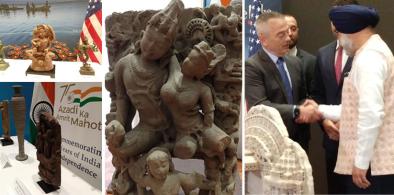
India gets back more stolen antiquities from the US

The operation targeting Kapoor began around 2011 after a tipoff from Indian officials and discovered a web of crime spanning India  Afghanistan, Cambodia, Indonesia, Myanmar, Nepal, Pakistan, Sri Lanka and Thailand.

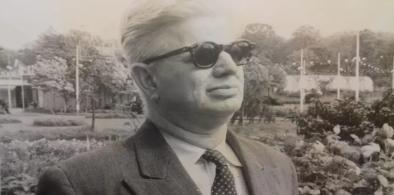
Remembering W. Khan and his love affair with the harmonium

This 12 July marked the 100th birthday of an airline executive who died young – an accomplished Urdu poet and, above all, “an amazing practitioner of Indian classical music” who elevated the humble harmonium to a solo instrument

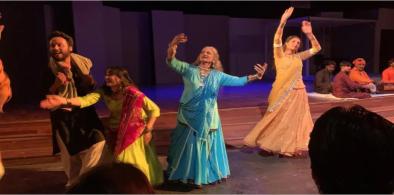
Dramatizing an ancient Sindhi folk tale with South Asian relevance

The River’s Daughter addresses urgent contemporary concerns about environmental destruction caused by the unethical practices of developers and extractive industries – issues that are relevant not just to Pakistan but all of South Asia.

Will NMACC speak truth to power through the arts?

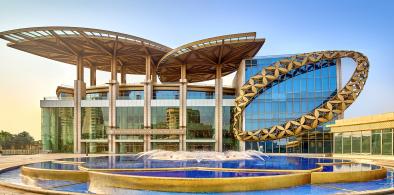
Will the cultural centre established by the Ambani’s support dissent and debate, and encourage freedom of expression, as is expected of a world-class arts and culture institute? Will it open its nine-star doors to Dalits and Adivasis, other than to put them on “display” as folk artists?

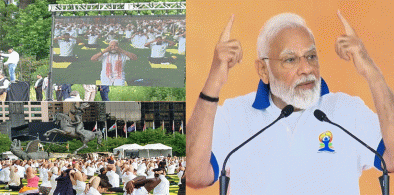
Yoga is a way of life, it should be free from commercialisation: Modi in New York

“Yoga comes from India and it has a very old tradition”, Modi said, "but like all ancient Indian traditions, it is also living, dynamic”.

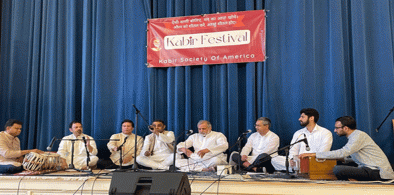
All roads lead to Kabir: South Asian diaspora celebrates the mystic poet-philosopher and his vast oeuvre

The Kabir festival idea arose from the need to develop a sense of cooperation amongst the people from South Asia that call this area home, conceived as an entirely voluntary effort by community members.

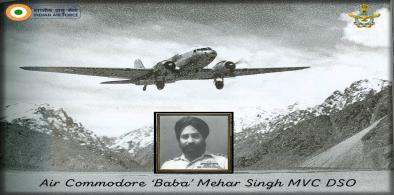
Recalling Mehar Baba, India’s legendary aviator and his flying exploits

While the British conferred the DSO (Distinguished Service Order) on Meher Singh, the Indian Air Force awarded him the MVC (Maha Vir Chakra). The citation for the MVC awarded to Mehar Singh read “Throughout his tenure as overall Commander of air operations in Jammu and Kashmir, Air Commodore Mehar Singh showed great devotion to duty at great personal risk and set an example to those serving under him”.