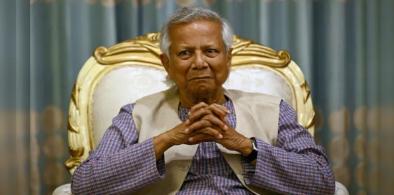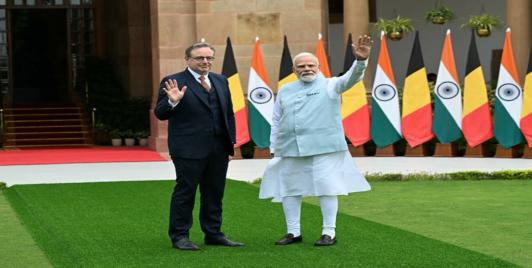


India's Prime Minister Narendra Modi meets Bangladesh's interim government head Muhammad Yunus

Bangladesh–India Relations at a Crossroads: Needed Recalibration, Not Rupture

The current strains in Bangladesh–India relations should therefore be seen not as an inevitable deterioration, but as a test of diplomatic maturity. Bangladesh and India share more than geography and history; they share a responsibility to ensure that temporary political frictions do not harden into structural mistrust. In a time of regional uncertainty, neither country benefits from a relationship defined by grievance or miscommunication. 

A Dangerous Power Grab in Pakistan; Unpredictable Consequences For Region

The 27th Amendment, celebrated by its proponents as a security reform, is in reality a political coup executed through constitutional means. It marks not only Munir’s personal triumph but the institutional victory of the military over all other state authorities. As history warns, empowering any unelected institution above the republic’s elected will invites instability—not strength. Pakistan may soon discover that consolidating military power does not secure the nation’s future, but instead places it at greater risk

How Foreign Digital Influencers Are Tarnishing India’s Global Image

India must now transition from conventional soft-power thinking to visibility governance—the systematic management of how the country appears, circulates, and is emotionally interpreted across global platforms. Failure to do so will leave India’s global image increasingly shaped by commercial incentives outside Indian control.  

Afghanistan Should Not Get Caught In The India-Pakistan Strategic Rivalry

The strengthening of Taliban-India ties runs counter to Pakistan’s interests. The more border clashes intensify between the Taliban and Pakistan, the more secure the Kashmir region and the Line of Control (LoC) become for India. Under such conditions, Pakistan will remain preoccupied with its northwestern border, giving India a unique opportunity to consolidate its control over Kashmir and potentially weaken, drive out, or eliminate Kashmiri militant groups 

More on Spotlight

Hasina's India visit is beneficial for regional stability and prosperity, China factor notwithstanding

India was keen to welcome PM Hasina before her China trip to ensure bilateral consensus on sensitive issues. Over the last several years, strategic ties have grown, with cooperation in science and technology, defence and security, energy, trade, commerce, and maritime issues. The goal of the visit was to strengthen these bonds.

A world in transition: Will this lead to a new world order or disorder?

China, Russia and the US, however, give little value to international laws. They accept them only if they suit their own interests. They reject them if they conflict with their interests.

Sri Lanka's debt deal with China: Implications for the economy and India-Sri Lanka relations

India and China have long been strategic rivals in South Asia. China's significant economic footprint in Sri Lanka, through investments in infrastructure projects like the Hambantota Port and the Colombo Port City, has raised concerns in New Delhi about Beijing’s growing influence. The debt deal, involving China, adds another layer to this complex relationship.

The Arakan Army: A growing security threat to Bangladesh and region

The AA’s control over large swathes of territory in Rakhine State, including strategic border areas, increases the risk of arms smuggling, human trafficking, and other illicit activities. Bangladesh's geography puts it at the heart of three major Asian drug trade routes - the Golden Wedge, the Golden Triangle and the Golden Crescent. This makes the country a lucrative transit for the region's drugs, especially from Myanmar and India, undermining Bangladesh’s internal security.

Intelligence sharing between India, Sri Lanka imperative to curb mounting IS threat to South Asia

The arrest of four Sri Lanka nationals last month in Ahmedabad, India by Gujarat's Anti-Terrorism Squad caught the attention of Sri Lankan authorities. During interrogation, the four admitted to being closely involved with the banned NTJ and confessed they joined IS through Pakistani handler Abu Bakr Al Baghdadi. 

In India’s changed polity, it is now clearly Narendra Modi versus Rahul Gandhi

Nearly 20 years Modi’s junior, Gandhi now has the opportunity to directly counterbalance a prime minister who for ten years since 2014 lorded over legislative actions because no opposition party had managed to win the required 10 per cent of the 543 parliamentary seats.

A politicised judiciary in Pakistan needs comprehensive reforms to restore trust

The judiciary in Pakistan is at a crossroads. The current trend, characterised by politicisation and inefficiency, jeopardises the basic foundations of justice and the rule of law.

The leak-ed scandal: Can the new law cure the pervasive malady of examination paper leaks in India?

The Act does not sufficiently address the root causes of paper leaks, such as systemic corruption and the involvement of organized networks. Without tackling these underlying issues, the Act risks becoming a reactive tool rather than a proactive solution.

Climate crisis is on us: World has little to lose on climate finance agreement

If the world is not to waste this opportunity to declare an all-out war on the looming climate crisis, climate negotiators need to ‘huddle together’ with urgency to save ourselves from the scorching temperatures, devastating wildfires, deadly floods and other climate extremes of the future.  

The Reasi terror attack and the Pakistani deep state's failed stratagems

Despite Pakistan’s repeated deniability of its proxy wars it conducts against India, it is a known fact that the State’s idea of counter terrorism is to selectively crack down on some terror outfits while overlooking the actions of the ones it nurtures and aligns with on similar strategic objectives. In an effort to mollify its "iron brother" China, Pakistan has carried out heavy-handed operations against its citizens who are not supportive of China and its growing presence in Pakistani affairs.

Western support to Sikh separatists is damaging for bilateral ties

It would be helpful to understand the context and background behind support to the Khalistanis by five western governments that particularly stand out i.e. the US, Canada, the UK, Germany, and Australia.

Pakistan's Economic Advisory Council: Will conflict of interest of members stymie effective economic governance?

The inclusion of merchants with evident vested interests in the EAC exemplifies the ethical quandary at the heart of Pakistan's economic administration. Their close financial links to the industries they are supposed to supervise and advise on are a typical example of putting the fox in charge of the henhouse. 

Sheikh Hasina’s India visit: Paving the way for bilateral advancements and strategic partnerships

India may in principle approve the supply of electricity from Bhutan to Bangladesh using its power grid. Bangladesh will seek smooth supply of essentials like wheat, sugar and onions from India.

Amid worsening Myanmar situation, pressuring Bangladesh to accept more refugees will deepen Rohingya crisis

As the situation in Rakhine state remains severe, with recurrent clashes between the Arakan Army and the Tatmadaw providing no apparent resolution, sustaining the lives of over 1.3 million Rohingya is a massive challenge for Bangladesh. 

Bangladesh needs to move to a circular economy for sustainable development

By combining Bangladesh's strong readymade garment industry with the Netherlands’ circular economy knowledge, one can create a win-win situation.