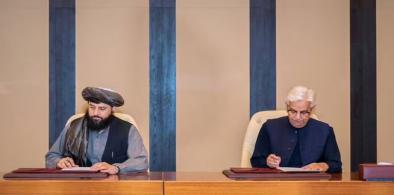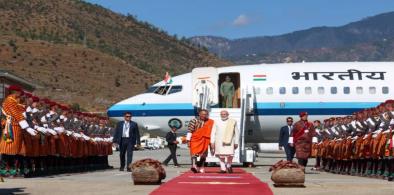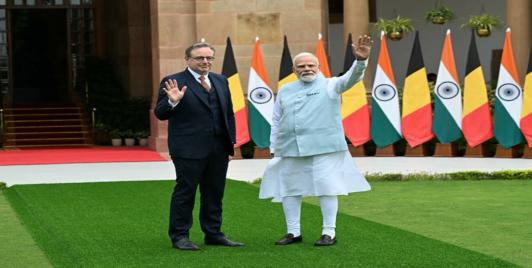
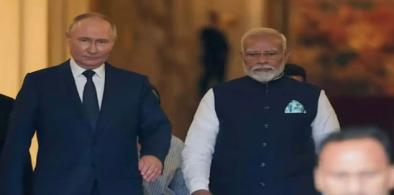
India's Prime Minister Narendra Modi meets Bangladesh's interim government head Muhammad Yunus

Bangladesh–India Relations at a Crossroads: Needed Recalibration, Not Rupture

The current strains in Bangladesh–India relations should therefore be seen not as an inevitable deterioration, but as a test of diplomatic maturity. Bangladesh and India share more than geography and history; they share a responsibility to ensure that temporary political frictions do not harden into structural mistrust. In a time of regional uncertainty, neither country benefits from a relationship defined by grievance or miscommunication. 

A Dangerous Power Grab in Pakistan; Unpredictable Consequences For Region

The 27th Amendment, celebrated by its proponents as a security reform, is in reality a political coup executed through constitutional means. It marks not only Munir’s personal triumph but the institutional victory of the military over all other state authorities. As history warns, empowering any unelected institution above the republic’s elected will invites instability—not strength. Pakistan may soon discover that consolidating military power does not secure the nation’s future, but instead places it at greater risk

How Foreign Digital Influencers Are Tarnishing India’s Global Image

India must now transition from conventional soft-power thinking to visibility governance—the systematic management of how the country appears, circulates, and is emotionally interpreted across global platforms. Failure to do so will leave India’s global image increasingly shaped by commercial incentives outside Indian control.  

Afghanistan Should Not Get Caught In The India-Pakistan Strategic Rivalry

The strengthening of Taliban-India ties runs counter to Pakistan’s interests. The more border clashes intensify between the Taliban and Pakistan, the more secure the Kashmir region and the Line of Control (LoC) become for India. Under such conditions, Pakistan will remain preoccupied with its northwestern border, giving India a unique opportunity to consolidate its control over Kashmir and potentially weaken, drive out, or eliminate Kashmiri militant groups 

More on Spotlight

Jaishankar's visit to Colombo: Will it signal continuity or change in bilateral ties under Dissanayake government?

Analysts believe that Jaishanakar's visit will be a significant opportunity for India to reinforce its commitment to providing development support for its strategically situated Indian Ocean neighbor amid worries about a shift in its foreign policy under the new president.  

Pakistan seeking to reshape regional dynamics through stronger Central Asia, Azerbaijan ties

Pakistan’s pivot to geo-economics has gained significant momentum, particularly in the context of its deepening ties with Central Asian Republics and Azerbaijan, aligning with the country's goal of becoming a regional trade hub

Can Pakistan and Bangladesh overcome historical grievances to redefine relations?

For India, Pakistan and Bangladesh's defence cooperation is reason for concern. The long, porous border between India and Bangladesh, along with New Delhi's historical position as a vital supporter of Dhaka, make any reconciliation between Islamabad and Dhaka a sensitive matter. The weapons agreement, in particular, has fuelled suspicion in India about a potential shift in Bangladesh's outlook, particularly in light of the anti-India rhetoric that surrounded the protests that led to Hasina's removal.

Knowledge diplomacy: India’s missing soft power tool

India’s superpower ambitions require a comprehensive strategy to use the Indian education sector, both private and government, towards advancing India's strategic aims and objectives. A starting point to experiment such knowledge/education diplomacy lies in its neighbourhood.

National anthems and identity crises continue to haunt South Asia

However, religion, domestic compulsions and failure to improve political conditions, with or without national elections, have embroiled Afghanistan, Pakistan and Bangladesh, all compounded by economic woes, in issues that impinge on their national identity.

Sri Lanka's new president: Can he deliver on economic stability and regional security?

In a way, Sri Lanka's economic crisis has served as a blessing in disguise, bringing India and Sri Lanka closer as South Asian neighbors. However, India remains concerned about security in the Indian Ocean, where China has been actively expanding its influence. 

Isolating the Taliban is not helping Afghanistan's people: International diplomats must return to Kabul

For Afghans to find their own solutions they need an engaged international community inside Afghanistan.  The more isolated they become the more possible it is for the most regressive among the Taliban – which it must be said is not a monolith – to impose tighter and tighter controls, which is what is currently happening.

Cross-border militancy, Taliban intransigence intensifies Pakistan's security dilemma

Then there is the thorny issue of "Lar o Bar," a nationalist idea that has long existed on the fringes of Pashtun politics. The phrase, literally meaning "here and there," reflects the dream of uniting Pashtuns on both sides of the Durand Line, the border drawn between Pakistan and Afghanistan during British rule. While the notion might resonate with cultural pride, it’s a direct threat to Pakistan’s territorial integrity.

Dismantling barriers to empower persons with disabilities: India must unlock potential of a largely untapped talent pool

India has made strides in creating a legal framework that supports the rights of individuals with disabilities, but their full inclusion is still a distant goal. The integration of sensory and speech-impaired individuals into the workforce requires a multi-faceted approach beyond vocational training that includes accessible infrastructure, employer sensitization, and use of assistive technologies.

Summit of the Future: From past lessons to present chaos to a future we want

The hope for a better and more sustainable future now lies, first with the youth in the ages of 18-25, studying in the universities and higher education institutes. These youth would be the young decision-makers by 2030. That year would see the end of SDGs and expected to halve the GHGs emissions. By 2050, the youth of today would be at the helm of the affairs in business and government.

As world abandons Afghanistan, Taliban, IS and ISK-P feed on each other to export terror

The region and the world should reconsider their policies toward Afghanistan and the Taliban. They must assist the Afghanistan people in forming a legitimate government and establish professional security forces. The Taliban are not a trustworthy partner in the fight against terrorism.

Pakistan seeks climate justice as its people battle climate change

In the bustling city of Karachi, solar panels are becoming a common sight. Pakistan is investing heavily in renewable energy, aiming to generate 30% of its electricity from renewable sources by 2030

Pakistan needs to address foundational causes of its persistent violence and social instability

It is a fact that Pakistan's obsession with military power without attending to the roots of political exclusion and economic disparity has left its vulnerable masses base to the extremes. 

Sri Lanka's presidential election: Voter faced with choice of status quo, mild tinkering or radical change

Most analysts agree that there is no clear-cut winner and the race to the presidency is a multiple-horse race

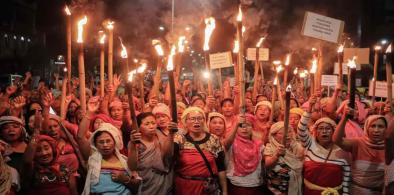
Kolkata's protests: Will it herald a new era of youth-propelled social awakening in India?

What sets these protests apart was their apolitical nature, illustrating that regardless of how firmly a government may seem entrenched in power, movements grounded in just causes can expose the vulnerability of even the most resilient regimes, as recent events have clearly shown.