Banaz Mahmod and Mukhtar Mai, victims of so-called ‘honour’ violence whose cases became powerful testimonies. Banaz through her repeated pleas for protection that went unanswered, and Mukhtar through her public resistance and survival. Screenshots: Good Morning Britain report and TEDx Talk interview (2011).

'Honour’ Still Tries to Silence Women With Community-Sanctioned Enforcement

What links these cases — Pakistan, Britain, India, the Netherlands — is not geography or faith, but backlash. ‘Honour’ is used as a pretext to kill not because women are obedient, but because they are not. It is activated when women seek education, choose partners, leave abusive homes, testify in public, or simply insist on being treated as full human beings.


Challenges Facing an AI-Geared World: A Robot Called Out the Failings in India’s Higher Education System

How do our regulators allow a university to function with almost every leadership position, academic and administrative, occupied by a member of the promoter family? How does patent filing become a game, as alleged in this case, or how does a paper authored under the university on banging vessels to kill the coronavirus get written? The incident brought to sharp light how India has slipped into an education system run on high fees by private institutions with questionable credentials.

BNP Rule in Bangladesh May Not Augur Well For India

Under the BNP, particularly during Khaleda Zia’s rule, four major anti-India terrorist camps were being run in the Chittagong Hill Tracts. Notably, these terrorist training camps had Al Qaeda and Pakistan ISI/military instructors. As a young officer, Pervez Musharraf (later president of Pakistan) also served as an instructor in these terrorist training camps. To assume that the radical elements of the BNP will not be in league with the JeI will be the height of naviete.

Four Stars of Destiny: Questions The Debate Is Missing

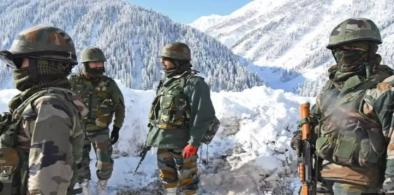
India needs to evolve a comprehensive and integrated strategy for the defence of the LAC, one that brings together military preparedness, diplomatic engagement, infrastructure development, technological surveillance, economic resilience, and informed public communication. Such a strategy cannot remain confined to closed institutional silos; while operational specifics must remain confidential, the broad contours of national intent and preparedness should be placed in the public domain. Transparency at the strategic level strengthens public confidence, builds national consensus, and signals clarity of purpose to adversaries.

More on Perspective

Indian Armed Forces' stellar role in Wayanad disaster relief: Serving the nation in crises

What became a reason for special attention was that the Madras Sappers were led by a woman officer, Major Sita Ashok Shelke. This single-woman officer in a 150-strong team worked hands-on with the locals during the construction,  planning the move of stores, approving the design and ensuring a safe, speedy launch. If the men kept awake for two nights, her responsibility required an even longer spell without sleep.

Violence against Hindus in Bangladesh is a boost to Islamophobia in India

Now, the two important power centres in Bangladesh are the interim government led by Prof Muhammad Yunus and the students who led the protests. Both are stressing the inclusive character of Bangladesh and taking a strong position on the protection of Hindus and other minorities.

Bangladesh in transition: Much to learn from Prof. Yunus and his philosophy

Yet, this will be a delicate task that may test India much more than Bangladesh. This is because the secular credo of Yunus and a pro-poor agenda that has defined his work and his life pose a unique political challenge to the agenda of right-wing politics that holds centre stage in India.

Is the Ganga water treaty between India and Bangladesh at risk?

Thus, the renewal of the Ganges water treaty is much more dependent on the bilateral relations between the two countries. Under the present conditions, there are politically driven ideological differences between both countries that may carry adverse consequences for the Ganga treaty. 

India’s sports bosses need to answer for its Olympic fiasco and poor showing

Shouldn’t we reflect as a nation of 1.4 billion people, with 117 participants at the Paris Olympics, winning only six medals (that included no gold) and ranked 71 among participating countries? Can we not learn from much smaller countries, some indeed tiny,  that won several gold and silver medals and ranked above India?

India needs to change the way we think

India must look to improve the quality of education and make it affordable equally to all irrespective of religion or caste. Else, we will continue to feel safe in “reservations” and never ever look at improving the quality of the society

What could be behind Sheikh Hasina’s ouster? Challenging times for India ahead

China was miffed with Hasina giving the Teesta project to India but why China gave $11 million to Bangladesh instead of earlier promised $3 billion during Hasina’s visit is because it perhaps knew regime change in Dhaka was coming?

Lessons from Bangladesh’s descent into chaos

How quickly a country which was coasting along for a decade of strong, export led growth with improvements in poverty as well as human development indicators and social capital, can crumble.

Who is responsible for the Wayanad disaster in southern India?

There are any number of disasters happening in India, with the sad conclusion that the elected representatives of the people are failing in their duties and remain indifferent to pressing local issues and the needs and grievances of the people.

Pakistan's mishandling could worsen Balochistan situation

Such behavior from the Pakistani State is a concern for the future of Balochistan. Pakistan needs to thoroughly review its policies in Balochistan; otherwise, it may not be long before another Bangladesh is born.

Can peace return to Manipur?

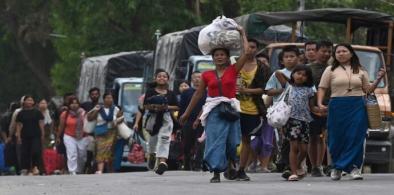
The rise of ethnic violence in Manipur has had a devastating impact on the state. Thousands of people have been killed and displaced from their homes. The violence has also crippled the economy and disrupted the development of the state. 

India's democratic traditions in danger: Time to lower the political temperature

The government’s answer is to keep the pot boiling as it lives a Rip Van Winkle story – almost as if it slept through the election results and now wants to live an old reality in a new world.

Unruling parliamentary behaviour setting a bad example for Indian democracy

The proceedings of the recent parliamentary session create doubts as to whether our MPs are capable of setting up such standards. By their behavior as seen currently, they are setting up a very bad example for the younger generation and are doing great harm to the fiber and fabric of a resurgent India.

Quota unrest in Bangladesh has lessons for India

There should also be no doubt that these protests are being fueled by China and Pakistan to depose the pro-India Sheikh Hasina Government and install a pro-Islamist anti-India government like the erstwhile BNP-led government in Bangladesh. 

Rumblings in the BJP point to a more fundamental problem

The reality is that communal politics of the kind played by the BJP, led by Prime Minister Modi, has stopped paying dividends of the kind that it once did.